
If you are searching for British Psychology Olympiad preparation, the practical answer is this: train with short, timed case diagnostics that force you to explain mechanisms, use evidence appropriately, apply the theory to the specific scenario, and state limitations. The British Psychology Olympiad, often abbreviated BPO in Hanlin's results reporting, is a psychology competition. In Hanlin Education's 2026 results report, published July 3, 2026, Hanlin recorded one student earning an individual gold, a team second-place result, advancement to the global round, and an Oxford summer school place reported as limited to 30 global seats. That is a first-party achievement note, not official scoring guidance.
This article gives you a preparation diagnostic you can use without official BPO scoring rules. It is a coaching technique, not a claim about how BPO organisers mark papers. Use it to judge whether your answers show analytical depth rather than textbook recall.
What Does BPO Preparation Actually Require?
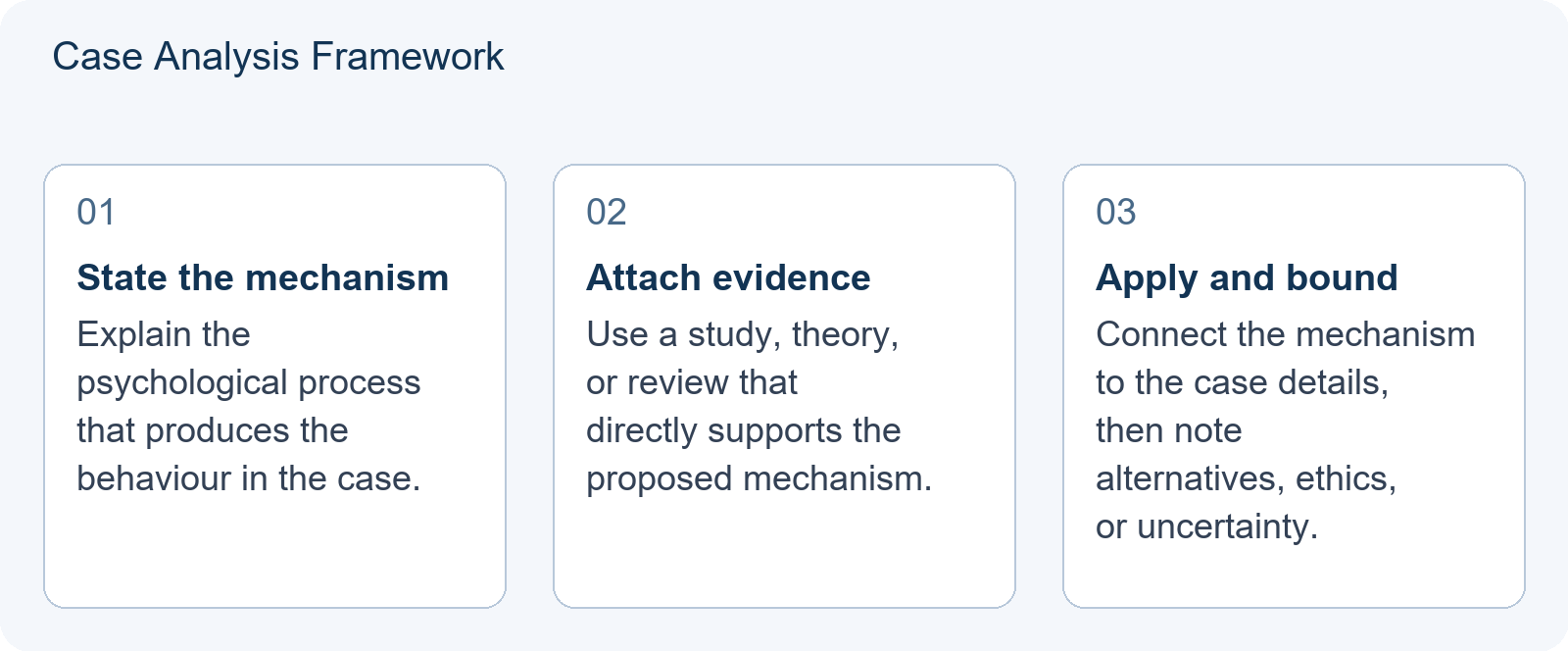
Psychology competitions reward students who can do more than name a concept. A strong answer usually has to turn a concept into an explanation. That means you should practise four moves repeatedly:
- Explain the mechanism: Do not stop at a label such as 'cognitive dissonance' or 'confirmation bias'. Explain what psychological process produces the behaviour in the case.
- Use evidence appropriately: Refer to studies, theories, or reviews that support your mechanism. Evidence should be linked to the claim, not dropped in as decoration.
- Apply to the specific case: Show why your mechanism fits this person, this context, and these details better than a generic explanation would.
- Acknowledge limits: Discuss alternative explanations, methodological weaknesses, cultural scope, or ethical constraints. This is often what separates a descriptive answer from an analytical one.
The John Locke source note used in this article describes that competition's essay judging as covering knowledge and understanding of material, effective use of evidence, quality of argumentation, structure, style, and persuasiveness. That is not a BPO rubric. It is useful only as an analogy: written competition answers often reward the same underlying analytical signals. For BPO-style case questions, the equivalent signals are mechanism, evidence, application, and limitation.
The Four-Column Case Map
To diagnose your own answer, map it onto four columns. If a column is empty, vague, or disconnected from the case, your answer is incomplete. The table below is a teaching diagnostic, not an official scoring sheet.
| Component | Question to Ask Yourself | Weak Signal | Stronger Signal |
|---|---|---|---|
| Mechanism | Why does this happen? What is the underlying process? | Naming a bias or theory without explaining how it operates. | A step-by-step psychological explanation that links cause, process, and observed behaviour. |
| Evidence | Which study, theory, or review supports this mechanism? | Citing a famous study without saying what it shows or why it fits. | Using evidence that directly supports the mechanism and noting its limits. |
| Application | How does this explain the specific person or situation in the prompt? | Generalising to all adolescents, all students, or all social-media users. | Connecting the mechanism to the exact behaviours, timing, and context in the case. |
| Limitation | What could be wrong with this explanation? What else might explain it? | Stating a conclusion as certain and ignoring ethics or alternatives. | Naming at least one plausible alternative and one methodological or ethical limit. |
Teaching Illustration: Adolescent Sleep and Phone Use
Note: This is a hypothetical teaching illustration, not an official BPO past paper or a real contest question.
Scenario: A 16-year-old student reports feeling exhausted during school days despite sleeping eight hours at night. They spend two hours on social media before bed, often scrolling through short-form videos. Their grades have dropped slightly over the last term.
Weak answer: 'The student has poor sleep hygiene because they use their phone too much. This causes fatigue. They should stop using phones before bed.'
Diagnosis: This answer labels a problem and gives advice, but it does not explain a mechanism, use evidence, apply to the specific case in detail, or recognise uncertainty.
A stronger answer skeleton:
- Mechanism: One plausible explanation is that evening light exposure and arousing content delay sleep onset and reduce sleep quality. The student may spend eight hours in bed but still experience fragmented or insufficient restorative sleep. This is a hypothesis to develop, not a single proven cause.
- Evidence: A strong response would cite adolescent sleep research or reviews on screen use and sleep, then explain what those sources do and do not show. Much evidence in this area is correlational, so the answer should not treat phone use as the only cause.
- Application: Apply the mechanism to the student's specific habit: two hours of short-form videos before bed, school-day fatigue, and a recent grade decline. The timing matters because the habit and the academic change occurred in the same term, but the answer should still avoid claiming proof of causation.
- Limitation: Consider academic stress, low mood, family routine, caffeine, or an undiagnosed sleep problem. Note that self-reported sleep duration can be inaccurate. If the answer proposes an intervention, it should mention consent, privacy, and the risk of oversimplifying adolescent mental health.
This teaching illustration is deliberately ordinary. The goal is not to solve adolescent sleep. The goal is to show how an answer can move from label to mechanism, from mechanism to evidence, from evidence to application, and from application to limitation.
How to Self-Score a Practice Answer
After writing a timed answer, score each column from 0 to 2 using your own coaching judgment. This is a local diagnostic, not an official scale.
- 0: The column is missing, or it is only a label with no explanation.
- 1: The column is present but generic, vague, or only loosely connected to the case.
- 2: The column is specific, linked to the case, and shows awareness of uncertainty or scope.
A total below 6 usually means the answer needs revision before it becomes strong competition practice. A total of 6 or above is a useful starting point, but you should still check whether the evidence is genuinely appropriate and whether the limitation section changes the conclusion rather than appearing as an afterthought.
Common Pitfalls in Psychology Case Answers
Based on general teaching experience and the diagnostic logic above, several recurring errors appear in psychology-focused responses:
- Correlation treated as causation: If two things occur together, do not assume one caused the other. Name at least one confounding variable or alternative pathway.
- Overgeneralisation: Findings from one population, age group, or culture should not be applied to all humans without a scope note. Psychology cases often depend on context.
- Neglecting ethics: If the case involves intervention, data collection, or vulnerable people, mention informed consent, confidentiality, or potential harm where relevant.
- Vague terminology: Use precise concepts. Instead of 'subconscious' as a catch-all, specify implicit memory, automatic processing, or another framework that fits your argument.
- Evidence as decoration: A study name without an explanation of what it shows is not strong evidence. Link the finding to the mechanism you are defending.
Practice Routine: 25-Minute Case Drills
Consistent, timed practice builds analytical speed. A simple routine is enough:
- Select a scenario: Use a real-world news story involving human behaviour, such as viral trends, workplace burnout, or an educational policy change. Do not use a real person's private medical details.
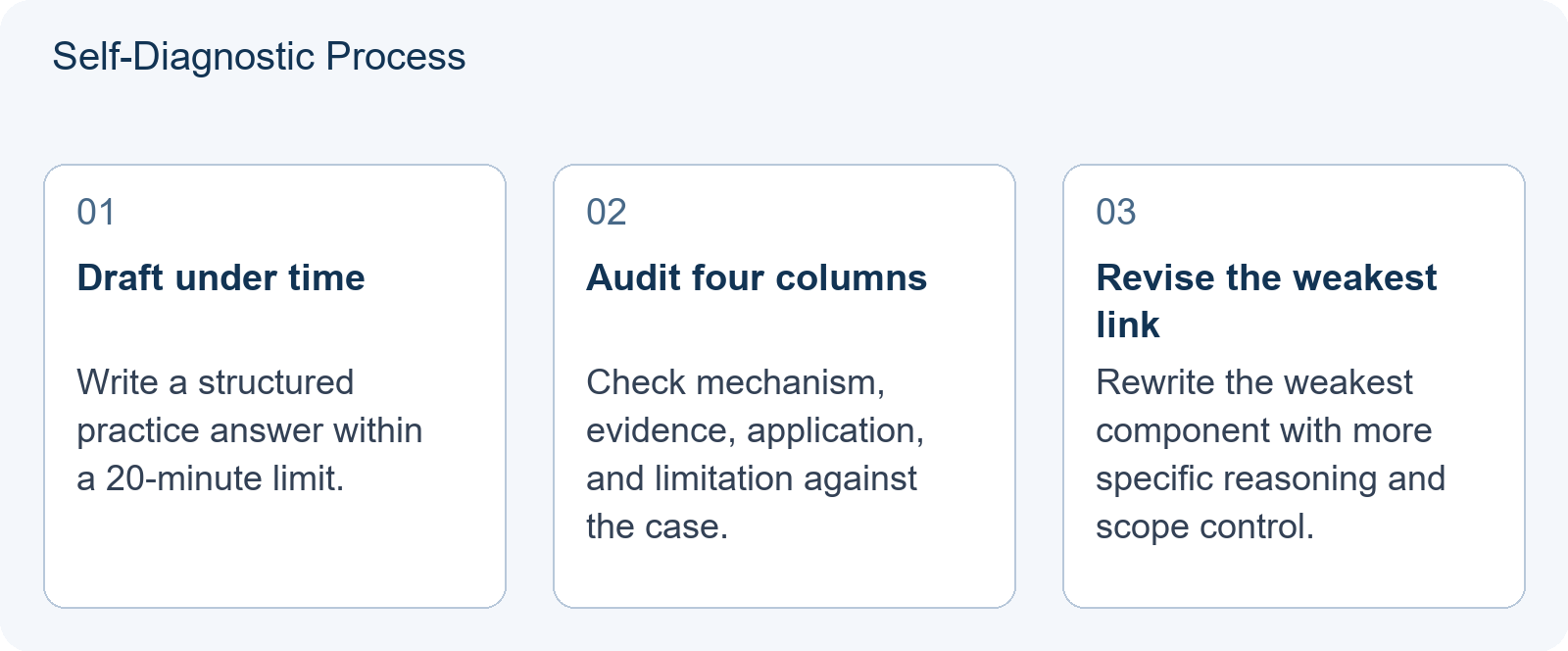
- Write under time: Give yourself 20 minutes to produce a structured response using the Four-Column Case Map.
- Self-score for five minutes: Check mechanism, evidence, application, and limitation. Identify the weakest column.
- Revise one section: Rewrite the weakest part with a clearer mechanism, better evidence, or a more honest limitation.
Over several weeks, this cycle helps you internalise the diagnostic. You stop asking, 'Which term should I use?' and start asking, 'What process explains this case, what evidence supports it, and what would make me revise my view?'
Using the Diagnostic With Other Preparation
Psychology competition preparation overlaps with other academic skills. Timed analysis, evidence selection, and clear limitation sections also matter in economics, essay competitions, and research projects. If timed analysis feels uncomfortable, the Economics competition preparation interest test: Try a 30-Minute Data Sprint offers a comparable timed diagnostic idea in another domain.
For a broader view of how to show progress across activities, see Academic Competition Portfolio: Showing Progress Across Several Related Activities. A case-study diagnostic can become one piece of that portfolio because it shows how you think, not only what you have studied.
Before asking for external feedback, see Research Project Mentorship: What a Student Should Bring to a First Meeting. The same preparation logic applies when you bring a written psychology case answer to a coach: include the prompt, your answer, your self-score, and the exact section where you felt uncertain.
Preparing for Feedback
If you seek external feedback, make the conversation specific. Bring your written response, the original case prompt, your self-assessment, and notes on where you lacked confidence. Ask the reviewer to focus on the weakest column rather than rewriting the whole answer for you. Hanlin Education's site describes international competition tutoring, and its 2026 results note records British Psychology Olympiad student success; however, the diagnostic in this article is an educational preparation technique, not official BPO scoring guidance. Use it to improve your reasoning, then check any current competition rules or format details with the relevant organisers or an authorised preparation source.
General event background is available at Hanlin Education.
Frequently Asked Questions
Does this article provide official BPO scoring rules?
No. It offers a coaching diagnostic for psychology case answers based on mechanism, evidence, application, and limitation. It does not reproduce official British Psychology Olympiad scoring criteria, which are set by the organisers.
Can I use this diagnostic for other psychology exams?
Yes. The four-column check is transferable to many essay-based or case-based psychology assessments, including school psychology essays and free-response practice. It is a preparation technique, not an official rubric for any specific exam.
What if my case answer has strong evidence but no mechanism?
It is incomplete. Evidence should support a psychological process. If you cannot explain why the evidence matters for the case, the answer is probably using evidence as decoration rather than as part of an argument.