
The short answer
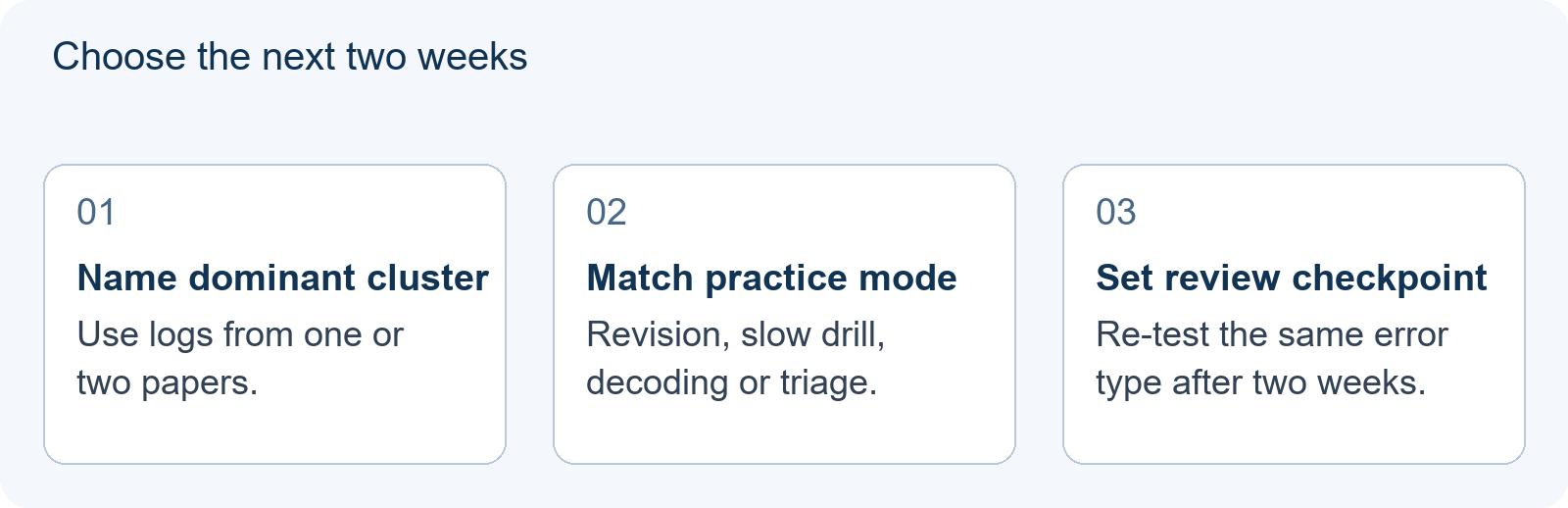
BBO past papers become useful when the student stops treating the total as the result and starts treating each flagged item as evidence. After an attempt, spend about 45 minutes coding every flagged item by topic and by the first point where the answer went wrong: knowledge, reasoning, misreading or timing. Then choose the next two-week block from the largest cluster, not from the raw total. This is a Hanlin preparation perspective, not official BBO scoring, grade-boundary or syllabus guidance. The supplied source material for this article contains no verified BBO paper-length, item-count, scoring, grade-boundary or syllabus detail, so this article deliberately stays method-only and uses a labelled teaching illustration rather than claiming an official paper format.
Why one total can imply two different plans
Teaching illustration: imagine two students who each flag nine items on the same 30-item practice set but need different work. Student A's nine flags are mostly recall gaps in two topics. Student B's nine flags are mostly correct facts applied through a broken reasoning chain. If both spend the next fortnight doing more full papers, Student A may keep meeting the same blank concepts, while Student B may keep repeating the same structural mistake under time pressure. The total is identical; the diagnosis is not.
This is why a corrected score is a weak planning document. It compresses several different events into one number: not knowing a fact, knowing it but not selecting it, misreading the command word, and running out of time are not interchangeable. A useful log keeps them separate long enough to see a pattern. For a related decision about when more practice stops being useful, see Math Competition Plateau: Choosing Between More Practice and Targeted Feedback.
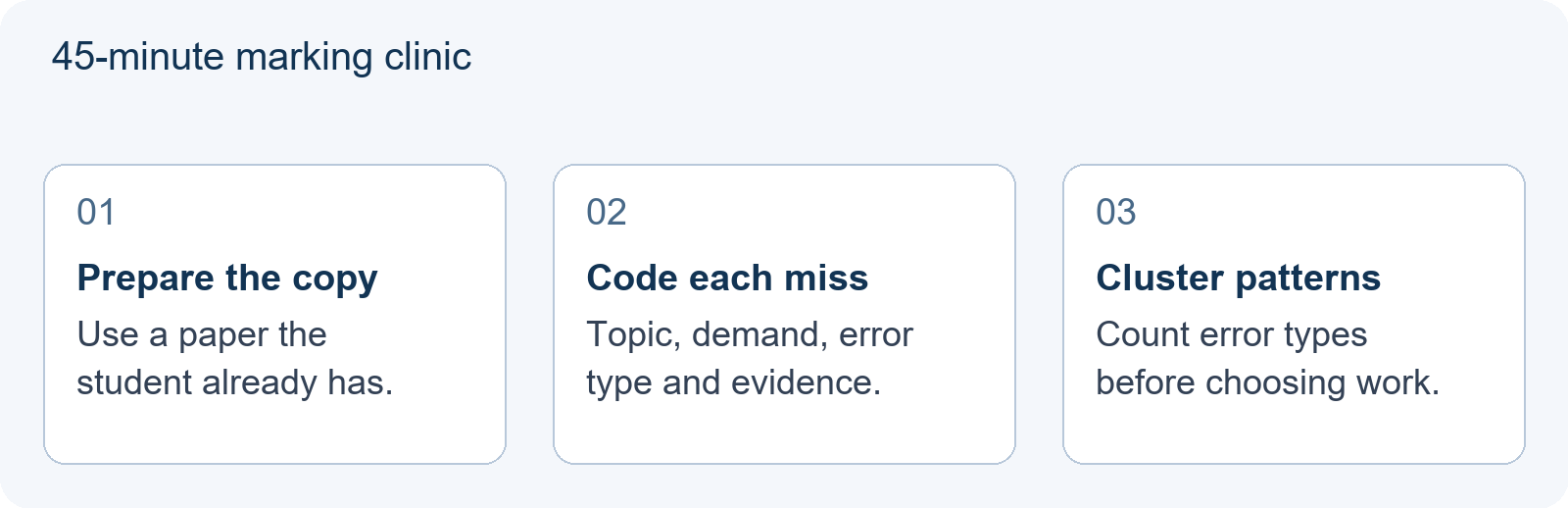
The 45-minute marking clinic
Use a paper the student already has or a school-provided copy. Do not turn the session into a hunt for free official downloads; the value is in the coding, not in accumulating papers. Work in four passes.
- Pass 1, 5 minutes: separate flagged from unflagged. Mark every item the student left blank, changed under pressure, guessed, or could not explain. Do not write the correct answer yet.
- Pass 2, 15 minutes: assign a primary error type. For each flagged item, choose the first point where the attempt broke: knowledge, reasoning, misread, or time. If two causes seem present, code the earlier one and note the secondary cause in the evidence column.
- Pass 3, 15 minutes: write evidence, not a verdict. 'I forgot the difference between competitive and non-competitive inhibition' is evidence. 'I am bad at biology' is not. 'I knew the effect but could not link the graph to the conclusion' is evidence. 'Careless' is too vague unless the student can point to the misread phrase.
- Pass 4, 10 minutes: choose one next action per row. The action must fit the error type: re-read a textbook section, rebuild a reasoning chain aloud, practise decoding command words, or rehearse a triage rule.
Use five columns so the log remains readable. The rows below are a teaching illustration using hypothetical items, not actual BBO questions.
| Item and topic | What the question asked | Primary error type | Evidence from the attempt | Next action |
|---|---|---|---|---|
| Membrane transport / item 4 | Explain why a cell response changes when a transport protein is blocked | Knowledge | Could not name the transport type | Revise transport table; 10 recall questions |
| Enzyme graph / item 11 | Use a graph to compare two conditions | Reasoning | Named graph axes but did not connect slope to rate | Rebuild the chain on blank paper |
| Experimental design / item 18 | Identify the variable to control | Misread | Answered 'independent variable' after missing 'controlled' | Underline command and limiting word |
| Data set / item 27 | Compare two treatments | Time | Skipped because long; had three minutes left | Set a triage rule; practise one data set untimed |
Worked teaching illustration: nine flags in a hypothetical paper
Teaching illustration only. This is not an actual BBO paper, not an official item count and not scoring guidance. Imagine a student completes a 30-item practice set and flags nine items. After the clinic, the counts are: 3 knowledge, 2 reasoning, 2 misread, 2 time. Twenty-one items are unflagged; the log does not call them 'correct' without checking, because a lucky guess can be unflagged.
Suppose the three knowledge flags cluster in membrane transport and enzyme inhibition. The two reasoning flags occur where the student knows the fact but cannot link evidence to a conclusion. The two misreads involve missed limiting words such as 'not' or 'controlled.' The two time flags are the last two data-interpretation items, both attempted with under three minutes remaining. The plan should not be 'do another full paper every day.' It should be a two-week block with different proportions.
| Block | Main work | Why it follows from the log |
|---|---|---|
| Week 1 | Two content-revision blocks on transport and enzymes; 10 short recall questions after each; one slow reasoning drill where the student draws the evidence-to-conclusion chain; a two-minute decoding drill on command words. | The knowledge cluster is narrow enough to repair directly; the reasoning drill addresses the second-largest cluster; decoding targets the misreads. |
| Week 2 | One mixed practice set under normal conditions; review only the same error codes; one timed section with an explicit triage rule; re-test one transport and one enzyme explanation. | The mixed set tests whether the clusters persist; the timed section checks whether timing flags were real or a symptom of earlier slowness. |
If the student instead had seven knowledge flags and two time flags, the plan would tilt toward content revision, with only one short timing drill. If the student had six reasoning flags and three misreads, the plan would tilt toward slow explanation and decoding, not more content notes. The arithmetic is simple; the discipline is refusing to let the total decide.
Reading the pattern without overfitting
A single paper can mislead. One difficult topic may produce a cluster because the paper happened to sample it heavily; one rushed section may reflect an unusually noisy day. So use the log to form a hypothesis, then test it. If the same error type appears in two logged papers, or in two different topics within one paper, the pattern is stronger. If a cluster appears once and then disappears, do not build a fortnight around it.
Three reading rules help. First, count primary codes, not symptoms: 'ran out of time' may be a timing problem or a knowledge problem that made earlier items slow. Second, separate topic from process. A student can have a transport-content gap and a general reasoning weakness; the first calls for revision, the second for slow drills. Third, keep a short note of what the student actually said. The explanation is the evidence; the tick or cross is only the trigger.
This is also where a family can avoid a common mistake: buying more papers when the log points to a different practice mode. More papers increase exposure, but they do not automatically repair a reasoning chain or a decoding habit. The decision aid is the cluster, not the shelf count. A log also gives the student language for a later review: 'My timing flags are concentrated in data interpretation after item 25' is more actionable than 'I need to go faster.'
What a past-paper log cannot tell you
It cannot tell you an official BBO grade, a predicted result, a grade boundary, or a fixed ability level. It cannot tell you that a student will perform the same way on a different paper, because format, topic sampling and time pressure may differ. It cannot tell you that one error type is 'just careless' unless the student can point to the exact phrase or decision that broke. And it cannot tell you that a score from one paper is comparable with a score from another paper unless the formats and conditions are checked against a reliable source.
For the same reason, do not convert a practice total into a probability of an award or an invitation. No such probability is established here, and the supplied source material does not provide BBO scoring or boundary facts. The log is a local diagnostic: it describes this attempt, under these conditions, with these coded errors. That is enough to choose the next practice block, but not enough to make an official claim. For a different competition's post-test diagnosis, see AMC Mock Test Feedback: What a Useful Diagnosis Should Explain to a Family. It addresses family-facing mock-test feedback and does not supply BBO rules.
When to bring the log to a diagnostic review
Seek feedback when the same error type persists after two logged papers, when the student cannot explain why an answer was chosen even after seeing the correct response, or when the family cannot agree on the next two-week priority. A completed log is more useful than a vague request for 'more practice' because it gives the reviewer specific evidence: topic, demand, error type, and the student's own explanation.
Bring the paper or a school-provided copy, the five-column log, and a one-paragraph summary: 'Most flags are reasoning, especially in experimental design; timing flags are limited to the last data items; knowledge flags are confined to two topics.' Ask for a review of the pattern, not a promise of a score. If the reviewer recommends a different practice mode, ask which column of the log supports that recommendation. This keeps the conversation diagnostic rather than generic.
If the student is building a longer record across several activities, keep the log concise and dated; the Hanlin article Academic Competition Portfolio: Showing Progress Across Several Related Activities discusses progress records in a broader portfolio context. The error log is not a substitute for official results or a formal transcript.
Preparing a course-fit or resource request
A useful request to any provider, including Hanlin, should describe the observed problem and the evidence, not ask for a generic 'BBO course.' Write four lines: the paper used and when it was attempted; the three most frequent primary error codes; one example of the student's explanation; and the next two-week goal. Then ask whether the proposed support addresses that pattern, what work the student will do between sessions, and how progress will be checked.
Do not ask a provider to guarantee an award, a score, or an invitation. Do not assume that a particular checklist is already a Hanlin service, and do not treat a past-paper request as a promise of a free pack. If you need current resource or course-fit information, use the site's contact page and ask for the exact contents and selected-year solutions that are actually available. The preparation value is in matching the support to the logged error pattern, not in collecting more paper files.
The final test is simple: after two weeks, can the student show fewer of the same primary error codes on a comparable task? If yes, the log did its job. If no, revise the hypothesis rather than adding another full paper to the pile.
General event background is available at Hanlin Education.
Frequently Asked Questions
How many BBO past papers should a student log before changing the plan?
Start with one complete attempt. A second attempt is useful when the same primary error type recurs, because one paper can over-represent a topic or a bad day. There is no official number here; the decision is diagnostic, not a rule.
What if the student remembers the questions from an earlier attempt?
Use a fresh paper if one is already available. If not, mark the remembered attempt from memory and code why each remembered answer was chosen. A remembered answer can still reveal a reasoning or decoding habit, but it is weaker evidence than a first attempt.
Should parents mark the paper?
A parent can keep time and record flagged items, but the student should supply the explanation for each primary code. A parent-only tick sheet loses the evidence column and often turns the review into a score conversation.