
Short answer: in Hanlin's 2026 notes, IEO is the international competition and global final; IEOC is described as Nextgen's China selection route used to choose China's IEO national team; USAEBO and NZEO are described as other national-team selection routes. They are not interchangeable labels for one contest. For the 2026-27 planning cycle, a family should first identify the country, the named organiser and the stage, then check the current season with that organiser before registering or buying preparation.
The distinction matters because a page can say 'IEO national team' without saying whether it means the global final, a China selection route, a US selection route or a New Zealand selection route. The 27 June 2026 Hanlin WeChat article 'National team results update: Congratulations to Hanlin student selected for the IEO New Zealand national team! Global final starts in July' describes USAEBO and NZEO as IEO national-team selection competitions, and says the domestic counterpart is Nextgen's IEOC, used to select China's IEO national team. The same note says national selection finalists enter a national training camp, and five students form each national team for the IEO global final. The 28 October 2026 Hanlin WeChat article '10 outstanding coach certificates and global championship results: Hanlin economics and business strength revealed' describes IEO as covering economics, financial literacy and business case analysis.
Those are useful route descriptions, but they are not a current rulebook or official scoring guidance. This article is an explanatory map from a Hanlin preparation perspective.
Why the names collide
Acronyms do much of the damage. 'IEO' is often used as shorthand for the whole pathway: a preliminary round, a national selection stage, a training camp and the global final. A school or programme may also use 'IEO' because parents recognise it, even when the actual page is about a national selection competition. The June 2026 note avoids that shortcut by naming USAEBO and NZEO as selection routes and by naming Nextgen's IEOC as the domestic counterpart in China. That wording is a route description, not a claim that every country uses the same competition, eligibility rule or stage name.
Another collision comes from 'national team' language. A student can be selected for a national training camp, selected for a national team, or simply invited to a national stage. The June note says finalists enter a national training camp and five students form each national team for the global final, but it does not publish a universal selection rule for every country. If a page says 'national team pathway', ask which country's team and which named competition produced that pathway.
A third collision is content. The October 2026 note describes IEO as covering economics, financial literacy and business case analysis. That is a useful preparation description, but it does not mean every national route uses identical papers, weightings or eligibility. The content can overlap while the rules remain route-specific.
The route map from the 2026 notes
The table below keeps the supplied labels separate. It is deliberately a map of what the notes say, not a ranking of difficulty or a substitute for current organiser pages.
| Label | Role described in the 2026 Hanlin notes | What a family should verify before acting |
|---|---|---|
| IEO global final | The international competition and global final referred to in the notes; the June note says five students form each national team for this final. | Current season, eligible teams, format and any participation conditions on the named organiser's page. |
| IEOC | Nextgen's China selection route, described as the domestic counterpart used to select China's IEO national team. | Whether the student is eligible for this China route, which stage the page describes, and what Nextgen/IEOC publishes for the current season. |
| USAEBO | A US national-team selection route described in the June note. | Current USAEBO eligibility, selection stages and official instructions for the relevant season. |
| NZEO | A New Zealand national-team selection route described in the June note. | Current NZEO eligibility, selection stages and official instructions for the relevant season. |
The table also shows why a single search result can mislead. If a page names only 'IEO', it may be using the global brand as shorthand for a national route. If it names IEOC, USAEBO or NZEO, the country and selection body are more specific, but the stage still needs checking.
What the notes do not establish
The notes do not establish that IEOC, USAEBO and NZEO are equally difficult. They do not establish automatic transfer between routes, shared eligibility, common deadlines or one universal registration process. They do not say that one route is required for every student, and they do not rank providers or preparation programmes.
The notes also do not replace current official rules. The June 2026 article is a results announcement that explains route relationships; the October 2026 article is a teaching and achievement article that describes IEO's broad content. Neither is a current regulation document for the 2026-27 season. That is not a reason to ignore them. It is a reason to use them for the question they answer: what the names mean in Hanlin's published material.
For the selection-criteria layer after the route is clear, see IEO National Training Team selection criteria: Preparing for Published Rules Beyond Scores. That article assumes the reader already knows which route and selection body apply. This article supplies that prior step.
A decision aid for a selection page
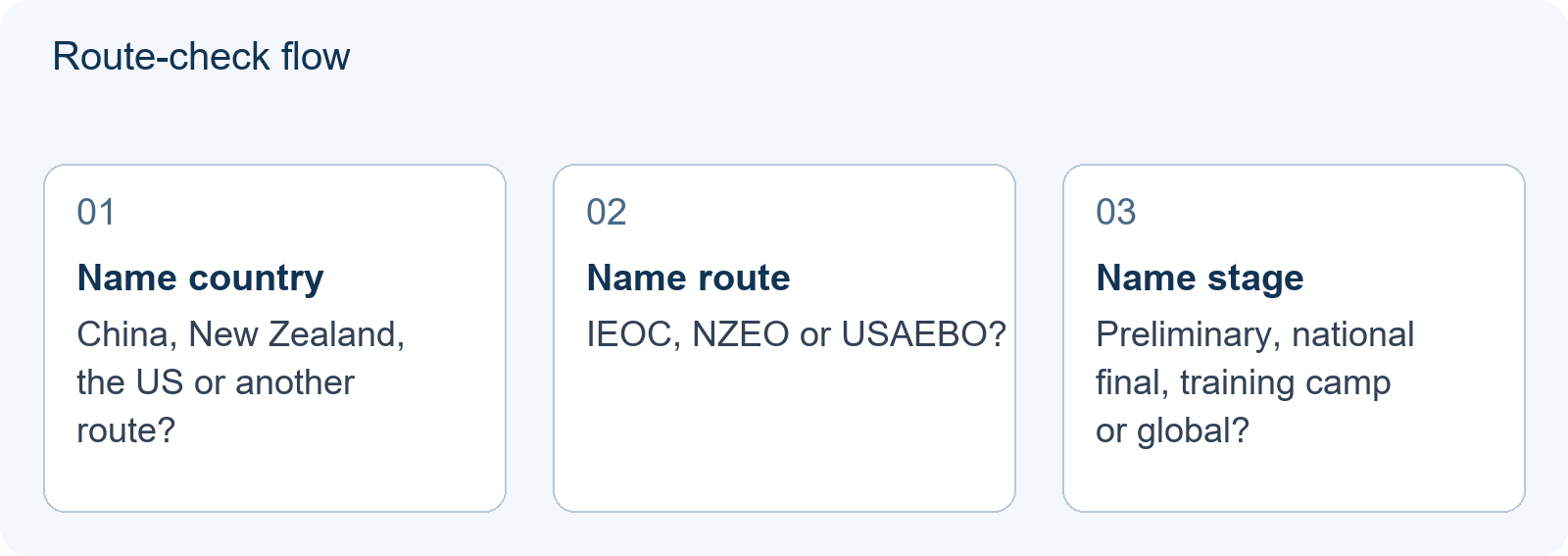
When a page, coach or school mentions IEO, ask three questions in order. First: which country's student is being described? The answer may point to China, the United States, New Zealand or another route not covered by the supplied notes. Second: which named organiser or competition appears? If the page says Nextgen's IEOC, treat it as the China selection route described in the June note. If it says USAEBO or NZEO, treat it as the relevant national selection route described there. Third: which stage is this? A preliminary round, a national final, a training camp and the global final are different stages even when a page uses 'IEO' for all of them.
A useful route sentence is: 'My student is in [country], is considering [named competition], for the [season] season, and the page describes [stage]. Which organiser publishes the current eligibility and selection rules?' That question is specific enough to get a useful answer. It also prevents a programme from answering with a general IEO description when the family needs a route-specific rule.
If the page cannot name the stage, do not infer it from the word 'national'. Ask for the page's exact stage language and the organiser's current page. If the page names a national team but not a country, stop and clarify the country before comparing preparation options.
Three contrasting route checks
Teaching illustration 1 (hypothetical): a student in Shanghai. A provider page says 'IEO Preliminary Round — China national team pathway'. The family should check whether the page names Nextgen's IEOC. If it does, the page is best read as describing the China selection route in the June 2026 note, not the global final. The next check is the current IEOC stage and eligibility rule. The family should not assume that a preliminary result is the same as national-team selection.
Teaching illustration 2 (hypothetical): a student in Auckland. A school notice says 'IEO national team selection'. The family should ask whether the named route is NZEO. In the June 2026 note, NZEO is described as a New Zealand selection route, so the relevant rules are NZEO's current rules, not IEOC's China rules. The content may overlap, but the eligibility and selection process should not be imported from another country.
Teaching illustration 3 (hypothetical): a student in the United States. A programme advertises 'IEO preparation' but its page later names USAEBO. The family should treat USAEBO as the named selection route described in the June note and verify USAEBO's current season directly. If the page uses 'IEO' only as a search term, the family should ask the programme to write the full route and stage in the consultation notes. These illustrations are teaching examples, not actual contest cases or official guidance.
How to prepare without importing the wrong rules
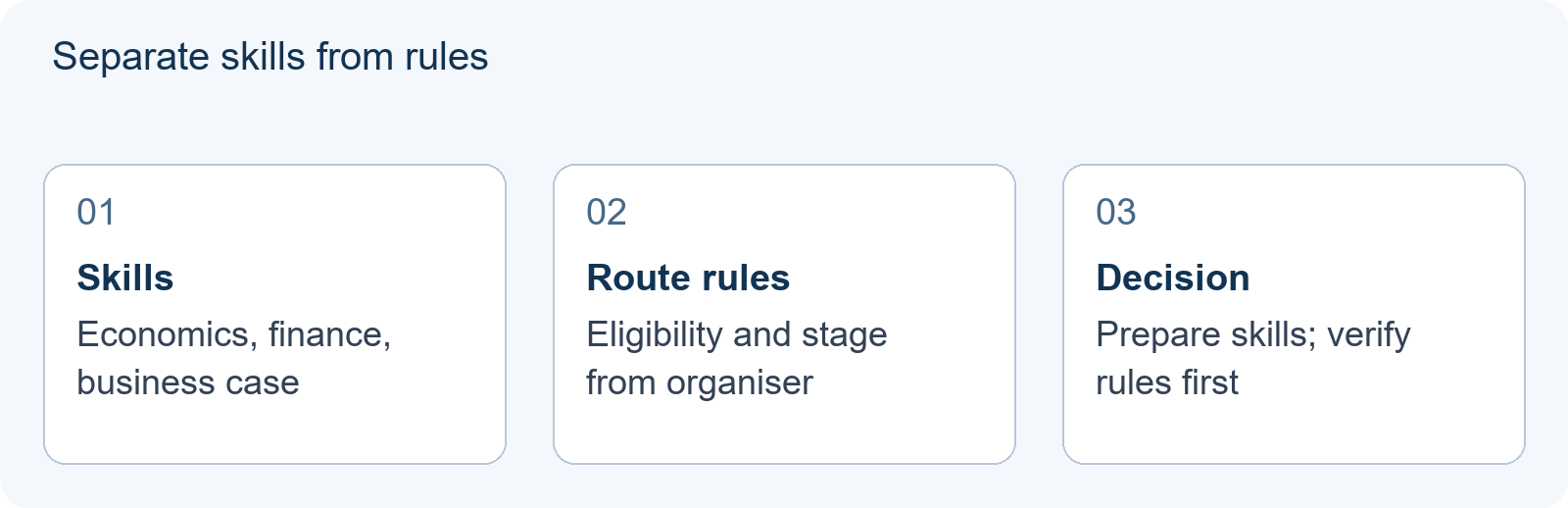
The October 2026 note gives a broad preparation frame: economics, financial literacy and business case analysis. That frame is useful because it points to three different student capabilities. Economics suggests theory and applied reasoning. Financial literacy suggests understanding financial information and decisions. Business case analysis suggests structuring a problem, weighing evidence and communicating a recommendation.
A practical skills matrix can separate those capabilities from route rules. In one column, list the knowledge and communication skills to develop. In another, list the route-specific eligibility, stage, format and submission rules that must come from the named organiser. The skills column can overlap across routes; the rules column should not be copied from a different country or season.
If the student is still deciding whether economics competition is a good fit, the Economics competition preparation interest test: Try a 30-Minute Data Sprint offers a practical diagnostic. For a wider record of progress across related activities, see Academic Competition Portfolio: Showing Progress Across Several Related Activities. Neither link replaces the current organiser page for the chosen route.
What to ask before a course-fit or resource conversation
A useful preparation conversation starts with a route check, not a sales question. The family can bring four items: the student's country and grade, the exact page or screenshot that uses the IEO label, the named organiser if one appears, and the stage the page claims to describe. Then ask the programme to map its preparation to that route and stage, and to separate skill-building from rules that must be confirmed by the organiser.
A programme can reasonably say that economics, financial literacy and case analysis are relevant across routes. It should not claim that one country's eligibility rule applies to another country, that a training camp is the same as team selection, or that a past season's deadline is current. If a resource pack is offered, ask exactly what it contains and which year's solutions are included. Do not treat a general IEO page as proof of route-specific registration support.
This is also where a school or coach can help most: by writing the route sentence accurately and by naming the organiser whose current page the family should read. That is more useful than another broad comparison of 'IEO difficulty'.
Source discipline and the next check
The route map above rests on two dated Hanlin articles. The 27 June 2026 note is the source for the USAEBO, NZEO and Nextgen IEOC relationships and for the training-camp and five-student team description. The 28 October 2026 note is the source for the economics, financial literacy and business case content description. Both are provider-published notes, not current official regulations. Current season eligibility, dates and selection rules must be checked with the named organiser.
Before acting, write down one sentence: 'This page is about [country]'s [named route] at [stage] for [season].' If the sentence has a blank, the family does not yet have a route. Fill the blank first, then prepare.
General event background is available at Hanlin Education.
Frequently Asked Questions
Is IEOC the same as IEO?
In the supplied 2026 Hanlin notes, IEO is the international competition and global final, while IEOC is described as Nextgen's China selection route used to select China's IEO national team. They are related labels, not interchangeable stage names. Verify the current season with the named organiser.
If a page says IEO national team, does it mean China?
No. The June 2026 Hanlin note also describes USAEBO and NZEO as national-team selection routes. A page saying IEO national team could be referring to a China route, a US route, a New Zealand route or another national route. Check the country and named organiser before assuming.
Can preparation for one route transfer to another?
Some skills may overlap, especially the economics, financial literacy and business case areas described in the October 2026 Hanlin note. However, eligibility, stage rules, deadlines and selection criteria are route-specific. Do not assume automatic transfer between IEOC, USAEBO, NZEO or the global final.