For families tracking progress in economics competitions, the leap from a strong local result to an IEO National Training Team is not simply a matter of scoring higher on the next test. National-team selection is usually administered by a country or region's IEO organising body, and the exact stages, weights and rubrics can vary. That is precisely why families need a sharper question: which criteria beyond scores are actually published, and which preparation habits make a student more ready for whatever the official process measures?
This article does not present an unofficial IEO scoring formula. Instead, it explains how to audit the gap between test performance and team readiness. It covers the funnel from qualifier to national representation, the value of consistency under pressure, the communication and collaboration habits that often matter in team-based academic competitions, and a practical timeline for future cycles. Hanlin's own site states that it has trained many national-team members in international competitions; that institutional context is useful, but it does not replace the current rules published by the relevant IEO national organiser.
The IEO Funnel: From Local Contest to National Representation
National pathways often begin with a qualifying stage. Students may face multiple-choice sections, short-answer economics problems, quantitative questions or written analysis. The public language around this stage often sounds purely meritocratic: rank high, advance. That is understandable, but incomplete. Qualification is rarely the same as final team selection.
Once a student enters a training camp or final selection pool, the organising body may evaluate different evidence. Depending on the country or region, that evidence may include additional exams, interviews, team problem-solving, policy presentations, data interpretation or research-style tasks. Some organisers may publish a weighted rubric; others may describe the process only in broad terms. The safe planning assumption is not that every IEO national team uses the same criteria. The safe assumption is that the official rules for the student's country or region decide what matters.
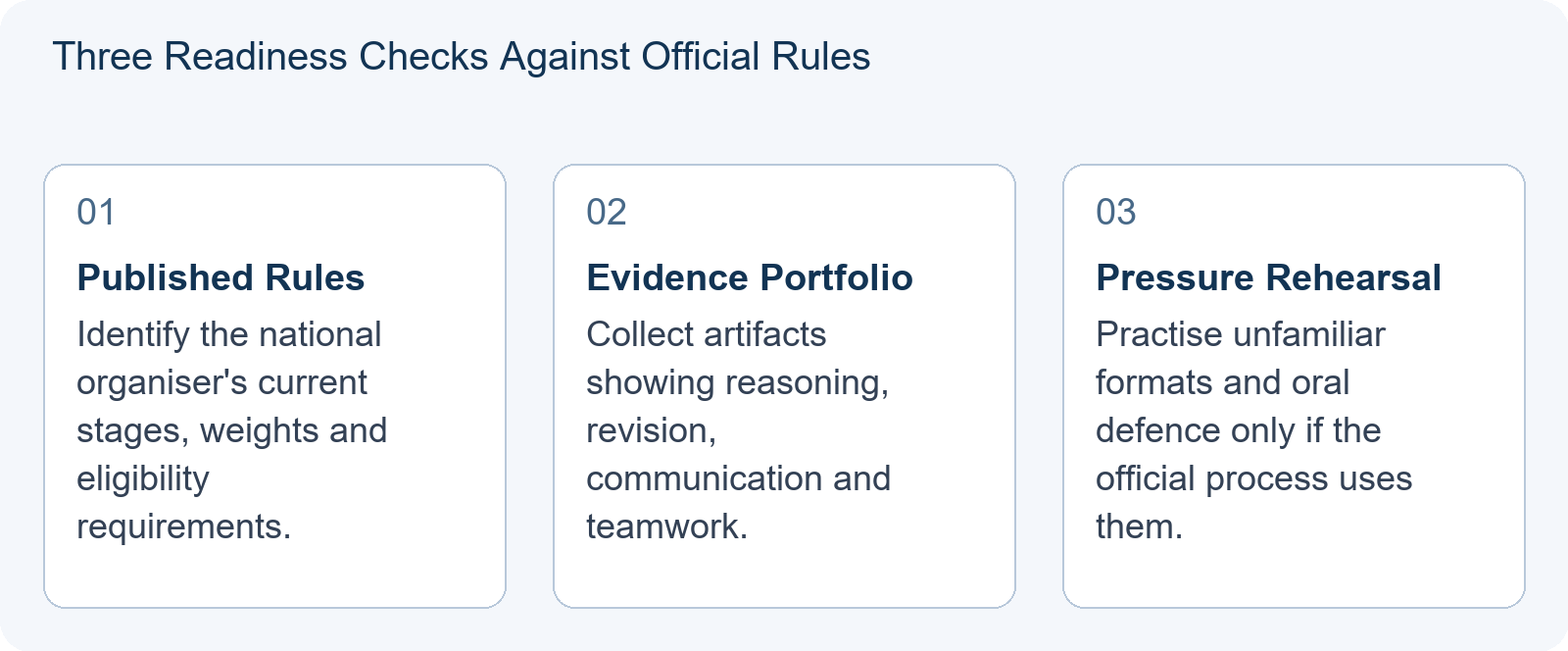
Therefore, the first step for any serious candidate is not another mock paper. It is rubric literacy. Find the current national organiser's page, read the eligibility and stage descriptions, and note what is explicitly assessed. Then map preparation to that document. If the published rules say scores decide everything, build score reliability. If the rules mention interviews, team tasks or written defence, prepare those too. If the rules are vague, do not invent hidden criteria; build broad economic reasoning and communication skills that transfer across formats.
Beyond the Score: Why Consistency Under Pressure Matters More Than One-Off Brilliance
A common misconception among ambitious students is that one spectacular result can compensate for uneven performance. In high-stakes team selection, that is often risky. A national team may need a student who can contribute reliably across several days, formats and problem types. Occasional brilliance is attractive, but reliability gives coaches and selectors a clearer basis for planning. This is not a claim about a specific IEO rubric; it is a general principle in team-based academic competition.
Teaching illustration, not an actual IEO past problem or official scoring rule: Two students both score 85 out of 100 on a national qualifier. Suppose, purely for illustration, the official rules state that final camp placement is 50% qualifier, 30% individual problem set and 20% team case. Student A earns 70 on the problem set and 60 on the team case. Student B earns 68 and 90. Student A's weighted total is 42.5 + 21 + 12 = 75.5. Student B's weighted total is 42.5 + 20.4 + 18 = 80.9. Under those hypothetical weights, Student B ranks higher despite a slightly lower problem-set score. The lesson is not that team cases always matter. The lesson is that families must read the actual published weights before assuming the qualifier score is decisive.
Consistency under pressure can be trained, but not by simply doing more of the same questions. Students need varied formats: timed calculation, open-response explanation, rapid assumption checks, data interpretation, and oral defence of an answer. They should practise switching between these modes without losing clarity. That kind of rehearsal builds the adaptability that many selection processes value, even when the official labels differ.
What Criteria May Matter Beyond Raw Scores
Because national rules vary, the following list should be treated as a preparation framework, not an official IEO checklist. For each item, check whether the current national organiser actually assesses it.
- Explicit reasoning: Can the student state assumptions, define variables and explain why a model applies? In economics, a correct number with an unexplained assumption is fragile.
- Consistency across formats: Does performance hold when the task changes from multiple-choice to written analysis or from individual work to a team case?
- Communication: Can the student explain an economic mechanism to a non-specialist, a coach or a teammate without hiding behind jargon?
- Collaboration: Does the student improve a group's reasoning by listening, testing ideas and resolving disagreements with evidence?
- Coachability: Can the student receive feedback, revise a position and show visible improvement within a short cycle?
- Integrity and judgment: Does the student handle data, citations and uncertainty honestly, especially when a problem has no single clean answer?
These qualities are difficult to fake in a live camp because they appear in small moments: how a student reacts to a challenge, whether they invite correction, and whether they can separate personal pride from the quality of an argument. A student who is merely a fast test-taker may still struggle if the official process includes any of these dimensions.
Building Team Readiness Without Guessing the Rubric
The practical answer is to build transferable readiness while staying anchored to the published rules. Start with a one-page audit. On the left, list the official stages and criteria. On the right, list the student's current evidence for each. If the official rules mention interviews, record mock interview feedback. If they mention team cases, record examples of collaborative modelling. If they mention written economics, collect revised essays or policy memos. If the rules do not mention a dimension, still develop it, but do not present it as official.
For communication, students can practise a three-minute explanation of a familiar economic concept, then a three-minute explanation of an unfamiliar chart. The goal is not theatrical polish. The goal is to make assumptions visible and reasoning easy to follow. For collaboration, group projects should include a rotating role: one student defines the problem, one proposes a model, one challenges assumptions, one summarises the final position. This prevents the common failure where one strong student does all the thinking and the rest merely agree.
For pressure, use short cycles rather than marathon drills. A 25-minute unfamiliar problem followed by 10 minutes of oral explanation can reveal more than another hour of repeated multiple-choice practice. After each cycle, ask three questions: What assumption did I make? Where did my reasoning break? What would I change next time? This creates a feedback loop that families can actually track.
Where Hanlin Fits, and What Hanlin Cannot Replace
Hanlin's official English site states that Hanlin has trained many national-team members in international competitions. Hanlin is an independent education provider and is not the official IEO national organiser. That is relevant institutional background for families seeking advanced competition coaching. It is not a substitute for the IEO national organiser's rules, and it should not be read as a guarantee that any particular student will be selected.
For Hanlin's own public records, families can review the competition-results archive, including 15 students selected for IEO national training teams; CNEC global championship. That page is an archive link; the current selection criteria still belong to the relevant national organiser. For broader portfolio planning across several competitions, see Academic Competition Portfolio: Showing Progress Across Several Related Activities. For students balancing school coursework and competition preparation, AP and Competition Preparation: Build a Study Plan Around Shared Skills offers a useful planning frame.
A good coach can help a student audit published requirements, design practice that matches those requirements, and document growth over time. A good coach should also say clearly when a claim is not in the official rules. That honesty protects families from preparing for an imagined selection process rather than the real one.
Timeline Planning for Future IEO Cycles
Because exact dates and eligibility rules change by country and year, this article does not provide a universal calendar. Instead, use a cycle-based timeline that can be shifted to the current official announcements.
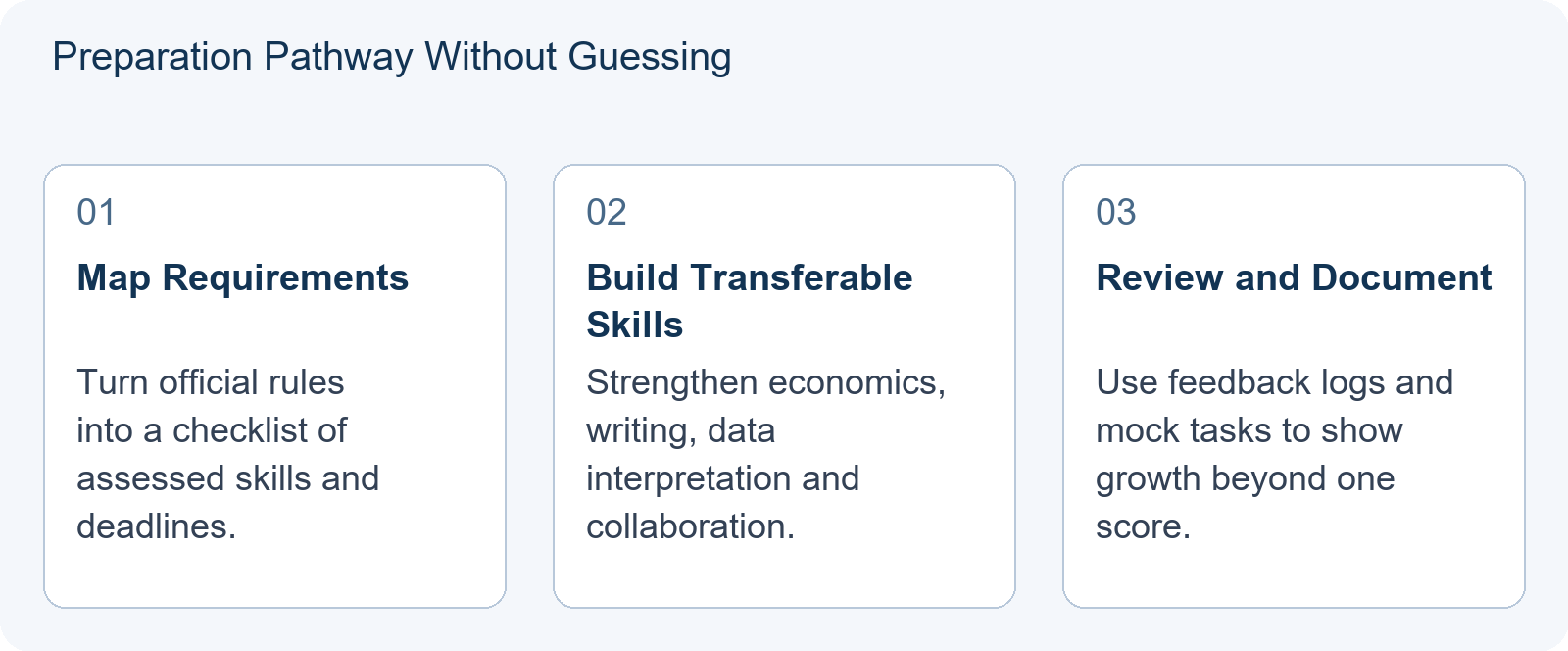
Phase 1: Rules audit. At the start of the cycle, locate the national organiser's current page. Save the eligibility rules, stage descriptions and deadlines. Translate them into a checklist. If a rule is unclear, ask the organiser or a coach to help interpret it, rather than relying on forum rumours.
Phase 2: Foundation and breadth. Strengthen microeconomics, macroeconomics, quantitative reasoning and data interpretation. At the same time, add one communication habit and one collaboration habit. For example, a student might write a weekly one-paragraph economic explanation and join a monthly team case discussion.
Phase 3: Format rehearsal. Once the official format is known, rehearse it. If the selection uses written analysis, practise under time pressure and review structure. If it uses interviews, record answers and review clarity. If it includes team tasks, practise contributing without dominating.
Phase 4: Evidence and reflection. Keep a simple readiness log. Record scores, but also record explanations, feedback received, revisions made and teamwork observations. This log helps a student see progress beyond a single number and gives mentors concrete material for advice.
Conclusion: Redefining Success in Economics Competitions
Selection for an IEO National Training Team, where such a team exists in a student's country or region, is not just a reward for high test scores. It can also reflect consistency, clear reasoning, communication and team fit, depending on the official process. The strongest preparation is therefore dual-track: respect the published rubric, and build transferable economic readiness that survives format changes. Families who do this avoid two opposite mistakes: assuming scores are everything, or inventing hidden criteria that no organiser has published. The result is a more honest, more useful, and more durable preparation plan.
Frequently Asked Questions
Does a perfect score guarantee selection for the IEO National Training Team?
No. A high score may be necessary for an initial qualifying stage, but final national-team selection depends on the country or region's published rules. Those rules may include additional exams, interviews, team tasks or written analysis. Families should read the current official process rather than assume the qualifier score is decisive.
How can students develop the non-score skills needed for team selection?
Students can practise explaining economic reasoning aloud, writing short policy-style analyses, revising work after feedback, and contributing to team problem-solving. These habits are useful in many team-based academic competitions, but they should be matched to the official rubric for the student's country or region.
Is there a specific timeline for preparing for IEO national team selection?
There is no universal timeline because national cycles and deadlines vary. A safe approach is to audit the current organiser's rules, build economics foundations, rehearse the published formats, and keep a readiness log. Confirm all dates and eligibility details directly with the official national organiser.