
Receiving your John Locke Essay results—whether a Commendation, High Commendation, or the realization that you did not place this cycle—marks a pivotal decision point for any student building a humanities portfolio. The question is not what the result means in isolation, but how you convert that feedback into demonstrable writing growth that admissions readers can recognize. This article works through concrete teaching illustrations showing how to diagnose your competition essay, why surface-level revisions fail, and what specific next steps build a stronger portfolio.
Understanding What John Locke Results Actually Signal
The John Locke Essay Competition, organized by the independent John Locke Institute, evaluates essays on five criteria: knowledge and understanding of relevant material, effective use of evidence, quality of argument, structure, and writing style and persuasiveness. This matters because the feedback you receive—or the absence of it—reflects performance against these specific academic standards, not a general "good writing" assessment.
According to Hanlin's 2026 competition results published October 6, 2026, disclosed student placements include High Commendations and Commendations across economics, history, politics, psychology, international relations, theology, and public policy. The source notes these are partial results, so the full distribution of Hanlin students across all award levels is not available. The competition awards one Winner, one Second Prize, and one Third Prize per category annually, with High Commendations and Commendations representing substantial but non-podium achievement.
For portfolio purposes, a Commendation or High Commendation signals that your work met rigorous scholarly standards. The strategic question becomes: how do you identify which aspects of your essay to strengthen, and how do you address those gaps?
Teaching Illustration: The Economics Essay That Earned High Commendation
The following is a teaching illustration for instructional purposes, not an actual student case.
Consider a student who submitted an economics essay on market failure and received High Commendation. Let us trace a diagnostic and revision process that converts this result into portfolio strength.
Step 1: Identify the specific weakness from competition standards. The student had strong theoretical knowledge (citing Coase, Pigou, and contemporary behavioral economics) and clean prose. However, the argument proceeded as a literature review: "Some scholars argue X, while others argue Y." The essay lacked an original analytical frame. Under the competition's "quality of argument" criterion, this is a common ceiling for essays that demonstrate competent synthesis without distinctive thesis.
Step 2: Design a revision with portfolio visibility. The student reworks the essay for a school economics journal. The revision introduces a novel mechanism: using auction theory to model how Pigouvian taxes fail when regulators misestimate demand elasticity, then tests this against three historical policy episodes. This adds original analytical architecture.
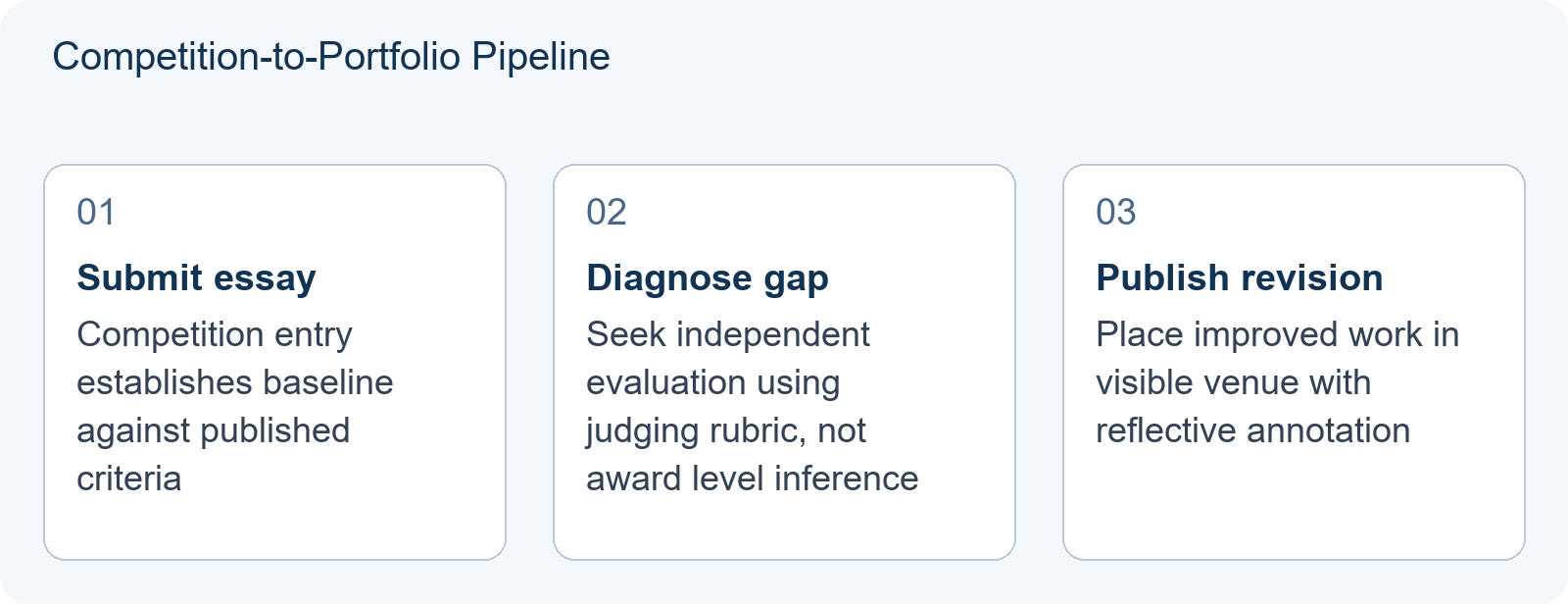
Step 3: Document the growth trajectory. In the portfolio, the student presents the original John Locke submission, any available feedback, and the revised journal submission with a brief reflective note explaining the analytical gap identified and addressed. This demonstrates metacognition and sustained engagement—precisely what selective admissions programs value.
This illustration shows a productive pattern: competition results identify a specific skill threshold, and the portfolio documents the crossing of that threshold.
Contrasting Teaching Illustration: The Superficial Revision That Weakens the Portfolio
The following is a teaching illustration, not an actual student case.
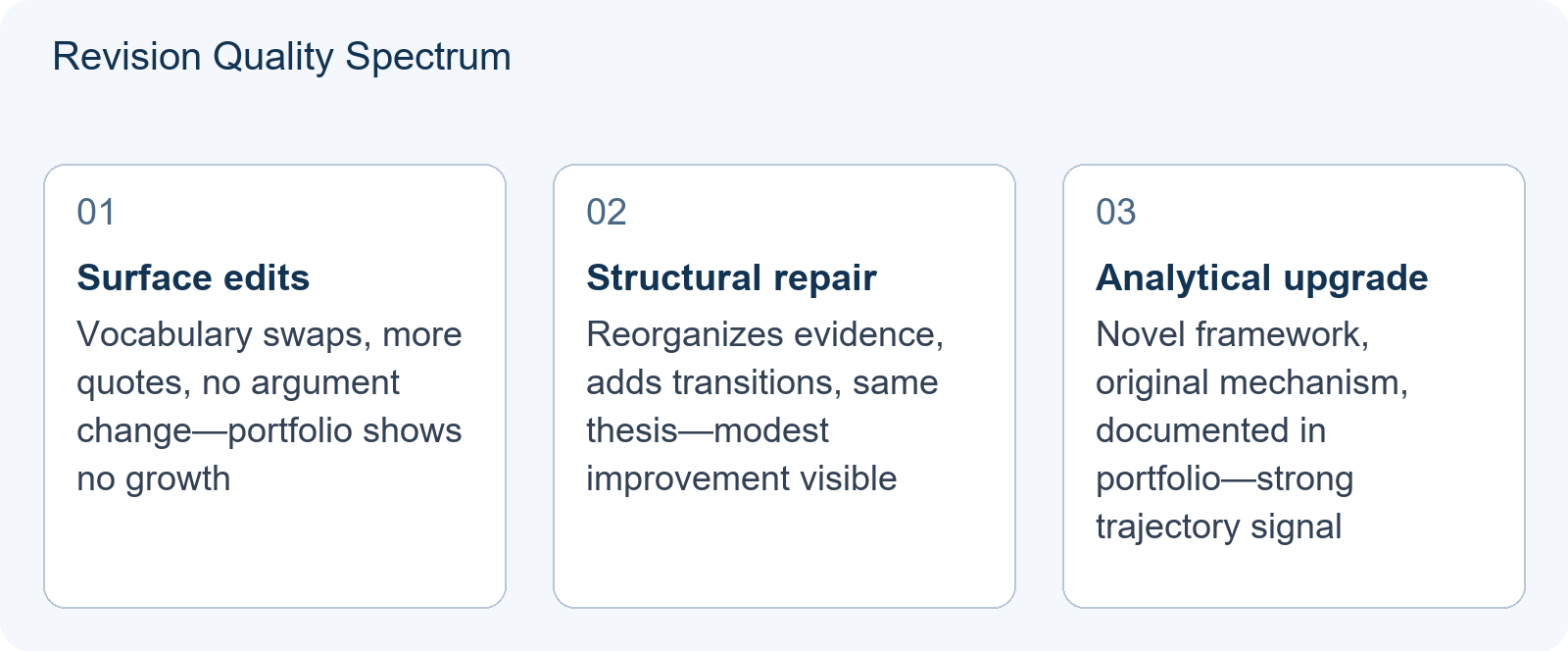
Consider a contrasting approach that fails. A student receives Commendation in history and concludes: "I need better vocabulary and more quotes." The student rewrites the essay with denser prose and twenty additional citations, then submits it unchanged to five other competitions.
This strategy fails on multiple dimensions. First, it misdiagnoses the competition feedback. John Locke essays are capped at 2,000 words; adding quotations without subtracting exposition compresses original analysis. Second, it produces no visible growth narrative—the revised essay and original are substantively identical in argument structure. Third, if multiple competition judges identify the same weakness, the student accumulates rejections without progress. Fourth, submitting substantially similar work to multiple competitions may violate originality or prior publication rules; students must check each competition's disclosure requirements.
The portfolio damage is subtle but real. Admissions readers who encounter multiple similar essays from the same applicant perceive either lack of self-awareness or, worse, an inability to incorporate feedback. The student has confused volume of revision with quality of revision.
The key distinction: productive revision targets the specific criterion that may have capped your score; superficial revision targets the easiest perceived problem (word choice, citation count) while leaving the actual constraint untouched.
Diagnostic Framework: Seeking Actionable Feedback Beyond the Award Level
Because John Locke provides limited individual feedback beyond placement, you must self-diagnose using the published criteria and external evaluation. Here is a concrete framework:
For any placement level:
First, obtain independent evaluation from a teacher or mentor familiar with academic essay competitions. Ask them to assess your essay against each of the five judging criteria specifically, not to guess why you received your placement.
Second, compare your essay's question engagement to available winning essays. Note how winners frame their intervention—what gap they claim to fill, what they explicitly refuse to do. This reveals the competition's "quality of argument" criterion in practice.
Third, audit your evidence use. The competition recommends sources including Google Scholar, JSTOR, Our World in Data, PubMed, government documents, and think tank reports. For your essay, verify: can you state, in one sentence, what each source contributes that no other source does? Generic deployment of sources signals weak evidence use.
Fourth, examine your structure and style against the word limit. At 2,000 words excluding charts, tables, footnotes, bibliography, and author declaration, every sentence must earn its place. Padding with quotations or throat-clearing introductions consumes analytical space.
For students who did not place, the honest assessment is harder but more valuable. The 2026 timeline shows registration from February 2 to March 31, with submissions due May 31. Students who worked intensively during this window and did not place should examine whether their preparation matched the competition's scholarly depth. Hanlin's 2026 results showed Commendations across diverse schools—Beijing, Shanghai, Guangzhou, overseas institutions—suggesting that placement reflects preparation quality rather than institutional prestige alone.
Building the Portfolio Narrative: From Competition to Sustained Inquiry
The strongest portfolios treat competitions as milestones in longer intellectual arcs, not as isolated achievements. Consider how to frame your John Locke participation:
Weak framing: "I received High Commendation in the John Locke Essay Competition, demonstrating my interest in economics."
Strong framing: "My John Locke essay on market failure revealed a gap in my ability to construct original analytical mechanisms. I revised the work using auction theory, published the result in my school's economics journal, and am now extending this framework to analyze carbon credit markets in my independent research."
The second framing shows intellectual trajectory. It converts competition feedback into a documented growth pattern. This is particularly important for students applying to programs emphasizing research readiness.
Hanlin's 2026 results announcement mentions that the organization provides one-on-one customized mentorship to assist students in polishing high-quality essays. Students who worked with mentors should specifically note how that guidance shaped their revision process. Even without formal mentorship, the principle applies: identify a knowledgeable reader who can evaluate your essay against the competition's stated criteria, not just general writing quality.
Preparing Your Next Submission: A Concrete Preparation Protocol
For students planning to re-enter John Locke or similar competitions, a preparation protocol grounded in the 2026 cycle's lessons:
Phase 1: Question Analysis (Weeks 1-2)
Obtain the current year's questions immediately upon release. For 2026, registration opened February 2. Analyze five winning essays from your target category, noting not what they argue but how they frame their intervention—what gap they claim to fill, what they explicitly refuse to do.
Phase 2: Evidence Audit (Weeks 3-4)
For your tentative topic, assemble a working bibliography of 15-20 sources. The test: can you state, in one sentence, what each source contributes that no other source does? If not, your evidence deployment will likely be generic.
Phase 3: Argument Construction (Weeks 5-6)
Draft a 300-word abstract before writing the full essay. The abstract must contain: (1) the specific question you answer, (2) the gap in existing approaches, (3) your analytical move, and (4) the implications. If any element is missing, the full essay will likely suffer the corresponding weakness.
Phase 4: Revision with External Feedback (Weeks 7-8)
Seek feedback from someone familiar with the competition's standards, not just general academic writing. The 2026 results announcement notes that Hanlin mentors provide professional advice on research and writing to assist students in polishing high-quality essays. Whether through formal or informal channels, the feedback must address the five judging criteria specifically.
This protocol assumes an 8-week preparation window. Students with less time should compress phases 1-2, but skipping argument construction (phase 3) typically produces essays that read as rushed rather than concise.
Related Resources and Next Steps
For students building broader competition portfolios, Hanlin's article on Academic Competition Portfolio: Showing Progress Across Several Related Activities provides frameworks for connecting multiple competition experiences coherently. Students considering research mentorship may review Research Project Mentorship: What a Student Should Bring to a First Meeting to prepare for initial advisor conversations.
Those weighing whether to prioritize competition participation or skill development might find relevant analysis in Math Competition Plateau: Choosing Between More Practice and Targeted Feedback—while mathematics-focused, its discussion of diagnostic feedback principles has analogues for humanities competitions.
The John Locke Institute itself is an independent educational organization; Hanlin's preparation services represent one perspective on approaching the competition. Students should verify current rules and deadlines directly through official channels, as timelines may shift for future cycles.
Frequently Asked Questions
Does a Commendation help my college application, or should I only mention higher placements?
A Commendation signals rigorous scholarly standards met under competition conditions. The key is framing: present it as part of a growth trajectory with specific revision work, not as a standalone credential. Admissions readers value demonstrated improvement over isolated achievement.
How do I get useful feedback if the competition only provides placement, not detailed comments?
Use the published judging criteria as a diagnostic rubric. Have a mentor or knowledgeable reader evaluate your essay against each of the five criteria specifically. Compare your essay to winning essays' question engagement and analytical framing, not just their conclusions.
Should I re-enter John Locke with a revised essay, or write a new essay entirely?
Write a new essay. The competition releases new questions annually, and revised previous work rarely addresses the new question's specific demands. However, apply the analytical lessons from your previous attempt—if your argument lacked originality, design your new essay around a genuinely novel mechanism from the start. Check each competition's originality and prior publication rules before submitting similar work elsewhere.