
When families receive an AMC mock test result, the immediate focus is often on the numerical score: "Did we pass?" or "How close are we to AIME qualification?" While the score provides a benchmark, it rarely offers actionable guidance for improvement. A truly useful diagnosis must explain why the student scored that way, distinguishing between lack of knowledge, poor time management, and strategic errors. This article outlines what effective feedback should reveal and how to interpret these insights for the next stage of preparation.
Beyond the Score: The Three Dimensions of Diagnostic Feedback
Effective feedback categorizes errors into three distinct dimensions: Knowledge Gaps, Process Failures, and Strategic Missteps. A raw score conflates these issues. For instance, missing a mid-test question could be due to not knowing the formula (Knowledge), running out of time because of earlier delays (Process), or guessing incorrectly under pressure (Strategic). Without this breakdown, students may waste hours reviewing topics they already understand while ignoring their actual weaknesses.
Hanlin's AMC10/12 mock testing program, as described in recent program materials, emphasizes simulating real exam conditions to identify these specific patterns. The goal is not just to measure current ability but to map the trajectory toward improvement. Families should look for reports that highlight which questions were skipped versus attempted, and whether errors were consistent across similar problem types.
Teaching Illustration: Diagnosing Time Allocation vs. Content Mastery
Note: The following student profiles are purely hypothetical teaching illustrations invented for explanatory purposes. They are not based on actual contest results or official scoring data.
Consider two students who both score 90 on an AMC 10 mock test. On the surface, their performance appears identical. However, a detailed diagnostic reveals different underlying issues:
- Student A's Profile: 12 correct, 1 wrong, 12 blank. This student answered early questions quickly, attempted some mid-level problems, but left many questions unanswered. The pattern suggests possible time management difficulties or excessive caution.
- Student B's Profile: 15 correct, 10 wrong, 0 blank. This student attempted every question but had a high error rate, suggesting rushed work or overconfidence in guessing.
Arithmetic verification: Student A: 12 × 6 + 12 × 1.5 + 1 × 0 = 72 + 18 + 0 = 90. Student B: 15 × 6 + 0 × 1.5 + 10 × 0 = 90 + 0 + 0 = 90. Both totals confirmed correct.
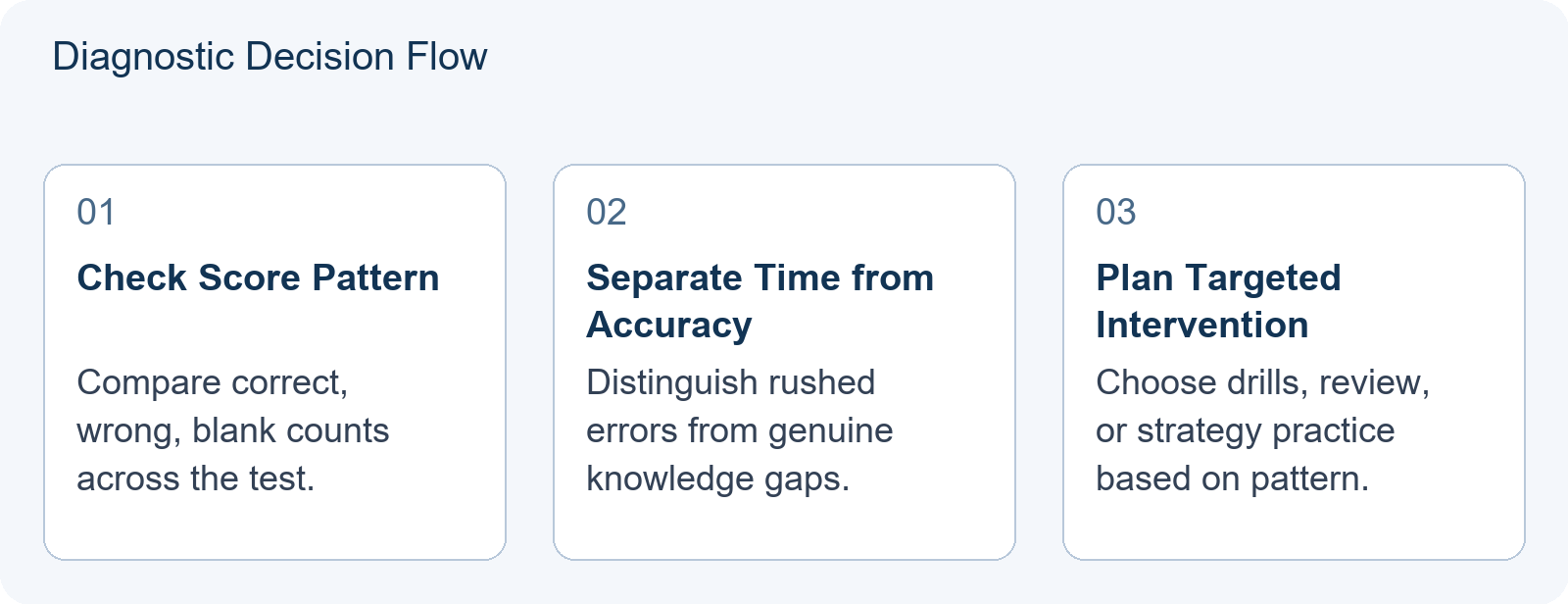
Diagnosis: Student A may need speed drills on mid-level problems and strategy training for when to commit to an answer versus leaving it blank. Student B needs pacing discipline and accuracy training—attempting every question is not automatically optimal. Generic advice like "study more" would fail both students. Effective feedback explicitly separates timing data from content accuracy.
Importantly, question position alone cannot determine whether a student lacks conceptual mastery or simply made a time-pressure error. An untimed independent reattempt of missed problems, followed by assessment of whether the student can solve similar problems in a different context, is needed to distinguish these cases.
Contrasting Case: When Superficial Feedback Fails
In contrast, superficial feedback might simply state: "Student A: Weak in mid-level problems; Student B: Weak in accuracy." This conclusion is invalid if derived solely from question position without analyzing how the performance pattern emerged. If Student A left questions blank because of time constraints rather than inability, labeling them "weak" in those topics misdirects the study plan. They may actually understand the concepts but lack the speed to apply them.
Similarly, if Student B made errors due to rushing rather than conceptual misunderstanding, intensive review of those specific topics may be unnecessary. The student needs practice in maintaining accuracy under time pressure. A useful diagnosis avoids attributing all errors to knowledge gaps, recognizing that process factors significantly impact scores.
Optional Coaching Bins: A Flexible Framework, Not Official Sections
Some preparation programs organize AMC problems into rough difficulty groupings for coaching purposes. These are optional coaching bins, not official contest sections with fixed boundaries:
- Questions 1–10 (coaching bin): Typically tests basic fluency. Errors here may indicate fundamental gaps, though not universally.
- Questions 11–20 (coaching bin): Often involves multi-step reasoning. Difficulty varies by year; some problems in this range may be more accessible than certain Q1–10 problems.
- Questions 21–25 (coaching bin): Generally the most challenging, but difficulty is not strictly linear. A Q22 may be more approachable than a Q19 depending on the specific contest.
These groupings are heuristic tools for organizing study, not rigid official categories. A student who struggles with Q5 should not assume Q21–25 are categorically irrelevant—their specific strengths and weaknesses matter more than position-based rules.
The Role of Error Analysis in Targeted Preparation
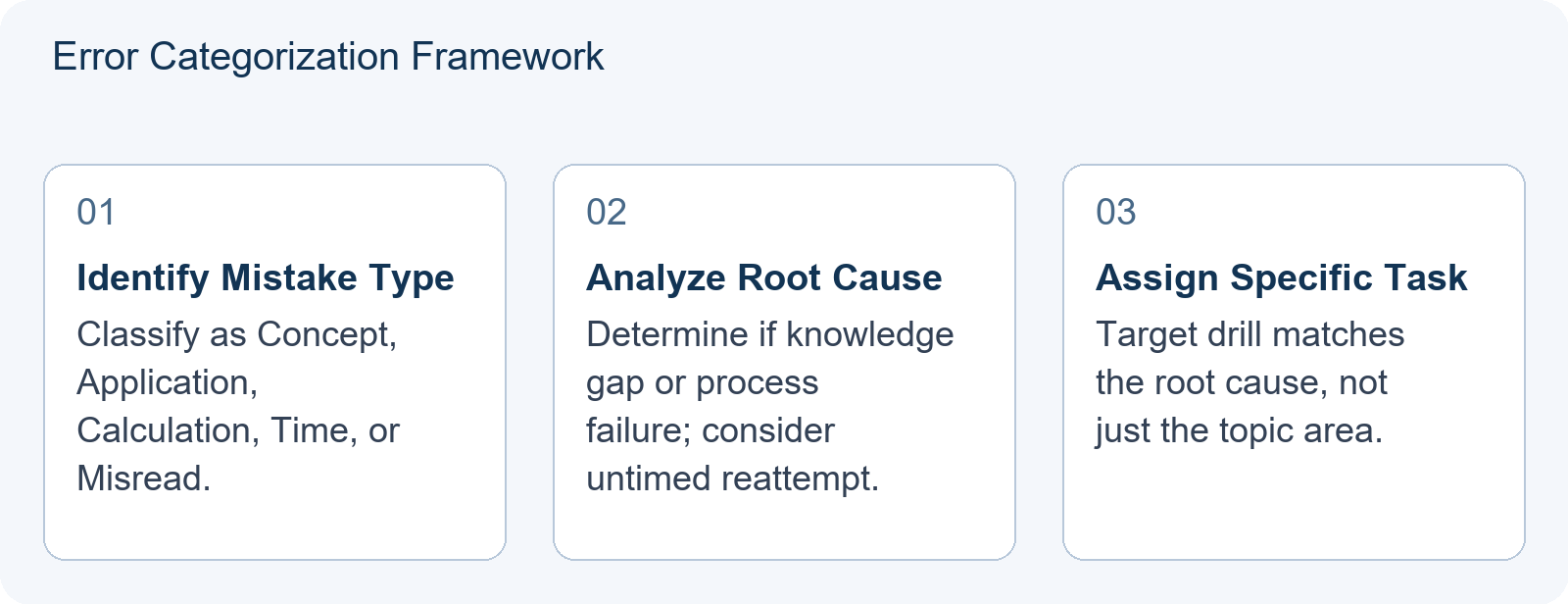
Detailed error analysis transforms a mock test from an assessment tool into a learning instrument. Students should categorize each mistake using a simple framework:
- Conceptual Gap: Did not know the relevant theorem or technique.
- Application Error: Knew the concept but applied it incorrectly.
- Calculation Slip: Correct method, arithmetic error.
- Time Pressure: Skipped or rushed due to clock management.
- Misinterpretation: Read the question wrong.
For example, if a student consistently makes "Calculation Slips" in algebraic manipulations, the solution may be focused computational fluency exercises rather than more algebra theory. If "Misinterpretations" dominate, reading comprehension strategies for math word problems become the priority. This granular approach ensures study time addresses root causes rather than symptoms.
Note that content review is sometimes needed—there is no universal rule that it is never appropriate. The key is matching the intervention to the diagnosed pattern rather than defaulting to comprehensive review.
From Diagnosis to Action Plan
A useful diagnosis concludes with a prioritized action plan. Instead of vague goals like "improve math skills," specific tasks emerge from the data:
- Immediate Fix: Address recurring calculation slips with daily timed drills.
- Short-Term Goal: Master one specific topic identified as a conceptual gap (e.g., combinatorics).
- Long-Term Strategy: Practice full-length mocks focusing on time allocation rules (for example, deciding in advance when to move on from a stalled problem).
This structured approach ensures that preparation is efficient and directly linked to observed weaknesses. It prevents the common pitfall of studying material already mastered while neglecting critical bottlenecks.
Understanding AIME Eligibility Context
While mock tests help gauge preparation level, no score on a practice test guarantees AIME qualification. Actual official eligibility depends on performance relative to the specific contest year's thresholds, which vary, and other conditions set by the organizing body. Mock test results should inform preparation direction, not be interpreted as predictive of specific outcomes.
Linking to Broader Competition Preparation
Understanding mock test feedback is part of a larger ecosystem of competition preparation. For students considering multiple activities, tracking progress across related events can provide context for isolated results. See our guide on Academic Competition Portfolio: Showing Progress Across Several Related Activities for strategies to integrate AMC results into a broader academic narrative.
Additionally, if a student hits a plateau despite good feedback, they may need to choose between increased volume of practice and higher-quality targeted intervention. Our article on Math Competition Plateau: Choosing Between More Practice and Targeted Feedback explores this decision point.
Finally, for those transitioning from AMC to research-based competitions, the analytical skills honed in error diagnosis are transferable. Learn more about preparing for such shifts in Research Project Mentorship: What a Student Should Bring to a First Meeting.
Interpreting the Diagnostic: From Score to Strategy
The distinction between Student A (12 correct, 1 wrong, 12 blank) and Student B (15 correct, 10 wrong, 0 blank) is not merely numerical; it represents two fundamentally different cognitive approaches to the exam. For families, understanding this divergence is critical because the remedial actions are mutually exclusive. Applying the wrong strategy can exacerbate the problem rather than solve it.
Student A’s Profile: The Caution Trap
Student A demonstrates high accuracy but low volume. This pattern often stems from perfectionism or a lack of confidence in mid-level problems. The student likely spends excessive time verifying answers on questions they already know, leaving insufficient time for later items. The diagnostic implication is clear: Student A does not need more content review. They need decision-making training. The goal is to reduce the time spent per question without sacrificing accuracy. A useful practice task involves "triage drills": give the student ten mixed-difficulty problems and ask them to categorize each as "Solve Now," "Skip," or "Guess" within 30 seconds per item, then execute only the "Solve Now" set. This builds the instinct to move on, which is essential for maximizing score potential.
Student B’s Profile: The Overconfidence Gap
Student B attempts every question but suffers a high error rate. This suggests a misunderstanding of the scoring penalty structure or an inability to recognize when a problem exceeds their current skill level. The student may believe that guessing has no downside, or they may be rushing through early questions to save time for harder ones, resulting in careless errors. The diagnostic implication is that Student B needs accuracy discipline. Content mastery is likely sufficient for the first 10–12 questions, but application under pressure is flawed. A targeted practice task is "error logging with cause analysis": after a mock test, the student must write down why each wrong answer was chosen (e.g., "misread variable," "arithmetic slip," "guessed randomly"). If "guessed randomly" appears frequently, the student must practice stopping at a point where confidence drops below 50% and leaving the question blank instead.
The Role of Untimed Reattempts
A common misconception is that a low score automatically indicates weak knowledge. To verify this, families should encourage untimed reattempts of missed problems. If Student A solves previously blanked questions correctly when given unlimited time, the issue is confirmed as process-related (time management), not knowledge-related. Conversely, if Student B makes the same conceptual errors even without time pressure, the issue is indeed a knowledge gap requiring targeted study. This simple experiment separates strategic failures from academic deficits, ensuring that preparation time is allocated efficiently.
Actionable Next Steps for Families
Instead of asking "Did you pass?", parents should ask "What did your error log reveal?" For Student A, the focus shifts to speed and confidence-building exercises. For Student B, the focus shifts to careful reading and strategic skipping. By tailoring interventions to these specific profiles, families can transform a static score into a dynamic roadmap for improvement. Remember, the mock test is not just a measure of ability; it is a diagnostic tool for behavior. Interpreting the "how" behind the "what" is the key to meaningful progress.
Frequently Asked Questions
Is a low score on the last few AMC questions always bad?
No. Skipping difficult questions to preserve time for more accessible ones is a valid strategy. Feedback should distinguish between strategic skips and forced skips due to time shortage. The optional coaching bins for Q21–25 are not official sections with fixed difficulty boundaries.
Can I diagnose my own AMC mock test errors effectively?
Yes, if you use a structured framework. Record why each error occurred (concept, calculation, time, misreading) rather than just noting the wrong answer. For time-pressure errors, try an untimed independent reattempt to assess true understanding before deciding what to study.
Does mock test feedback guarantee AIME qualification?
No. Mock tests indicate current performance level and identify areas for improvement, but actual qualification depends on official contest performance relative to variable thresholds, plus other eligibility conditions. Mock results should guide preparation, not be treated as predictive guarantees.