
Why the First Meeting Matters More Than Most Students Expect
Research project mentorship is not a lecture where the mentor delivers instructions and the student takes notes. It is a working conversation where the mentor assesses whether the student has a genuine question, the skills to pursue it, and the maturity to handle setbacks. Students who arrive prepared move faster; those who arrive empty-handed often waste the first three sessions on vague brainstorming.
This article addresses a narrow, practical question: what should a student physically and intellectually bring to a first mentorship meeting? It does not replace the broader overview of how research mentorship fits into competition preparation. For context on how research projects connect to specific competition categories, see ISEF category guide, Part I: the first eleven disciplines. For a student's perspective on how mentorship shaped an admissions journey, see A student journey to offers from UC Berkeley, Carnegie Mellon and Rice. Instead, we work through two hypothetical cases, one contrasting mistake, and a usable practice decision you can apply before your own first meeting.
Case A: The Student Who Arrives With a Refined Question
Imagine a tenth-grade student interested in environmental modeling. Before the first meeting, she does the following:
- Reads two recent papers from a modeling journal, notes which methods recur, and identifies one she does not understand
- Writes a one-paragraph description of a local problem: seasonal flooding in her county
- Prepares a single printed page with three specific questions: whether her problem is too broad, which method from the papers might apply, and what data she would need
During the meeting, the mentor spends fifteen minutes clarifying the scope, suggests narrowing to drainage infrastructure in two adjacent neighborhoods, and points her toward a public dataset. By the end of the hour, they agree on a two-week reading plan and a tentative modeling approach. The mentor later reports that this student "arrived with enough structure to be guided, enough gaps to be taught."
This case illustrates the core principle: the first meeting is most productive when the student has done enough preliminary work to expose specific gaps, not when she expects the mentor to generate the project from zero.
Case B: The Student Who Brings Only Enthusiasm
Now imagine a student with similar interest in environmental science who arrives with only a general statement: "I want to do something about climate change." He has not read any papers, has not identified a local or specific problem, and expects the mentor to propose a complete research question.
The mentor spends the first twenty minutes probing for any anchor—geography, method, data source, prior coursework—and discovers the student has never worked with spatial data. The meeting ends with a homework assignment: find three municipalities that publish flood records, and read one introductory paper. No progress is made on the actual project design. The student leaves frustrated, feeling the mentor was unhelpful, when in fact the session was consumed by foundational discovery that could have happened beforehand.
The difference between Case A and Case B is not talent or background. It is preparation.
The Common Mistake: Confusing a Topic With a Question
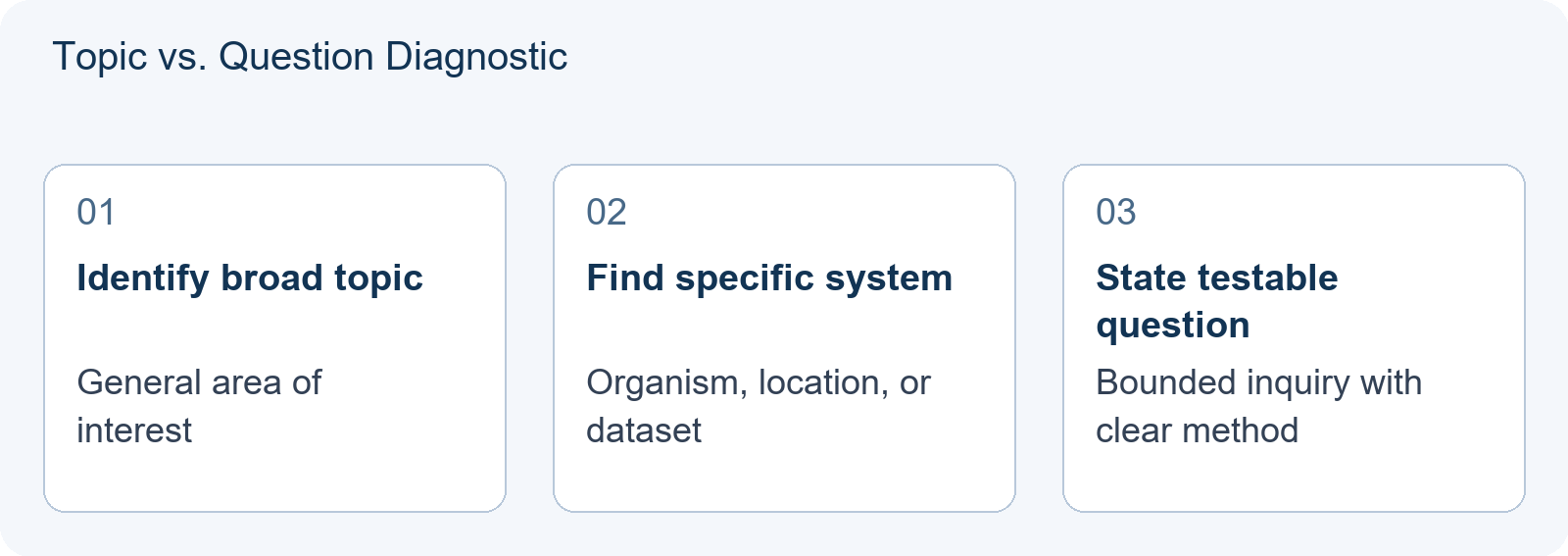
Both students above care about environmental issues. The failing student in Case B believes "climate change" is a sufficient starting point. It is not. A topic is a category; a question is a testable, bounded inquiry. Mentors report that this confusion is the single most common reason first meetings stall.
| What the student says | What the mentor hears | Diagnostic question to ask yourself |
|---|---|---|
| "I like biology." | No entry point; needs subfield and problem | What organism, process, or system specifically? |
| "I want to study cancer." | Massively broad; clinical or basic research? | What cell type, mechanism, or dataset will I use? |
| "I read about CRISPR." | Popular topic; unclear if student understands it | What aspect of CRISPR do I want to investigate, and with what tools? |
| "How do I win this competition?" | Goal-oriented but process-blind | What question am I genuinely curious about, independent of awards? |
Use this table to audit your own preparation. If you fall into the left column, you need more groundwork before scheduling a meeting.
A Practical Preparation Sequence
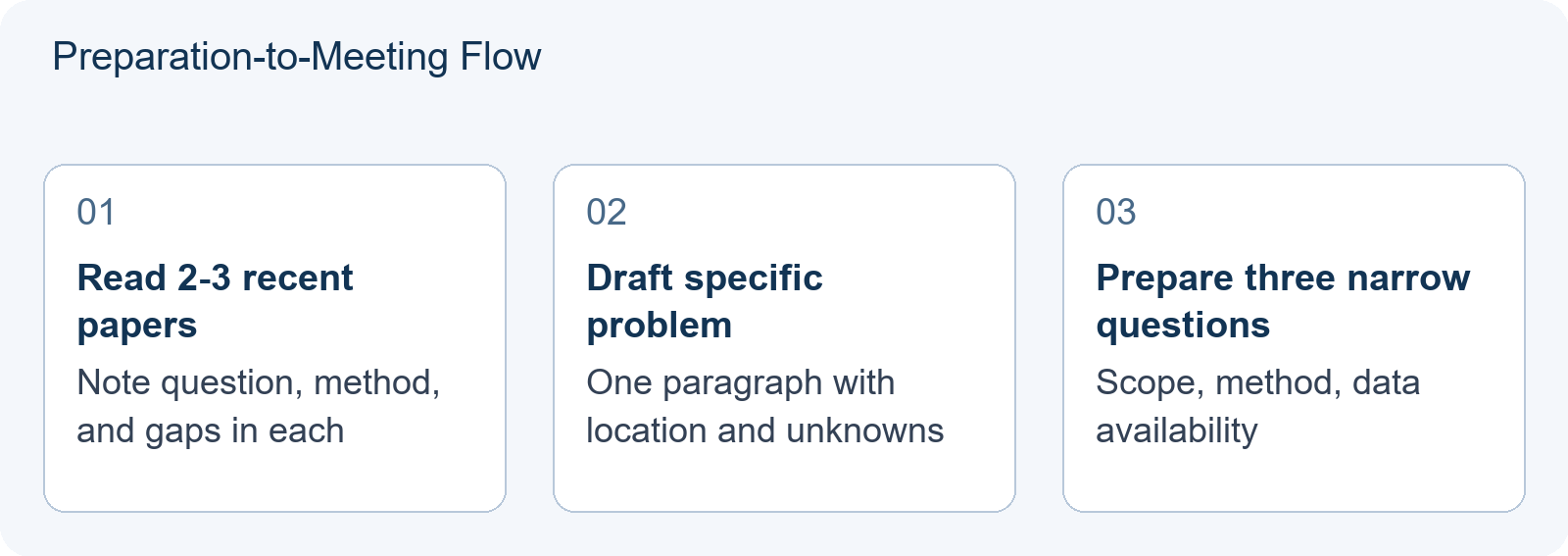
Based on the patterns above, here is a targeted sequence you can complete in the week before a first mentorship meeting:
- Read two to three recent papers in your area of interest. Not textbooks from five years ago—actual recent research. Note the structure: what question did the authors ask, what method did they use, what limitation did they acknowledge?
- Write one paragraph describing a specific problem you have observed or read about. Include where it occurs, why it matters, and what you do not yet know.
- Prepare three questions that are narrow enough to answer in conversation. Examples: "Is this problem too large for a high school project?" "Which of these two methods seems more appropriate?" "What data would I need, and is it publicly available?"
- Bring a notebook or device to record the mentor's responses and your own follow-up tasks. The meeting is only as good as your record of it.
For students considering how research mentorship connects to specific competitions, understanding category requirements early helps focus your preparation. Students at schools with established research cultures often begin this process earlier; for perspective on one such environment, see A student experience at Shanghai Concordia Gubei.
What Skill You Should Demonstrate Next
After a well-prepared first meeting, the student should be able to articulate: a refined question, a plausible method, and a specific data or literature gap that will occupy the next two to four weeks. If you cannot state these three things at the end of the meeting, either your preparation was insufficient or the mentor's guidance was unclear. In either case, the remedy is the same: return to the preparation sequence above, fill the gaps, and request a follow-up.
The goal of research project mentorship is not to receive a finished project from your mentor. It is to develop the capacity to define and pursue your own questions with increasing independence. The first meeting sets the trajectory for everything that follows.
Preparing Your Own Materials: A Non-Salesy Checklist
If you are unsure whether your materials are ready, use this decision framework before contacting a mentor or program:
- Can I state my interest in one sentence that names a specific system, population, or phenomenon?
- Have I found at least one recent paper that addresses something adjacent to my interest?
- Do I have a written note of what confused me in that paper?
- Can I name one source of data or observation that might be relevant?
- Do I know what I want from the meeting—feedback on scope, method, feasibility, or something else?
If you answer "no" to more than one item, delay the meeting and complete the preparation sequence. A mentor's time is most valuable when it builds on your own prior effort.
Frequently Asked Questions
How much reading is enough before a first meeting?
Two to three recent papers in your area of interest is usually sufficient. The goal is not mastery but enough exposure to identify what you do not understand and to ask specific questions about scope and method.
What if I cannot find papers I understand?
Start with review articles or the introduction sections of research papers. If you still struggle, bring your confusion to the meeting as one of your three questions. The mentor can then guide your reading strategy.
Should I bring a full research proposal to the first meeting?
No. A full proposal is usually premature and may commit you to an unworkable path. Bring a specific problem description and questions, not a locked plan. The mentor's role is to help you refine direction, not approve a finished design.