
For many high school students, the American Mathematics Competitions (AMC) represent a prestigious gateway to advanced mathematical recognition. However, a common dilemma arises for Grade 10 students: should they take AMC 10 or jump straight into AMC 12? This decision impacts not just your immediate score potential but also your long-term preparation strategy for the AIME (American Invitational Mathematics Examination).
Understanding the Eligibility Rules
The primary distinction lies in grade level. According to the standard competition framework, AMC 10 is open to students in Grade 10 and below. In contrast, AMC 12 is available to students in Grade 12 and below. This means that while a Grade 10 student is eligible for both, the choice is strategic rather than mandatory.
| Feature | AMC 10 | AMC 12 |
|---|---|---|
| Eligible Grades | 10 and below | 12 and below |
| Question Count | 25 Multiple Choice | 25 Multiple Choice |
| Time Limit | 75 Minutes | 75 Minutes |
| Max Score | 150 Points | 150 Points |
| Scoring System | +6 Correct, +1.5 Blank, 0 Wrong | +6 Correct, +1.5 Blank, 0 Wrong |
Content Differences: What Changes?
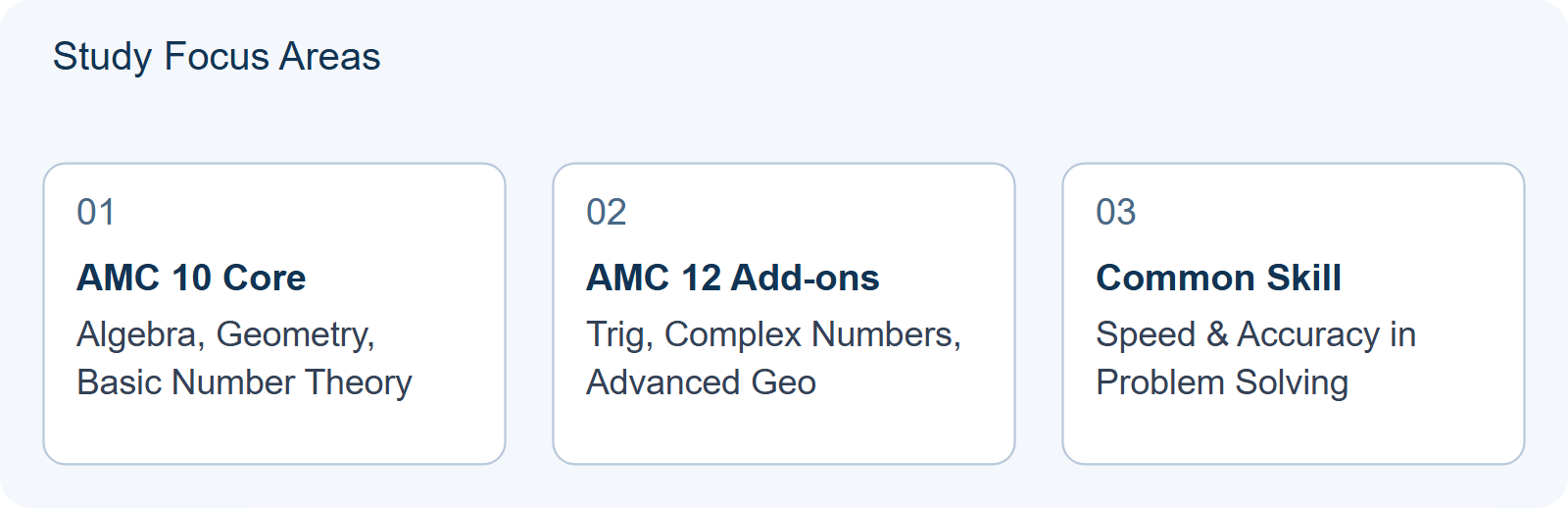
While both exams share a similar format, the scope of mathematics tested differs significantly. AMC 10 focuses on algebra, geometry, number theory, and counting/probability at a pre-calculus level. It tests fundamental problem-solving skills without requiring advanced trigonometric identities or complex logarithmic functions.
AMC 12, however, expands this scope. It includes everything in AMC 10 but adds topics such as:
- Advanced Algebra: Trigonometry, logarithms, and complex numbers.
- Advanced Geometry: Conic sections and more complex spatial reasoning.
- Advanced Number Theory: Euler’s theorem and Chinese Remainder Theorem concepts.
Notably, neither exam typically covers calculus or linear algebra, keeping the focus on discrete mathematics and classical geometry.
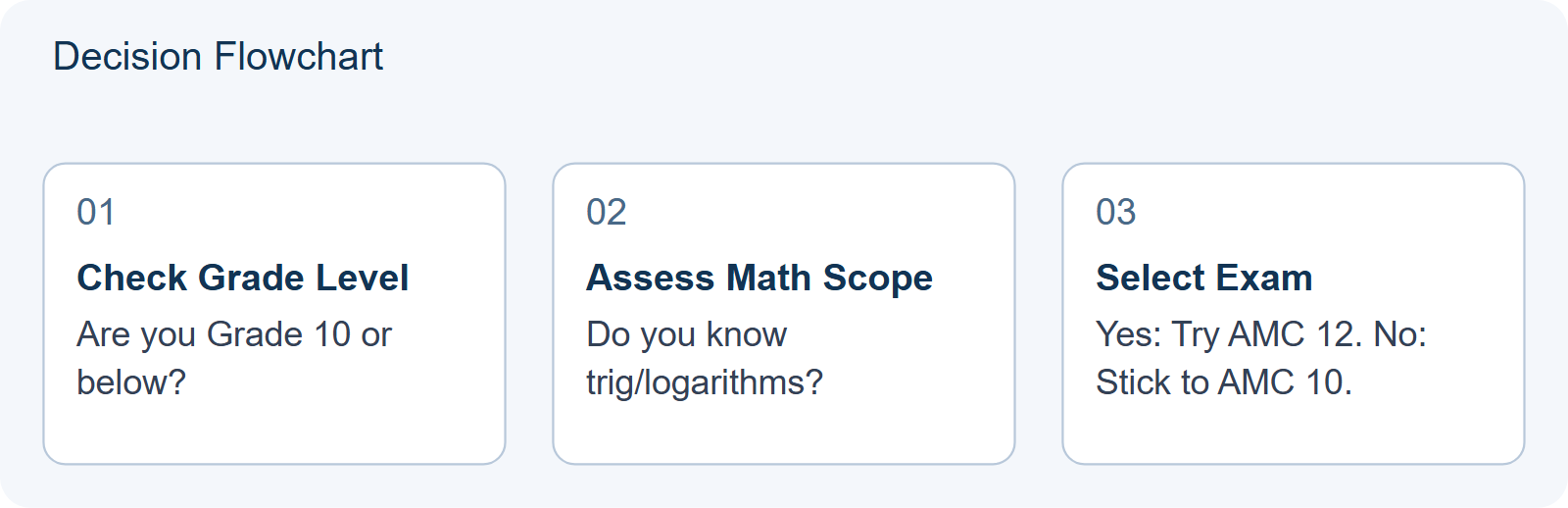
Strategic Considerations for Grade 10 Students
Choosing between the two requires an honest assessment of your current mathematical toolkit. Here are three scenarios to help you decide:
Scenario 1: The Strong Foundation Student
If you have mastered basic algebra and geometry but have limited exposure to trigonometry or complex numbers, AMC 10 is the safer route. You can aim for a high score (Top 5% or Top 1%) which qualifies you for the AIME. A strong AMC 10 score demonstrates proficiency without risking a low score due to unfamiliar topics.
Scenario 2: The Advanced Learner
If you have already studied pre-calculus topics, including trigonometric identities and logarithmic functions, AMC 12 might be appropriate. Some Grade 10 students who are ahead in their curriculum find AMC 10 too easy and prefer the challenge of AMC 12. However, be aware that AMC 12 problems can be more time-consuming and conceptually dense.
Scenario 3: The Dual-Entry Strategy
Many students choose to take both forms if available (Form A and Form B). If you are unsure, taking AMC 10 first allows you to gauge your speed and accuracy. If you perform exceptionally well, you might consider attempting AMC 12 in subsequent years or during the same season if scheduling permits.
Preparation Tips from Certified Coaches
At Hanlin, our certified AMC coaches emphasize that preparation is less about memorizing formulas and more about developing logical intuition. Here are actionable steps:
- Past Paper Analysis: Work through previous years’ papers under timed conditions. Identify whether your errors stem from calculation mistakes or conceptual gaps.
- Topic-Specific Drills: For AMC 10, focus heavily on combinatorics and geometry proofs. For AMC 12, ensure you are comfortable with function transformations and trigonometric applications.
- Mock Exams: Use platforms like Hanlin’s online simulation tools to replicate the pressure of the 75-minute window. Immediate feedback helps pinpoint weak areas.
Remember, the goal is not just to qualify for AIME but to build a robust mathematical foundation. Whether you choose AMC 10 or AMC 12, consistent practice and guided instruction are key to success.
HYPOTHETICAL/ILLUSTRATIVE: The "Trig Trap" Decision Case
To apply the strategic considerations above, consider a hypothetical student named Alex. Alex is in Grade 10 and has consistently scored above 120 on practice AMC 10 papers. However, Alex’s school curriculum has not yet introduced trigonometric identities or complex numbers. Alex faces a choice: stick with the familiar AMC 10 format to maximize score potential, or attempt AMC 12 to test advanced readiness.
Choice A: The Safe AMC 10 Route
Alex prepares exclusively for AMC 10 topics. During a timed mock exam, Alex solves 20 problems correctly but struggles with speed on combinatorics questions. By focusing on time management drills for counting problems, Alex aims for a Top 5% finish. This route leverages existing strengths and minimizes risk from unknown content areas.
Choice B: The Ambitious AMC 12 Route
Alex attempts to self-study basic trigonometry before the exam. In a mock AMC 12 paper, Alex encounters a problem requiring the Law of Cosines. Without solid foundational knowledge, Alex spends five minutes guessing, causing a cascade of rushed errors on subsequent geometry questions. The final score drops significantly below the AIME qualification threshold due to unfamiliarity rather than lack of logical skill.
| Decision Factor | AMC 10 Strategy (Alex) | AMC 12 Strategy (Alex) |
|---|---|---|
| Content Gap Risk | Low: Topics align with current coursework. | High: Requires external study of pre-calc concepts. |
| Time Management Impact | Manageable: Focus on speed in known areas. | Disruptive: Unfamiliar formulas cause hesitation. |
| AIME Qualification Probability | Higher: Based on demonstrated proficiency. | Lower: Dependent on rapid mastery of new topics. |
What Changes the Decision?
The pivotal factor here is not raw intelligence, but curricular alignment. If Alex had already completed a pre-calculus course covering trigonometric functions, Choice B would become viable. The decision shifts when the student can solve AMC 12-specific problems without pausing to recall definitions. Another changing factor is the penalty structure: since wrong answers yield zero points while blanks yield partial credit, guessing on an unfamiliar AMC 12 topic is strategically inferior to leaving it blank, which directly impacts the total score more severely than missing a difficult AMC 10 question.
Reusable Self-Check
Before finalizing your route, perform this diagnostic:
- The Formula Recall Test: Can you instantly write down the area formula for a triangle using sine, or the definition of a logarithm? If no, you are likely underprepared for AMC 12.
- The Time Cost Analysis: Take one past AMC 12 paper. Identify how many minutes you spend on questions involving topics outside your current syllabus. If this exceeds 15 minutes, your score ceiling is artificially lowered by knowledge gaps, not reasoning ability.
- The Confidence Metric: Do you feel anxious about specific topics, or just challenged by difficulty? Anxiety about unknown content suggests sticking to AMC 10 allows you to compete on equal footing with peers who share your curricular background.
This illustrative case demonstrates that choosing AMC 12 should be based on verified competency in extended topics, not merely on high performance in standard algebra. For most Grade 10 students, mastering the depth of AMC 10 provides a stronger foundation for future AIME success than struggling through breadth in AMC 12.
Preparing for AMC10 versus AMC12 requires more than just solving problems; it demands a strategic understanding of mathematical depth. Educators often bridge algorithmic thinking with mathematics teaching approaches, helping students navigate complex concepts effectively. Early mastery, such as achieving four AP scores of 5 in Grade 8, demonstrates the value of structured preparation. Furthermore, aligning competition study with broader academic goals is essential, especially when considering the overview of the 2027 AP reforms that may influence future course planning and student trajectories.
Frequently Asked Questions
Can I take both AMC 10 and AMC 12?
Generally, students register for one version (Version A or Version B) of either AMC 10 or AMC 12. Taking both exams in the same season is rare and depends on specific registration policies; most students choose one based on their grade and comfort level.
Is AMC 12 harder than AMC 10?
Yes, AMC 12 covers a broader range of topics, including advanced algebra and trigonometry. However, some early questions may overlap. The difficulty spike usually occurs in the middle-to-late questions where specialized knowledge is required.
What is the benefit of choosing AMC 10 over AMC 12?
For Grade 10 students, AMC 10 aligns better with typical curriculum progress. It reduces the risk of encountering unknown topics, allowing you to maximize your score and potentially qualify for AIME with greater confidence.