
The 2026 China Junior Physics Challenge (JPC) takes place on Saturday, 21 November 2026, from 14:00 to 14:50. The China-region organiser page lists the British Physics Olympiad and ASDAN China; ASEEDER publishes the current schedule. This bilingual English/Chinese competition invites students in grades 7–9 to tackle 60 multiple-choice questions spanning dynamics, electricity, optics, heat, units, waves, astronomy, and general physics knowledge including history. With only 50 minutes on the clock, candidates average roughly 50 seconds per question—a planning average that makes quick recognition valuable.
At Hanlin International Education, our coaching approach treats the JPC as a timed recognition exercise rather than a deep derivation test. We teach students to identify which questions deserve their attention and which rely on a single conceptual hook. This four-week plan translates that approach into daily practice.
Week 1: Establish Your Baseline and Map Your Gaps
Begin with a full timed diagnostic set of topic-matched junior physics multiple-choice questions. The goal is not your score; it is the data behind your score.
Run the diagnostic under competition conditions: 50 minutes, no interruptions, answer sheet only. Immediately after, classify every error into three columns:
| Error Category | What It Looks Like | Typical Fix |
|---|---|---|
| Knowledge Gap | Wrong concept or formula applied | Rebuild with textbook chapter + 5 similar drills |
| Reading/Pace | Misread question; rushed and guessed | Annotate stems; practise 30-second first-pass triage |
| Careless Slip | Arithmetic, unit, or sign error | Structured check step; slow down on "easy" items |
Track topic distribution separately. If your errors cluster in astronomy or physics history—areas often underrepresented in school curricula—flag them for deliberate coverage in week two.
Week 2: Targeted Drills by Topic and Skill
Split your practice into two daily sessions of 25 minutes each. Morning sessions target weak topics; evening sessions reinforce strengths to build automaticity.
For knowledge gaps, work in topic blocks: one day on dynamics (Newton's laws, energy conservation, circular motion), another on electricity (Ohm's law, simple circuits, power), then optics (lens rules, colour, reflection/refraction), heat (specific heat, phase changes, gas laws qualitatively), waves (frequency, wavelength, speed relationships), and astronomy (solar system scales, orbital basics, historical models). Hanlin's coaching approach includes deliberate coverage of astronomy, history, and everyday physics contexts—areas where school preparation often thins.
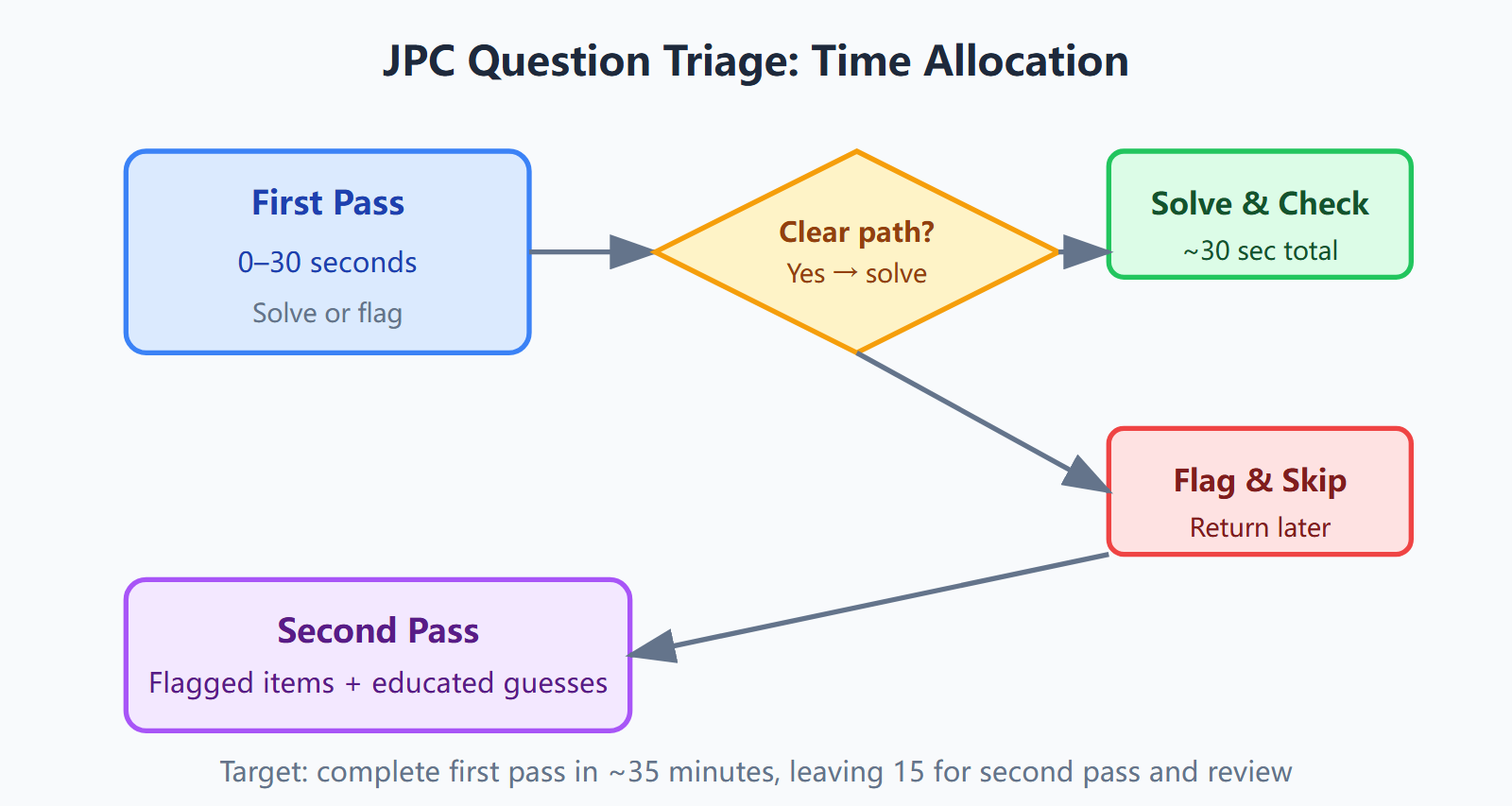
For reading and pace errors, practise this triage method:
- First 10 seconds: Identify the physics domain and whether the question is conceptual or numerical.
- Next 20 seconds: If a clear path exists, execute it. If not, mark and move.
- Final 20 seconds (on revisit): Eliminate obviously wrong options; make an educated selection.
Do not linger beyond 60 seconds on any single item during practice. The habit of moving on preserves time for questions you can solve confidently.
Week 3: Full-Length Rehearsals and Pattern Recognition
By week three, shift to complete 60-question sets under full competition conditions. Space these every other day to allow recovery and analysis. On off days, review error logs and run short 15-question drills on persistent weak spots.
During rehearsals, practise these specific recognition patterns that Hanlin coaches observe on the JPC:
- Unit trap questions: Answers differ only by powers of ten or unit conversions (km/h vs m/s). Verify dimensions before calculating.
- Everyday physics contexts: Scenarios involving bicycles, kitchen appliances, or sports equipment. The physics is standard; the framing is unfamiliar.
- Astronomy scale questions: Order-of-magnitude comparisons (Earth-Moon distance vs Earth-Sun distance) that reward memorised reference values.
- Historical figure matching: Associating a named scientist with a discovery or experiment; practise checking the source of each attribution.
Track your timing per quarter: questions 1–15, 16–30, 31–45, and 46–60. Many students slow dramatically in the middle third as fatigue sets in. If this pattern appears, insert a deliberate 10-second reset breath after question 30.
Week 4: Sharpen and Stabilise
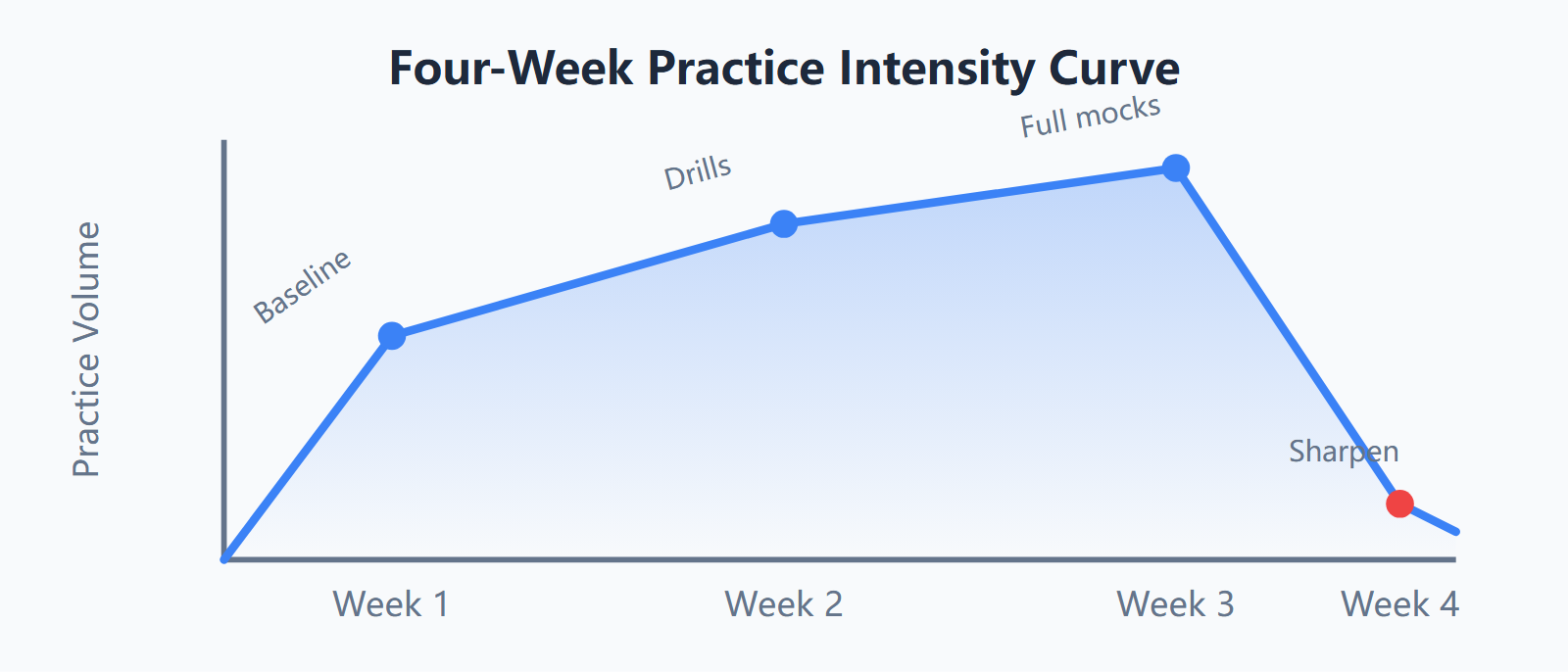
The final week reduces volume and increases specificity. Run one final full timed set early in the week—no more. Spend remaining days on:
- Reviewing organised error logs (your personal "do not repeat" list)
- Memorising key constants and conversion factors
- Practising 10-question rapid-fire sets at slightly faster than competition pace to build comfort margin
The Final 48 Hours: What Actually Helps
The last two days before the competition reward restraint over cramming.
48 hours before: Complete a light 20-question review set focused exclusively on your strongest topics. The goal is confidence maintenance, not new learning. Confirm the venue, arrival time, and permitted equipment with your school or organiser.
24 hours before: No timed practice. Review your error log once, then set materials aside. Prioritise sleep quantity and regularity—cognitive performance degrades measurably with even modest sleep debt.
Day of: Arrive early. During the competition, use your two-pass strategy. If a question resists after about 60 seconds, flag it and move on; return to it if time remains. Follow the organiser's current answer and scoring instructions.
Frequently Asked Questions
What format and final should China-region JPC entrants prepare for?
ASEEDER's current China-region page specifies a bilingual 50-minute paper with 60 multiple-choice questions for grades 7–9 on 21 November 2026. It also describes a separate later final with experiments. Check the organiser's current page for the rules of the region in which you will participate.
Should I study differently for the astronomy and history questions?
Yes. These questions reward factual recall and conceptual familiarity more than calculation. We recommend building a personal reference sheet of key figures (e.g., Galileo, Newton, Maxwell, Curie), pivotal experiments, and astronomical scales. Hanlin's coaching approach includes deliberate coverage of these areas because standard school curricula often underemphasise them.
Is 50 seconds per question a strict rule?
No. The 50-second figure is a planning average (50 minutes ÷ 60 questions). In practice, some questions require 20 seconds; others deserve 90. The two-pass strategy described above accommodates this variation by front-loading quick wins and reserving time for complex items.
Related Competitions and Next Steps
Students who enjoy the JPC's pace and topical breadth may also consider the British Physics Olympiad (BPhO) for deeper problem-solving challenges, or the Junior BAAO for astronomy-focused competition. Hanlin's JPC competition page documents our coaching observations on timed recognition, topic coverage, and placement testing to set appropriate course tiers.
Source Note
Official competition details verified from ASEEDER (checked 28 September 2026): https://www.seedasdan.asia/en/jpc-en/. Hanlin coaching observations documented at https://en.hanlin.com/competitions/jpc.