
If you are planning for the IEO preliminary round, a practical question is not “How many past papers can I finish?” but “How should I divide the first block of preparation hours among economics theory, financial literacy and business-case reasoning?” A useful starting answer is to treat 36 hours as a planning envelope, not an official requirement. Hanlin’s 28 October 2026 course report, “10 Outstanding Coach Certificates and Global Championship Results: Hanlin’s Economics and Business Strength” (Hanlin Courses WeChat; translated from Chinese), lists an IEO preliminary class of 36 hours in a 3–8 student format and an in-house IEO Economics Notes resource. The same report describes IEO as covering economics, financial literacy and business-case analysis, and as testing theoretical foundations, logical analysis and application. Those are Hanlin’s published preparation descriptions, not a substitute for the current season’s official rules. Check the current official IEO or operator page for the actual round structure, eligibility and scoring before finalising any plan. This is an independent preparation discussion, not official IEO guidance.
Use the 36-hour figure as an envelope, not a rule
The 36-hour reference is useful because it forces a budget. It is not useful if it becomes a promise that every student needs exactly 36 hours, or that 36 hours guarantees a particular result. The source reports a class format, not an official preparation requirement. A student with strong microeconomics but slow case reading may need a different distribution from a student who can read cases quickly but loses marks on definitions and diagrams.
Before allocating hours, separate three questions: what does the current official format actually require; what does the student’s marked work show; and what can the family realistically schedule? A plan that ignores the official format is guesswork. A plan that ignores the marked work is generic. A plan that ignores the calendar is likely to be abandoned. The 36-hour envelope belongs after those three checks, not before them.
If you are still deciding between related routes, the existing IEO vs IEOC: A Route Map for Selection Pages and Preparation handles selection-page navigation. This article assumes the IEO preliminary route has been chosen and focuses on how to organise the first preparation block.
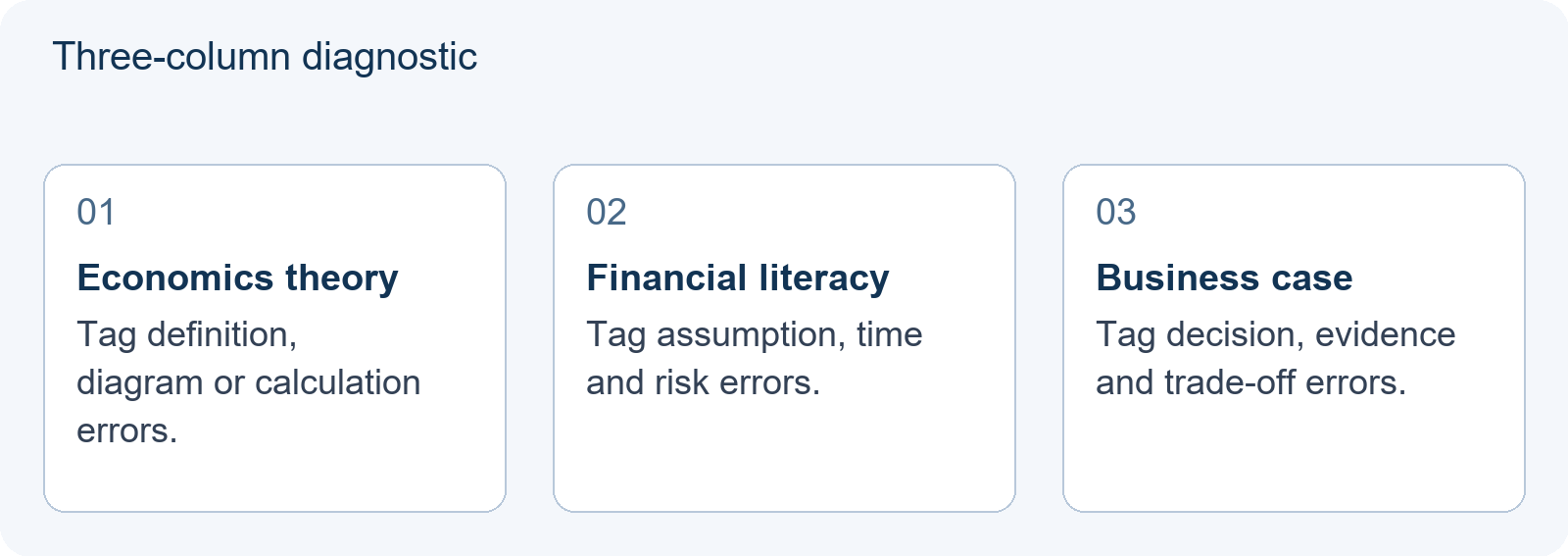
Build a three-column diagnostic before buying more resources
Do not reduce a mixed set to one percentage. Use three columns that match the demands described in the Hanlin report: economics theory, financial literacy, and business-case reasoning. A short mixed set of about 45 minutes is enough for a first diagnostic, or use recently marked work you already have. The goal is not a precise score; it is a first error profile.
| Column | What to record | First repair question |
|---|---|---|
| Economics theory | Definition confusion, diagram shift versus movement, calculation slip, multi-step application break | Did the student name the changed variable before choosing a model? |
| Financial literacy | Missing assumption, time-horizon error, risk or constraint ignored, comparison on inconsistent basis | Can the student state the decision, time period and constraint in one sentence? |
| Business case | Unclear decision, evidence not tied to the brief, trade-off omitted, recommendation too general | Does each paragraph answer the case question rather than summarise the case? |
Label the first diagnosis “provisional.” One short set can show a pattern, but it cannot distinguish a careless slip from a missing concept. Re-mark a second short set after the first repair block. For a separate example of a diagnostic-first routine in another economics competition, see the existing LSESU Economics Challenge 2027: A Quantitative Diagnostic Before Topic Revision; do not transfer its rules to IEO.
Economics block: separate definitions, diagrams and calculations
Teaching illustration, not a contest problem. A student sees the price of coffee rise and quantity bought fall, then writes “demand decreased.” The statement is incomplete. If only the good’s own price changed, the demand curve has not shifted; the observed fall is a movement along the demand curve, a fall in quantity demanded. A demand shift requires a non-price determinant, such as a rise in consumer income for a normal good, which shifts demand to the right.
The repair is not “learn more demand.” It is a checking habit: before writing “shift” or “movement,” circle the variable that changed. If it is the good’s own price, start with movement along the curve. If it is income, tastes, prices of related goods or another non-price determinant, ask whether a shift is justified. In the review log, record the error as “diagram/definition,” not simply “economics.” That distinction determines whether the next hour should be spent redrawing curves or re-reading definitions.
A second student may calculate equilibrium price correctly but lose the final mark because the answer does not state the direction of the shift and the resulting change in both price and quantity. The fix is a three-line answer template: determinant, curve shift, new equilibrium comparison. This is a coaching judgment, not an official mark scheme. It is still useful because it turns a vague “be clearer” instruction into a repeatable check.
Financial-literacy block: write the assumption before the answer
Teaching illustration, not a contest problem. Compare two one-year options for 1,000. Option A pays 5% simple annual interest: 1,000 × 1.05 = 1,050. Option B pays 4.8% nominal annual interest compounded monthly: 1,000 × (1 + 0.048/12)^12. The monthly rate is 0.004, and the year-end value is approximately 1,049.07. Option A is slightly higher by about 0.93 in this simplified comparison.
The arithmetic matters, but the financial-literacy point is the assumption statement. The comparison assumes no fees, no early withdrawal, a full one-year horizon, and reinvestment of monthly interest in Option B at the same rate. Change the horizon or introduce a penalty, and the ranking may change. A student who writes only “B because compounding” has noticed a feature but skipped the decision context.
A complete answer states four things: the decision, the time horizon, the constraint or risk, and the comparison basis. For example: “For money needed in exactly one year, with no access before then, A pays 1,050 and B pays about 1,049.07; A is marginally higher under these assumptions.” That sentence names the assumptions; a longer paragraph that never names them remains incomplete. In review, mark missing assumptions separately from calculation slips. They require different practice.
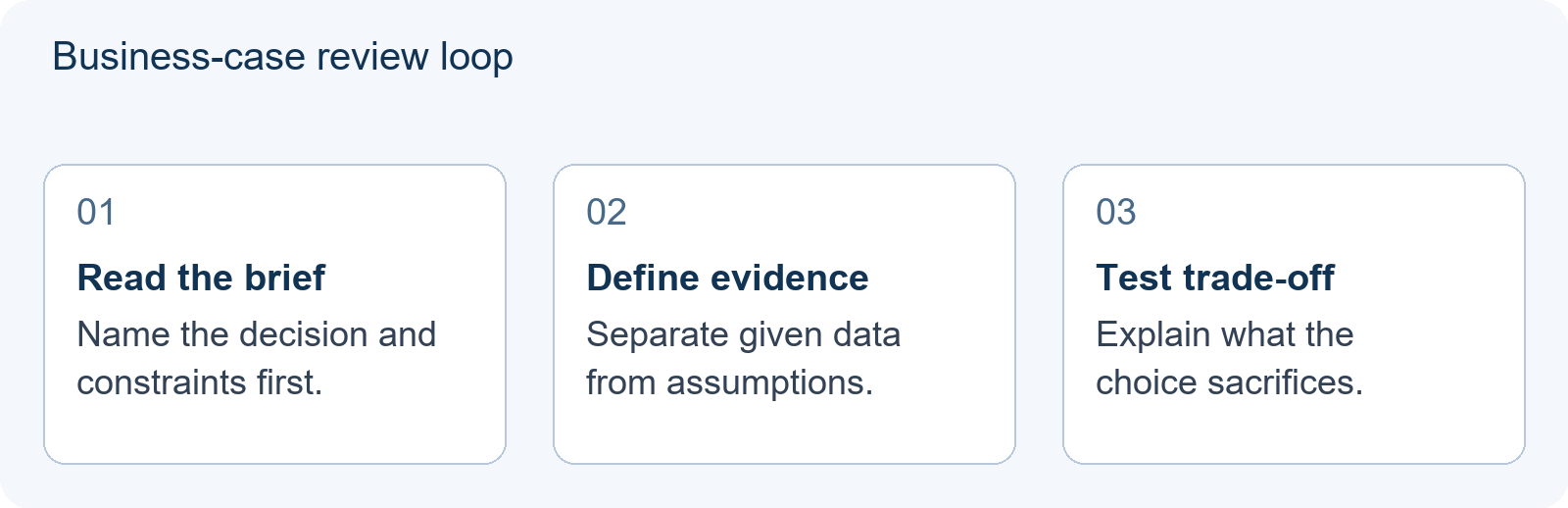
Business-case block: use a read-define-evidence-trade-off loop
Teaching illustration, not a contest problem. A local bakery is considering a 5% price increase next quarter. An incomplete answer lists generic advantages and disadvantages of raising prices. A complete answer first defines the decision: should the bakery raise its main product price by 5% next quarter, given local competition and limited seating capacity? It then separates given evidence from assumptions: current sales volumes, customer complaints, supplier costs and competitor prices are evidence; “customers will not mind” is an assumption that needs support.
Next, the answer tests the trade-off. A higher price may improve margin per item, but it may also reduce volume, ease capacity pressure or damage repeat customer demand. The recommendation should be conditional: raise the price only if the evidence shows low sensitivity among repeat customers and if capacity is the binding constraint; otherwise test a smaller increase or a different product line. This is not a full case solution, but it demonstrates the loop.
One failure mode is turning the case into a general essay about the industry. The correction is to make every paragraph answer the case question. If a paragraph does not identify a decision, use evidence, explain a trade-off, or offer a recommendation, it probably belongs in a plan rather than in the answer. During review, code each paragraph with one of these four labels: decision, evidence, trade-off, or recommendation. Paragraphs with no label are candidates for deletion or rewriting.
A sample 36-hour split for one hypothetical student
The following is a teaching illustration, not official scoring guidance and not a claim that this split fits every student. It shows how the 36-hour Hanlin course reference can be converted into a diagnostic-based plan after the first error profile.
| Block | Hypothetical hours | Purpose | Exit check |
|---|---|---|---|
| Economics theory | 16 | Definitions, diagrams, calculation chains and multi-step application | Can explain a shift versus a movement without prompts |
| Financial literacy | 10 | Time, risk, constraints and assumption statements | Writes the comparison basis before calculating |
| Business case | 8 | Decision, evidence and trade-off paragraphs | Every paragraph has a case function |
| Mixed review | 2 | Re-mark short mixed work and update the error log | Error categories change or the plan changes |
For this hypothetical student, economics is the largest block because the diagnostic showed repeated diagram and calculation breaks. A different student with strong theory but weak assumption statements might move two hours from economics to financial literacy. A student whose case paragraphs repeatedly miss the decision might keep eight case hours but change the review routine rather than simply adding more reading. The point is not the exact numbers; it is that the split follows evidence.
Review cycle: move hours only when the error category changes
After each block, re-mark a short mixed set. Do not ask only “Did the score go up?” Ask whether the same error category appeared again. If diagram errors fall but calculation errors remain, the next economics hour should change focus. If financial-literacy answers now state assumptions but still miscompare time horizons, the repair is narrower. If business-case paragraphs still summarise instead of deciding, more case reading without a paragraph-level check is a weak use of additional time.
Move hours only when the evidence changes. A student who improves from “missing definition” to “correct definition but incomplete application” has changed category and may need application practice rather than more definition review. A student who repeats the same case-reading error across two review cycles needs external feedback, not another solo attempt. The existing IEO National Training Team selection criteria: Preparing for Published Rules Beyond Scores article is relevant if the longer-term question is how published rules and selection stages fit together; it is not a substitute for the current preliminary-round format.
What to bring to a preparation conversation
A useful preparation conversation starts with evidence, not with “What course should I buy?” Bring four items: a one-page diagnostic table with the three error columns; two short marked sets from different dates; one business-case outline with paragraph labels; and a realistic weekly calendar. Ask whether the 36-hour envelope should be adjusted for the observed error profile, and which block should be protected if the calendar becomes tight.
This checklist is a reader preparation aid, not a description of a standard Hanlin service. It also does not replace official rules. If the current official format, eligibility or scoring is unclear, resolve that first. A plan built on an unverified format is not a plan; it is a schedule for the wrong task.
General event background is available at Event background.
Frequently Asked Questions
Is 36 hours an official IEO preliminary requirement?
No. The 36-hour figure comes from Hanlin’s 28 October 2026 course report, which lists an IEO preliminary class of 36 hours in a 3–8 student format. It is a planning reference, not an official requirement. Check the current official IEO or operator page for the actual format, eligibility and scoring.
Should every student use the 16/10/8/2 hour split?
No. That split is a teaching illustration for one hypothetical student. A real plan should follow a three-column diagnostic of economics theory, financial literacy and business-case errors. Hours should move when the evidence shows that the error category has changed.
When is it time to seek external feedback?
Seek feedback when the same case-reading, quantitative setup or assumption error repeats across two review cycles. Bring marked work, the error log and the current plan so the feedback can address the pattern rather than only the latest score.