
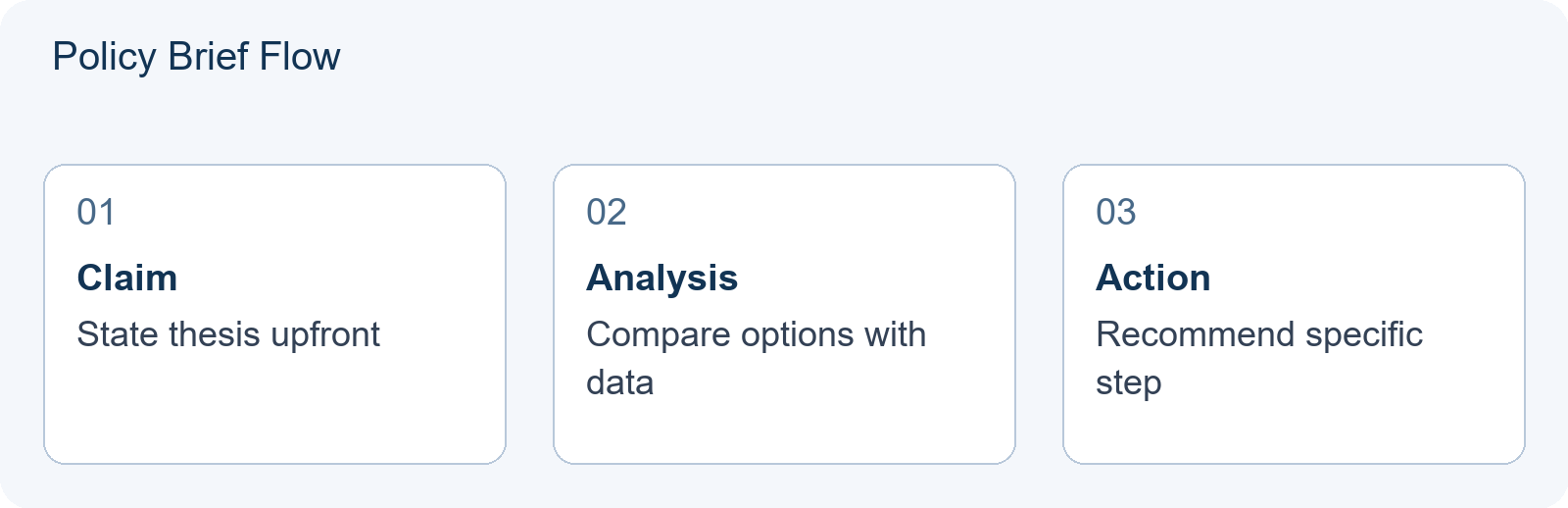
If you are preparing for the HIR Academic Writing Contest — the Harvard International Review's student writing challenge — the single most useful editorial move is to stop drafting it like a school essay and start drafting it like a short policy brief: one headline claim, a defined problem, a comparison of options, and one recommendation. The seven-part structure below gives you a drafting scaffold you can reuse across prompts. The supplied Hanlin source notes do not include an official HIR rubric or registration workflow, so treat this framework as a coaching judgment about how to organise global-affairs writing — not as an official scoring guide.
Why a Policy-Brief Structure Helps HIR-Style Drafts
A common first draft treats an HIR prompt as a question to be answered with a narrative arc. School essays often reward exploration, ambiguity, and personal reflection. Global-affairs writing — the genre the Harvard International Review is known for — usually reads more cleanly when the writer commits early to a position and then defends it with evidence. That is a teaching judgment about audience and genre, not a claim about an official HIR rubric.
Compare the same underlying content drafted in two ways:
- Exploratory opening: “The impact of climate change on coastal cities is complex and multifaceted. While some argue for adaptation, others suggest mitigation. This essay will explore both sides…”
- Policy-brief opening: “Coastal cities face rising infrastructure risk from sea-level rise. Current adaptation spending is misallocated. A hybrid green–grey investment prioritised by population density would reduce expected damages per dollar of public spending.”
The second version gives the reader a thesis, a mechanism, and a criterion for judging the argument. Even when the underlying research is identical, the policy-brief framing is easier for an editor to evaluate because every paragraph answers a predictable question: what is the problem, what are the options, and what should be done?
The Seven-Part Policy-Brief Structure
Use this sequence when you outline a global-issue draft. Each section has one job; if a paragraph cannot be assigned to a section, it probably does not belong in the draft.
1. Headline Claim
State your central thesis in the first sentence or two. Avoid “This paper discusses…” Use active language: “To reduce X, policymakers should do Y, because Z.” The headline claim should be falsifiable — a reader should be able to disagree with it.
2. Problem Definition
Define the scope of the issue. Who is affected? Where? Over what time horizon? Add one or two concrete quantities if you have them, with the year and source. A problem statement that could apply to any country at any time is too vague to anchor an argument.
3. Background Context
Give the reader only the context needed to follow the argument. Assume an intelligent generalist. Define technical terms on first use. Historical narrative that does not feed directly into the analysis should be cut — it consumes word budget you need for the options and the recommendation.
4. Options Analysis
This is the analytical centre. Present at least two alternatives and evaluate each on the same criteria — feasibility, cost, speed, distributional effects, or whatever your argument actually turns on. The goal is not to appear neutral; it is to show that you considered the main alternative before recommending one.
5. Recommendation
State your preferred solution in one sentence, then operationalise it. “Improve education” is a theme; “prioritise applied statistics instruction in districts with fewer than X qualified teachers per thousand students” is a recommendation. Specificity is what separates policy briefs from opinion pieces.
6. Limitations
Acknowledge the weaknesses of your own proposal. Political feasibility, data gaps, unintended consequences, and enforcement costs all count. Admitting limitations is not the same as retracting the recommendation; it is evidence that you understand how the proposal would land in practice.
7. Counterargument
Name the strongest objection a well-informed reader would raise, and answer it directly. Do not strawman. If you cannot answer the objection, adjust the recommendation rather than the objection.
Teaching Illustration: A Global-Issue Prompt Outlined as a Brief
The table below is a teaching illustration — an invented prompt and an invented outline, used only to show how the seven sections connect. It is not a past HIR prompt and is not drawn from any official contest material. The rows deliberately avoid invented statistics; if you want numbers in your own draft, source each one.
| Section | Illustrative Function (teaching example) |
|---|---|
| Headline | Nations should prioritise algorithmic transparency over content removal to address platform-amplified misinformation. |
| Problem | Current removal policies raise free-expression concerns and rarely reduce reposts; independent audits remain uncommon. |
| Background | Short definition of misinformation, existing regulatory models, and the free-expression trade-off. |
| Options | Option A: state-led content removal. Option B: mandated third-party algorithm audits with published compliance reports. |
| Recommendation | Adopt Option B. Publish audit summaries; exempt small platforms below a stated size threshold. |
| Limitations | Audit staffing is scarce; cross-border enforcement requires treaty-level cooperation. |
| Counterargument | Critics argue audits leak proprietary code. Respond by specifying anonymised audit logs and legal confidentiality. |
Notice two things about the illustration. First, the recommendation is derived from the options analysis, not announced at the start. Second, no fabricated quantity is required to make the argument — only a clear mechanism. If you want to add a statistic, source it.
Diagnostic: Does Each Paragraph Advance the Argument?
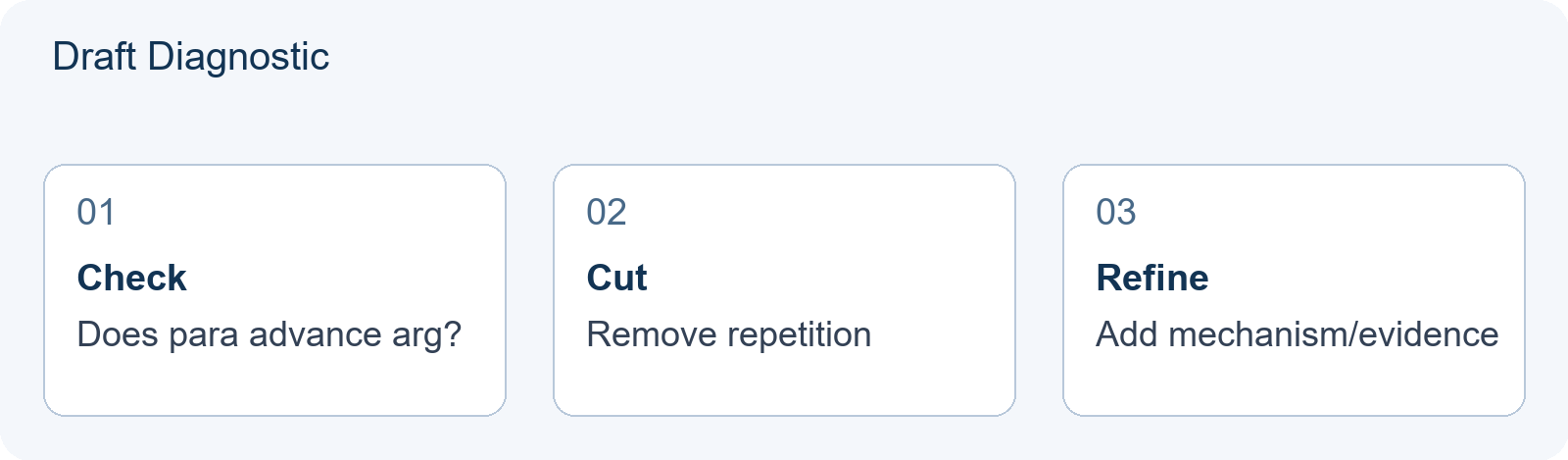
After drafting, read each paragraph and write a one-sentence summary in the margin. Then classify it:
- Keep: the paragraph introduces new evidence that supports the recommendation.
- Cut: the paragraph repeats background already stated, or introduces a new topic unrelated to the headline claim.
- Move: the paragraph is a counterargument that should sit next to the section it answers rather than at the end.
- Rewrite: the paragraph describes a problem without pointing to any option or trade-off.
This diagnostic is deliberately mechanical. It is easier to be honest about whether a paragraph serves the argument when you are not also judging your prose.
Evidence and Citation Habits
In a global-issue draft, evidence quality is what distinguishes a strong argument from an asserted one. Prefer primary documents, peer-reviewed research, and reports from recognised institutions over aggregated blog summaries. Where a claim rests on a single number, state the population, the year, and the source so a reader can track it.
Two habits are worth building early:
- Write the citation at the moment you draft the sentence, not later. Sentences that resist citing usually need rewriting.
- Separate your judgement from your evidence. “The data suggest X; in my reading, that means Y” is more credible than a single blended claim.
The supplied Hanlin notes do not contain HIR's current citation guidelines, so confirm the required style with the current official contest material before submitting.
Editing Pass: Cutting Abstraction and Adding Mechanism
Once the structure holds, edit for concreteness. Replace nominalisations with verbs: “the implementation of the policy” becomes “implementing the policy.” Insert a mechanism wherever you have written a value claim: if you say a proposal is “efficient”, name the channel through which efficiency is realised. Define specialised vocabulary on first use and shorten the recommendation section if it has drifted into restatement.
Read the draft aloud. Sentences you stumble over usually have too many clauses. Complex syntax often masks weak analysis; shorter syntax tends to expose it, which is exactly what you want in a final proof.
Why This Structure Suits HIR-Style Prompts
The Harvard International Review's student writing challenge is a global-affairs writing competition; that identity is what makes the policy-brief form a reasonable match for its prompts, because it puts the reader in the position of an informed decision-maker. This remains a coaching judgment, not a description of an official rubric. Against the supplied Hanlin source notes, the relevant first-party record is the 2026 mid-year results report (“2026 Hanlin Youfang Successes: Hundreds of Awards in Half a Year, National Team Selections, Global Perfect Scores…”, Hanlin Courses WeChat account, published 3 July 2026), which lists Harvard International Review Academic Writing Challenge outcomes for Hanlin and Dawen students — including a 2024 finalist defence participant and writing awards in 2023 and 2022. That record shows familiarity with the contest, but it does not include a registration workflow or published judging criteria, so we have not reproduced either here.
Next Steps
If you want structured feedback on a draft, ask a reviewer to check four things: is the headline claim falsifiable; does the options section compare the same criteria across each option; does the recommendation follow from the analysis; and does every paragraph survive the diagnostic. For broader context on combining writing competitions into a portfolio, see Academic Competition Portfolio: Showing Progress Across Several Related Activities. If your prompt sits closer to data-driven economic writing, the interest-test method in Economics competition preparation interest test: Try a 30-Minute Data Sprint may help you pick a viable topic. Readers arriving from philosophy-essay contests may find useful transferable advice in John Locke Essay Results: Turn Competition Feedback Into a Stronger Writing Portfolio.
Applying the Diagnostic to Your Own Draft
The seven-part structure is only useful if you can identify where your draft deviates from it. Use this three-step diagnostic on a current paragraph. First, highlight the sentence that states your central claim. If no sentence does this, your draft lacks a Headline Claim; rewrite the opening to assert a specific position rather than describing the topic. Second, check for mechanism. Does the paragraph explain how a proposed action leads to an outcome? If it lists benefits without explaining the causal link, it fails the Options Analysis requirement. Third, verify scope. Does the recommendation apply universally or to a defined group? A policy brief must specify who acts and under what conditions.
Diagnostic Example: Consider the sentence: "More funding for education will help students succeed." This fails all three checks. It has no falsifiable claim (what kind of success?), no mechanism (how does money translate to learning?), and no scope (which students?).
Revised Version (structural illustration, not an evidence claim): "A district with class sizes above a stated threshold should cap them at that threshold to improve individual attention, and the draft should cite evidence that the mechanism operates at that scale." This version defines the condition (class sizes above a stated threshold), points to a mechanism (individual attention), and limits the scope (the district), while making clear that supporting evidence must be supplied.
Next Practice Task: Take one paragraph from your current draft. Apply the three checks. Rewrite it to include a clear actor, a defined condition, and a causal mechanism. If you cannot find these elements, cut the paragraph and move to the next section.
General event background is available at Hanlin Education.
Frequently Asked Questions
Does the HIR contest judge creativity or structure?
The supplied Hanlin notes do not include the HIR rubric, so this article cannot describe official judging. As coaching guidance, the framework above prioritises structure because structure is diagnosable: you can check whether each paragraph advances the headline claim. Treat any preference for policy-brief style as a teaching recommendation, not a rule.
Can I use personal anecdotes in my draft?
Anecdotes can illustrate a broader point, but empirical evidence, expert sources, and explicit reasoning usually carry more weight in global-affairs writing. If you include one, keep it short and tie it to a claim the rest of the paragraph will substantiate.
How long should my HIR draft be?
Follow the current official HIR contest guidelines for word count; the supplied Hanlin notes do not contain them. Independently of the limit, keep every paragraph earning its space — this framework assumes brevity is an editorial virtue, not a formal requirement.