
What this article answers
Readers searching for the Harvard International Economics Essay Contest (HIEEC) usually already know it is an economics essay competition; what they lack is a way to choose and frame a topic that will reward analytical economic reasoning rather than a descriptive summary. This article supplies a six-part topic-selection framework, a diagnostic that distinguishes descriptive from analytical thesis statements, and a worked teaching illustration. It does not publish deadlines, word limits, question lists or judging criteria. Hanlin's publicly visible homepage material (hanlin.com, retrieved 2026-10-26) lists a 2027-titled HIEEC article under its latest news, confirming HIEEC as an economics essay competition in the site's own material, but it does not carry the organiser's procedural rules. Any rule question should be checked against the current official HIEEC source.
What can and cannot be confirmed here
Attribution first. The Hanlin homepage (Hanlin International Education Official Website, retrieved 2026-10-26) names HIEEC as an economics essay competition hosted by Harvard in a 2027-titled guide. That is the extent of the first-party confirmation available for this article. The same source does not list word limits, prompt categories, eligibility, submission windows or judging rubrics. A URL alone does not verify a rule, and missing information in a source note does not mean the organiser has not published something.
Because of that, everything below is offered as a writing clinic for economics essays in the HIEEC genre, not as a substitute for the current official HIEEC page. Where a claim depends on another competition's documented format, the source is named in place.
Where this preparation problem sits among related competitions
Students often meet HIEEC, the International Economics Olympiad (IEO) and the John Locke Essay Competition in the same competition round-up. They are not the same task, and confusing them wastes preparation time. The table below summarises the contrast that matters for study planning. The IEO column reflects Hanlin's own coverage of IEO pathways and the published selection-rule discussion on the internal page linked below; the John Locke column reflects the format facts documented in Hanlin's John Locke note (Hanlin Course WeChat Public Account, published 2026-10-20), which lists a 2000-word limit, multiple categories including economics, history and philosophy, and judge criteria covering knowledge, evidence, argument quality, structure and style. The HIEEC column states assumptions our preparation framework makes, not verified HIEEC rules.
| Dimension | HIEEC (assumption in this article) | IEO (per Hanlin IEO/CNEC notes) | John Locke (per Hanlin John Locke note) |
|---|---|---|---|
| Core task | Analytical economics essay | Test-based economics olympiad with team and individual rounds | Short essay in one of several humanities/social-science categories |
| Documented format fact | None asserted here | National training-team selection and pathway stages described in Hanlin notes | 2000-word limit, category choice, judge criteria (Hanlin International Education, 2026-10-20) |
| Preparation focus | Mechanism, welfare criterion, policy trade-off | Data interpretation, quantitative reasoning, current-affairs literacy | Argumentative clarity, source use, persuasive structure |
For students building a test-based economics route in parallel, the internal article IEO National Training Team selection criteria: Preparing for Published Rules Beyond Scores explains how to separate published selection rules from raw score chasing. Essay-based preparation, by contrast, is assessed through the argument a student commits to writing.
The six-part topic-selection framework
A strong economics essay explains why a phenomenon occurs and what follows — it does not merely report it. The framework below gives each part a role, so a draft that drifts into description can be diagnosed against a fixed checklist.
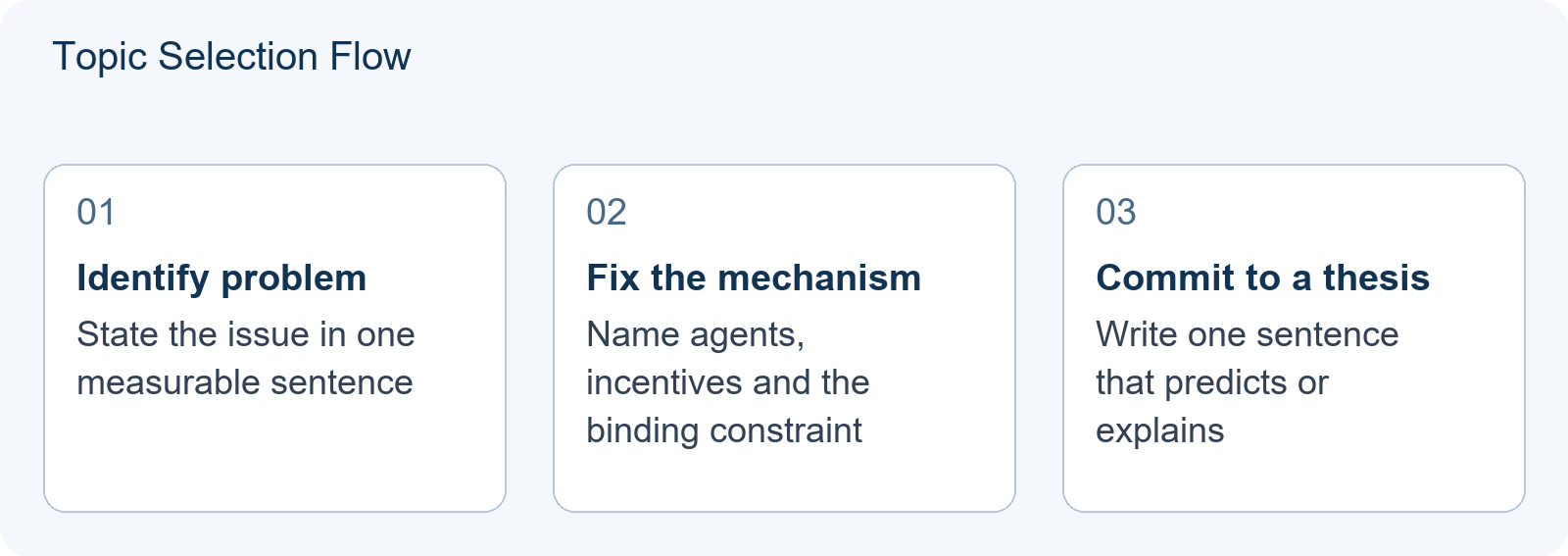
- Problem identification. State the economic issue in one sentence with a measurable anchor (for example, "the persistence of above-target price growth in a medium-sized open economy"). Avoid themes with no boundary; "the economy" is not a topic.
- Mechanism. Draw the causal chain. Which agents act, what incentives they respond to, and what constraint binds? A mechanism is behavioural, not statistical — it says why the numbers move together.
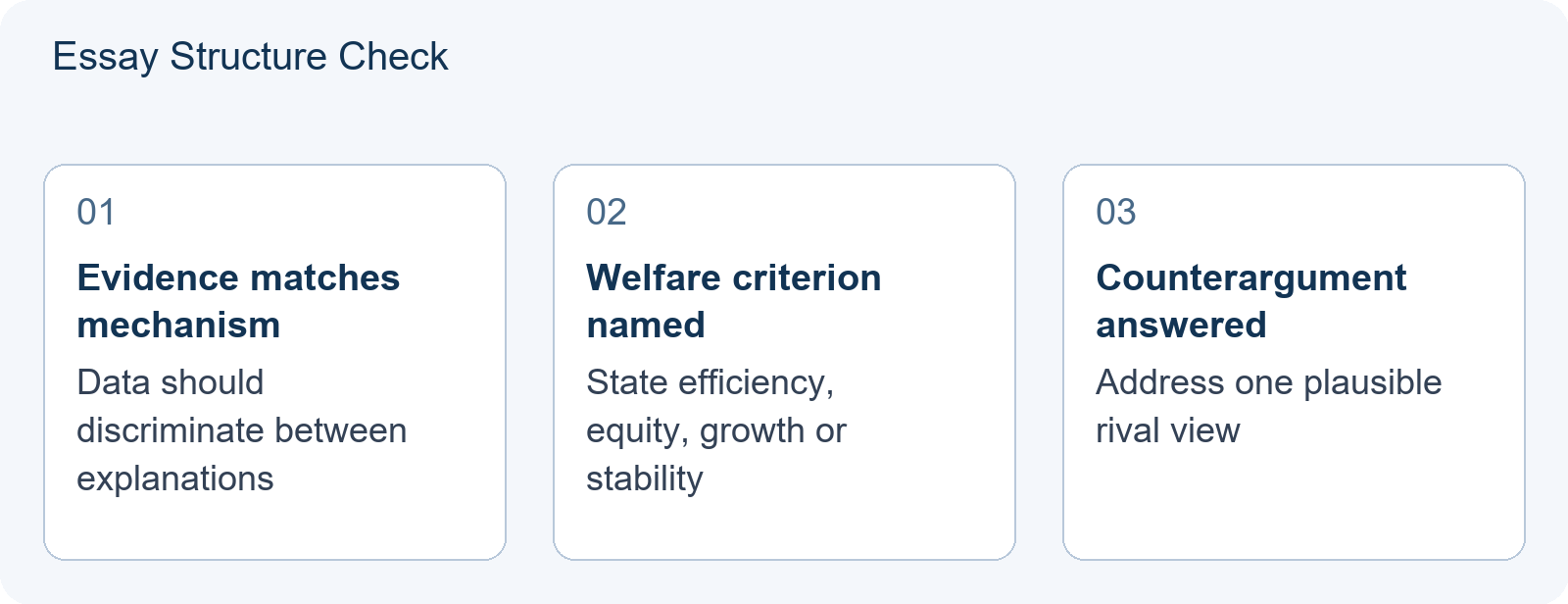
- Evidence selection. Choose data or cases that test the mechanism you named, not data that merely decorates the conclusion. If your mechanism predicts a pattern in one sector but not another, that asymmetry is evidence.
- Welfare criterion. Define what "better" means — efficiency, distributional equity, price stability, growth — and state the criterion explicitly. A policy cannot be evaluated against no yardstick.
- Policy trade-off. Name one cost the policy imposes and one group that bears it. Most credible economic arguments admit losers, not only aggregate winners.
- Counterargument. Answer one plausible alternative explanation or objection. Anticipating the strongest rival view is what separates persuasion from assertion.
Read the list as a diagnostic, not a rigid section order. A short essay may fold evidence into the mechanism and the counterargument into the trade-off paragraph, but all six functions should be resolvable somewhere in the text.
Teaching illustration: descriptive versus analytical
The contrast below is an invented teaching illustration, not a contest prompt and not official guidance.
Hypothetical prompt. A local council proposes raising the legal minimum wage by 10% in a retail-heavy city. Write an economics essay evaluating the proposal.
Descriptive draft. "Many countries have raised minimum wages. Studies show mixed effects. In the city's retail sector, wages are around the minimum. Raising the minimum wage would help workers but might hurt small businesses." This version names the topic but commits to no mechanism, no welfare criterion and no trade-off beyond a slogan.
Analytical draft. "The proposal would raise pay for workers whose wage is currently set by the legal floor. In a retail sector where a few large employers dominate local hiring, the wage floor may compress employers' markdown of pay, so the cost is more likely absorbed in reduced margins or slower hiring for the least experienced applicants than in wholesale layoffs. If the council judges the policy by distributional equity — raising income for the bottom decile — the trade-off is a possible reduction in entry-level openings; if it judges by total employment, evidence would need to show whether the reduction is material. A rival view is that the local labour market is competitive, not concentrated, in which case the same policy would produce a more standard employment decline and the case for the policy weakens."
The second draft commits to a mechanism (employer market power), names a welfare criterion, states a trade-off, and answers a competing view. Its evidence needs are also clearer: measure local labour-market concentration and entry-level openings rather than list wage figures. That is the shift HIEEC-style preparation is trying to train.
Diagnostic checklist for a thesis statement
Before committing to an outline, test the thesis in one sentence:
- Does it predict or explain? A thesis such as "Higher import competition will reduce the bargaining power of domestic producers in the affected industry" predicts an outcome through behaviour.
- Does it name a mechanism? A thesis that only says "import competition is bad" names no mechanism.
- Does it merely report a state of affairs? "Trade has increased since 1990" is a description, not a thesis.
The signal is usually a causal conjunction — because, therefore, leads to, results from, hinges on. If no causal link is present, the draft is descriptive and needs to be reframed before writing begins. This is the same discipline behind the internal article Economics competition preparation interest test: Try a 30-Minute Data Sprint, which uses a short timed exercise to check whether a student reasons from data or merely restates it.
Common pitfalls
- Data dumping. Statistics are used to decorate a conclusion instead of testing a mechanism. A single well-chosen indicator that discriminates between two explanations beats ten figures that do not.
- Undefined welfare standard. Arguing a policy is "good" without saying whether good means efficiency, equity, growth or stability. The chosen criterion must be stated and used consistently.
- Missing mechanism. Treating a correlation as causation without saying what agents do and why. If the mechanism is silent, the essay has no engine.
- Ignoring distribution. Assuming aggregate gains mean every group benefits. Distributional effects are frequently the most interesting part of an economics essay.
- Ignoring time horizons. A policy can raise welfare immediately and lower it later, or vice versa. Naming the horizon makes the trade-off visible.
Preparation routine that fits an essay contest
- Read for mechanisms, not headlines. When reading economics journalism or a textbook chapter, force yourself to complete the sentence "the model that explains this is..." Write the answer in one line.
- Thesis drills. For five diverse prompts, produce one causal thesis sentence per prompt within five minutes. The drill is speed and precision, not length.
- Build an evidence bank by mechanism, not by topic. Group studies and case examples by the mechanism they illustrate (entry deterrence, information asymmetry, wage stickiness, tax incidence). A mechanism-tagged bank is reusable across prompts.
Hanlin's CNEC note (Hanlin Course WeChat Public Account, 2026-10-16) documents economics competition preparation support built around CNEC/NEC, including diagnostic mock tests that identify weak knowledge areas and proposed group placements. That style of diagnostic maps well onto essay preparation: identify the missing function (mechanism, welfare criterion, counterargument) rather than adding more content. Students preparing for post-result reflection can also review John Locke Essay Results: Turn Competition Feedback Into a Stronger Writing Portfolio for a related but separate task — turning writing feedback into portfolio evidence after a submission cycle has closed.
Next step
Use the six-part framework once on a topic you already know well, then run the three-question thesis diagnostic on the sentence you produce. If the sentence describes rather than predicts, reframe before writing. A mentor or coach can compress this loop by checking whether each function is present and whether the evidence actually tests the mechanism named. No provider can guarantee an outcome in a competition, but a structured review of the argument makes the next draft materially stronger.
General event background is available at Hanlin Education.
Frequently Asked Questions
Is HIEEC similar to the John Locke Essay Competition?
Both are essay competitions, but they are separate. Hanlin's John Locke note documents that contest's 2000-word limit, category choice and judge criteria; the HIEEC material available to us only confirms HIEEC as an economics essay competition. Read the current official page for each competition instead of assuming rules transfer.
Do I need advanced mathematics to prepare for an economics essay contest?
Preparation for the writing task emphasises mechanism, welfare criterion and policy trade-off, which are verbal reasoning skills. That does not replace mathematical fluency a student may need elsewhere in an economics pathway, and it is not an official statement about HIEEC evaluation.
Where can I find the current HIEEC rules?
Consult the official Harvard International Economics Essay Contest page. This article provides a preparation framework and does not publish HIEEC deadlines, word limits or judging criteria.