
Model Entrepreneur Competition (MEC) asks teams to address a market pain point with a product or service and a feasible model, covering market, product, marketing, financial planning, and risk. Before your team commits to the writing phase, test whether the concept deserves the effort. This seven-day exercise draws on Hanlin's MEC preparation approach to help student teams validate, revise, or discard ideas using evidence rather than enthusiasm; it is not an organiser requirement.
Why Teams Rush Into Writing
Student teams often confuse excitement with evidence. A teammate's personal frustration becomes "everyone has this problem." A parent's encouragement becomes "market demand confirmed." MEC describes its origins with Columbia Business School's Venture for All and IEG, and current official information notes that IEG hosts the global competition; regional formats vary. The official framework asks for market pain, product solution, and financial feasibility. None of that requires a polished deck first. It requires proof that anyone outside your team cares.
The danger is sunk-cost escalation. Once you have written twenty pages, you resist abandoning the idea. The seven-day test front-loads discomfort so you can pivot cheaply.
The Seven-Day Evidence Sprint
This is a suggested teaching exercise, not an MEC requirement. Adjust days to your schedule, but maintain the sequence: customer definition before interviews, interviews before economics, economics before decision.
Day 1: Define the Customer and the Painful Job
Write one paragraph answering: Who specifically experiences the problem? What are they trying to accomplish when the problem appears? What makes it painful enough that they would change behavior?
Be narrower than "students." A strong target: "International high school students in Beijing who spend more than three hours weekly reconciling conflicting assignment deadlines across WeChat, email, and LMS platforms because their school uses three non-integrated systems." The painful job is "know what to do next without checking four places."
Weak targets kill plans. If you cannot name where these people gather, how they currently describe the problem, or what they sacrifice to work around it, you are not ready for Day 2.
Day 2: Map Current Workarounds and Competitors
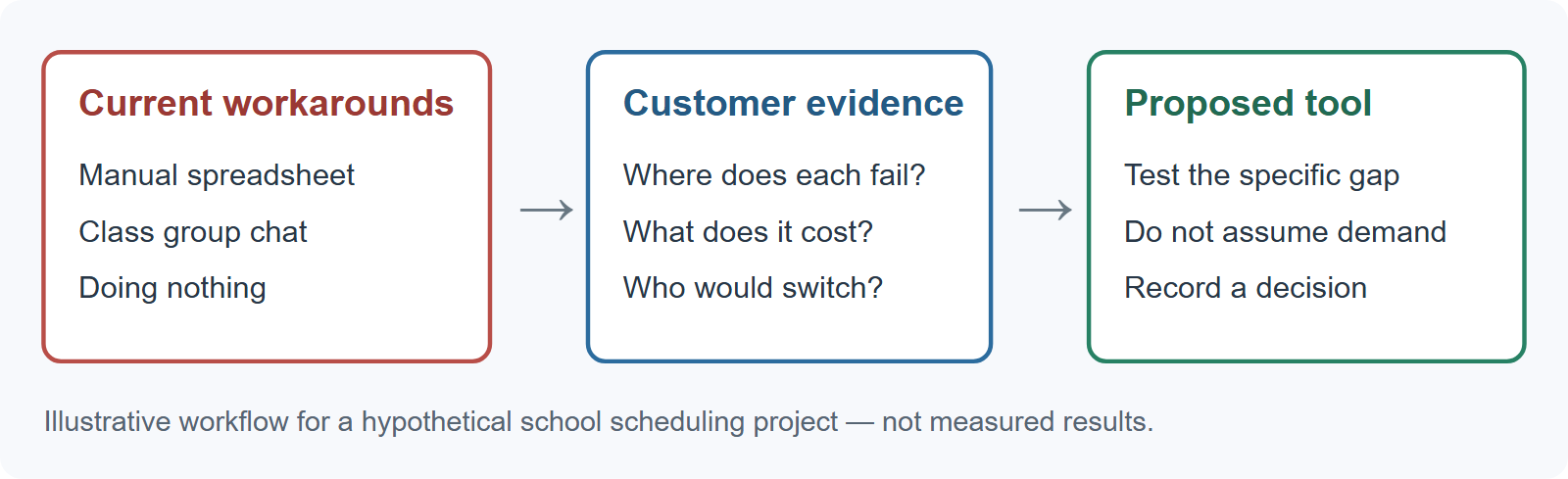
Every pain point already has a solution, even if terrible. List how your target customer currently copes. For the scheduling example: manual spreadsheet, class representative's WeChat summary, sticky notes, or doing nothing and missing deadlines. Each workaround reveals what customers value (speed, accuracy, social reliability) and what they tolerate (effort, ambiguity).
Competitors include direct competitors (apps like Todoist adapted for school use), indirect substitutes (the class representative's WeChat), and inertia (doing nothing). Map these on two axes: ease of use and reliability of information. Your opportunity lies where existing solutions fail on dimensions your target customer prioritizes.
Days 3-4: Conduct Exploratory Interviews
As a teaching recommendation, not an official requirement, aim for five to eight short conversations with people matching your Day 1 definition. This is a suggested practice design, not a guaranteed sample size. Each interview should last fifteen to twenty minutes. Your goal is understanding, not selling.
Structure each conversation:
- Context: "Can you walk me through the last time you [experienced the problem]?"
- Current behavior: "What did you do? What tools did you use?"
- Emotion: "What was frustrating about that?"
- Constraints: "What would need to be true for you to try something different?"
Record notes immediately after. Flag quotes that surprise you. If three of five people describe a problem you had not considered, your Day 1 definition may be wrong. That is useful data, not failure.
Day 5: Test Willingness and Constraints Without Leading
The fatal interview mistake is asking "Would you use this?" People say yes to be polite. Instead, test commitment through behavior or constraint questions:
- "When you tried to solve this before, what did you spend? Time or money?"
- "Who else would need to agree for you to switch?"
- "What would make you stop using your current method?"
Document specific answers. "My advisor would need to approve it" reveals a decision-maker you missed. "I tried three apps and deleted them all" reveals switching costs. "I just ask my roommate" reveals your problem may not be painful enough.
Day 6: Sketch Unit Economics With a Hypothetical Example
Hanlin's MEC teaching page covers projected P&L, break-even, and scenario analysis. Before building a full model, test whether your unit economics even work in principle. The figures below are invented for illustration.
Hypothetical Worked Example: "ClassSync" Scheduling Tool
Suppose your team proposes a subscription app for international high schools. You invent the following figures for illustration only:
| Item | Invented Figure (Hypothetical) | Source Assumption |
|---|---|---|
| Annual subscription per school | ¥4,800 | Unverified price guess to test with school decision-makers |
| Target schools in Year 1 | 15 | Unverified sales-volume guess; replace with reachable-school evidence |
| Revenue Year 1 | ¥72,000 | 15 × ¥4,800 |
| Development cost (one-time) | ¥35,000 | Invented development estimate; validate before planning |
| Annual server/hosting | ¥8,000 | Invented hosting estimate; obtain a real quote |
| Customer acquisition (events, demos) | ¥12,000 | Invented acquisition estimate; test the actual sales channel |
| Net Year 1 | ¥17,000 | ¥72,000 − ¥35,000 − ¥8,000 − ¥12,000 |
This is a teaching illustration, not MEC submission data or a forecast. The arithmetic is less valuable than identifying which assumptions require real evidence: who controls the school budget, what it would cost to acquire a school, and whether the product can be built and supported at the estimated cost.
Day 7: Decide Using an Evidence Log
Compile your findings in a single page:
| Weak Claim | Strong Evidence |
|---|---|
| "Students are frustrated with scheduling." | Hypothetical evidence log: "Five of six interviewed students reported missed deadlines; each described a specific incident." |
| "Schools would pay for this." | Hypothetical evidence log: "Two administrators described current spending on partial solutions; one requested a pilot proposal." |
| "Our app is better than competitors." | Hypothetical evidence log: "Target users ranked reliability over speed and showed where current tools failed." |
| "My friends liked the idea." | "Friends are not target customers; no payment commitment or behavior change demonstrated." |
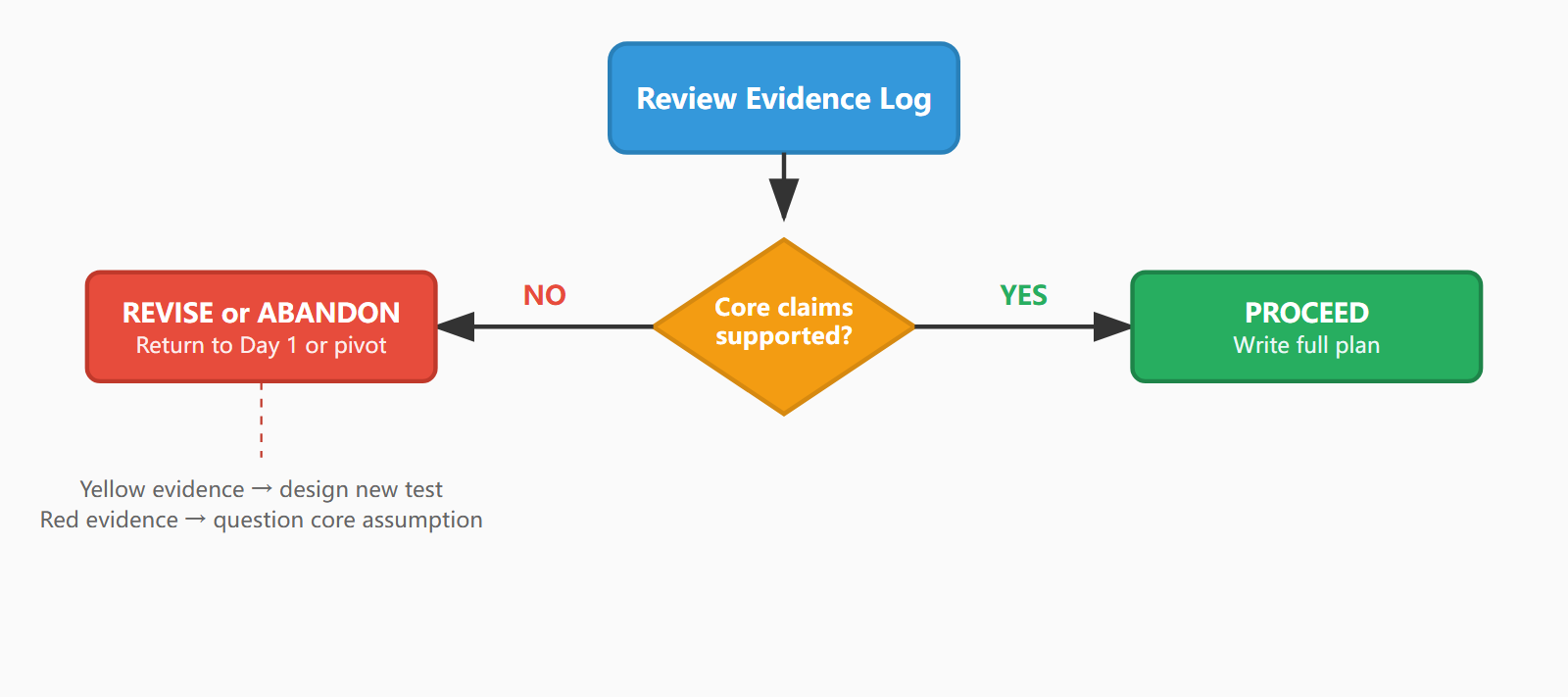
Label evidence green (direct observation or commitment), yellow (indirect signal, needs follow-up), or red (assumption untested). Decide based on the importance of each claim, not the number of green boxes. A single red claim about who would pay may outweigh several green comments about convenience. Blue Ocean strategy tools can help teams look for less contested spaces if their initial idea proves crowded.
How to Avoid "My Friends Liked It" as Evidence
Social approval from familiar contacts is the most common validation trap. Friends share your context, want to support you, and rarely face the actual constraints of your target customer. Replace friend conversations with structured interviews using the methods above. If you must test with peers, require them to perform a concrete action: pre-register interest, introduce you to their school's administrator, or describe their last failed attempt to solve the problem. Vague positivity without behavioral commitment is not evidence.
Frequently Asked Questions
How many interviews do we need for MEC?
The checked MEC material does not specify an interview count. For this teaching exercise, we suggest five to eight exploratory conversations to surface patterns. Quality of insight matters more than quantity. One detailed interview with a precise match can be more useful than ten superficial conversations.
Can we change our idea after starting the business plan?
You can revise the concept during preparation, but check your regional handbook for any rules after submission. This seven-day exercise helps find weak assumptions while changes are still easy. Hanlin's MEC preparation includes cross-examination rehearsal, which can expose gaps in a plan.
What if our unit economics only work with optimistic assumptions?
Flag the sensitivity explicitly. In your plan, compare base, optimistic, and pessimistic scenarios. The MEC organiser's general framework includes risk analysis. If only the optimistic scenario works, revisit the price, cost, or customer assumptions before you commit.
Connecting to Broader Competition Skills
The skills practiced here—customer definition, evidence gathering, and financial sketching—transfer to other competitions. Diamond Challenge emphasizes similar validation, though with different submission formats. The discipline of distinguishing weak claims from strong evidence serves any entrepreneurial pitch.
Source Note
Official MEC information checked 2026-09-28 at officialmec.org and officialmec.org/mec-model-entrepreneur-competition/. Regional formats vary; verify the specific regional 2027 handbook for your competition site. All financial figures and interview counts in this article are hypothetical teaching illustrations, not official MEC rules.