
If your family is planning for the 2027 LSESU Economics Challenge, the first decision should not be “microeconomics or macroeconomics?” Start with a short diagnostic across all three areas the event is described as covering: microeconomics, macroeconomics and mathematics/quantitative analysis. The reason is practical: a student can know the concept of elasticity and still lose marks by omitting the P/Q scaling step, or understand GDP components and still misread a percentage-change question. A topic-first plan can spend two weeks re-teaching content when the real repair is quantitative setup.
Hanlin’s 28 October 2026 note, Ten Outstanding Coach Certificates and Global Championship Results: Hanlin’s Economics and Business Strength in Focus, describes the 2027 LSESU Economics Challenge and a Hanlin preparation course. It does not publish official exam weighting, question counts, dates or award rules. Treat the note’s course-hour split as a coaching allocation, not an official specification. This article gives a suggested 12-item diagnostic structure, a worked elasticity illustration and a decision rule for the first two-week block.
What the 2027 note does—and does not—say
The same Hanlin note describes the event as run by the London School of Economics Students’ Union Economics Society (LSESU Economics Society) in cooperation with ASEEDER, and states that the 2027 event covers microeconomics, macroeconomics and mathematics/quantitative analysis. For preparation, it describes a Hanlin course of 10 hours microeconomics, 10 hours macroeconomics, 8 hours quantitative foundations and 2 hours question training and analysis, aimed at students who have not taken NEC or IEO training. That is a Hanlin course description, not an official blueprint.
| Source detail | What it supports | What it does not support |
|---|---|---|
| Three content areas: micro, macro, mathematics/quantitative analysis | A diagnostic should sample all three before a topic order is chosen | Any official question count, section weight or score allocation |
| Hanlin course: 10 micro / 10 macro / 8 quantitative / 2 question training hours | A coaching judgment about how one beginner course is organised | Official LSESU exam weighting or a required preparation route |
| Course aimed at students without NEC or IEO training | Families should ask whether a course pace assumes prior competition training | Eligibility rules, placement policy or a prediction of results |
Published selection rules can differ by stage and event; the IEO National Training Team selection criteria: Preparing for Published Rules Beyond Scores article is a reminder not to import another competition’s rules into LSESU planning. The supplied note does not establish LSESU selection or award criteria, so none are assumed here.
Why a topic order can mislead
A student who chooses microeconomics first because “demand and supply” sounds familiar may practise the right vocabulary while repeating the same quantitative error. For example, a student may correctly explain that a price ceiling creates shortage but then calculate a percentage change from the wrong base. Another may know that GDP can be measured by expenditure but misread a table because the units change from millions to billions. These are not the same learning needs.
A useful diagnostic separates at least five error types: content confusion, setup error, arithmetic slip, graph or table reading error, and wording or time pressure. The first two often look alike in a total score. A student who writes the wrong elasticity value may have forgotten the concept, or may have used the slope only. A parent who sees “6 out of 12” cannot tell which repair is urgent. A short error log can.
If the student has not yet decided whether economics competition is a fit at all, the separate Economics competition preparation interest test: Try a 30-Minute Data Sprint offers a different starting point: a 30-minute data sprint, not LSESU-specific preparation. This diagnostic assumes the student is already considering the 2027 event and needs a first revision order.
Build the 12-item diagnostic
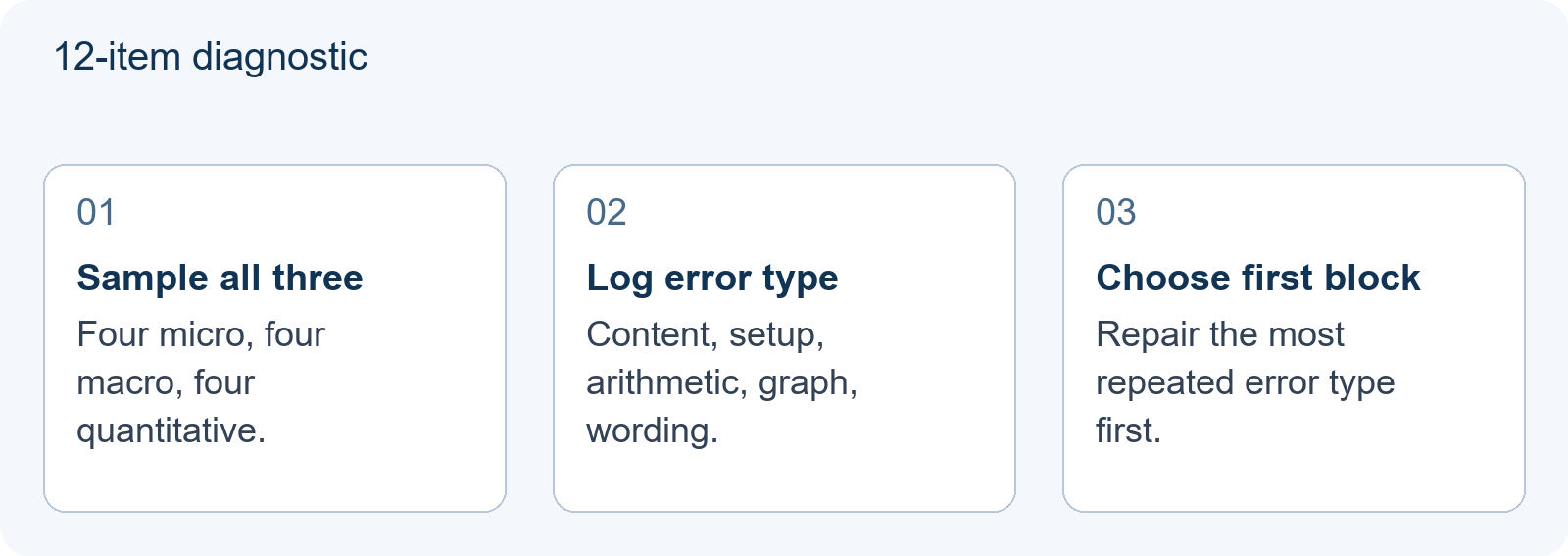
The following is a teaching diagnostic, not an official paper and not a prediction of LSESU questions. Use four items per block, keep the set short enough to finish in one sitting, and ask the student to write one line of reasoning for each answer. Do not use past-paper questions unless you have a lawful source and clear permission to use them.
| Block | Four suggested item types | What a wrong answer may reveal |
|---|---|---|
| Microeconomics | Opportunity cost with units; movement along a curve versus a shift; elasticity sign and magnitude; consumer or producer surplus on a simple graph | Concept confusion, graph reading, unit handling or missing interpretation |
| Macroeconomics | GDP expenditure component; unemployment classification; real versus nominal comparison; a simple policy transmission chain | Definition gaps, sequencing errors, data interpretation or overlong reasoning |
| Quantitative | Percentage change; ratio or unit conversion; rearranging a linear relation; a simple probability or comparison statement | Algebra, scaling, proportion, base selection or cautious interpretation |
Mark each item twice. First mark correct or incorrect. Then mark the dominant error type: content, setup, arithmetic, graph/table or wording. A correct answer with shaky reasoning is not the same as a fluent correct answer, and an incorrect answer caused by one arithmetic slip is not the same as a missing concept. The goal is a pattern that can survive contact with new questions.
Worked teaching illustration: elasticity
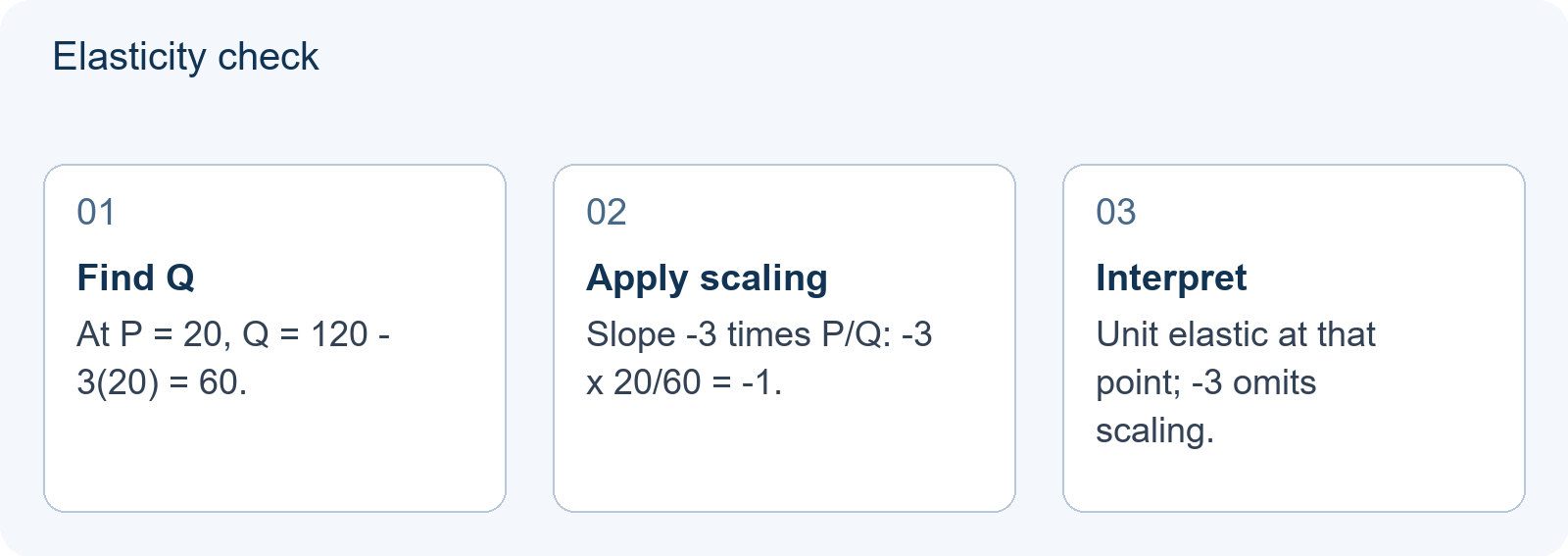
This is an illustrative item, not an official LSESU question. Suppose demand is Q = 120 − 3P and the question asks for point elasticity at P = 20. First find quantity: Q = 120 − 3(20) = 60. The derivative is dQ/dP = −3. Point elasticity is (dQ/dP)(P/Q) = (−3)(20/60) = −1. At that point, demand is unit elastic: a small 1% price rise is associated with approximately a 1% quantity fall.
An answer of −3 is not a different theory of demand; it is the slope without the P/Q scaling step. That is a quantitative setup error, not necessarily a missing economics concept. By contrast, a student who says a price fall shifts the demand curve right has confused a movement along the curve with a shift: that is a content error. A student who obtains −1 but cannot explain what “unit elastic” means has an interpretation gap. The diagnostic should record these separately because the first calls for a scaling drill, the second for concept review, and the third for explanation practice.
The same separation matters in macroeconomics. A student may correctly list consumption, investment, government spending and net exports but then mishandle a table whose values are in different units. Re-teaching GDP components will not fix the unit error. A short quantitative repair block, followed by one applied macro item, is more targeted.
Read the pattern, not the total
A total of 7 out of 12 can hide very different needs. Use the error log to choose the first two-week block. The following decision rule is a teaching suggestion, not an official recommendation.
| Diagnostic pattern | First two-week focus | Evidence to keep |
|---|---|---|
| Quantitative setup errors repeat across micro and macro items | Short quantitative repair most days, with one micro and one macro application | Same algebra or scaling step recurring in different contexts |
| Content errors cluster in one block | Begin that block, with a short quantitative warm-up | Student can calculate once the concept is explained |
| Graph or table reading errors dominate | Graph translation and table-unit drills before more content | Axes, labels, movement versus shift, units and base values |
| Few conceptual errors but timed work collapses | Mixed timed sets and review, not re-teaching | Untimed accuracy is high; time stamps show hesitation points |
If the pattern is mixed, do not choose by subject preference. Rank the error types by how often they change the answer. A repeated quantitative setup error across two topics usually deserves earlier attention than a single forgotten definition. A single graph-reading error in an otherwise clean set may need a short drill, not a new unit.
A suggested six-week sequence
Week 1: complete the diagnostic and build the error log. Week 2: microeconomics revision with a short quantitative warm-up every session. Week 3: macroeconomics revision plus graph and table translation. Week 4: quantitative repair drawn from the student’s own errors, including percentage change, ratios and rearranging relations. Week 5: mixed sets that combine two content areas with quantitative work. Week 6: timed mixed practice and a review of recurring errors, not new content.
If the diagnostic shows quantitative errors in both micro and macro, move the repair earlier and keep the content blocks shorter. If content errors dominate, keep a 10-to-15-minute quantitative warm-up but spend the main block on concepts and explanation. The Hanlin note’s 10/10/8/2 split can be used as a comparison point when considering a structured course, but it should not override the student’s error pattern. For students also taking AP Economics, the AP and Competition Preparation: Build a Study Plan Around Shared Skills article discusses shared-skill planning for AP and competitions.
When to seek course support
Seek support if the same quantitative step recurs across two topics after two weeks of targeted practice, if the student cannot explain the economic meaning of a calculation even when the number is right, or if graph and table errors persist despite short drills. A consultation is also reasonable when timed performance drops sharply compared with untimed accuracy, because that pattern may need pacing and feedback rather than more content.
Bring the completed diagnostic table, two items the student corrected, and one item that still feels confusing. Ask how the course pace handles students with different error patterns. The Hanlin note describes its 2027 LSESU course as aimed at students who have not taken NEC or IEO training; if that is not the student’s profile, ask how the sequence would be adjusted rather than assuming a placement or outcome. The purpose of the conversation is to map evidence to a plan, not to predict a score or an award.
General event background is available at Hanlin Education.
Frequently Asked Questions
What should a student do if the diagnostic shows mixed errors?
Do not choose microeconomics or macroeconomics by preference alone. Rank the error types by how often they change the answer. If the same quantitative setup error appears in both micro and macro items, start with short quantitative repair and apply it to one item from each content area. If content errors cluster in one block, begin there with a short quantitative warm-up. Recheck after two weeks with new items.
How should a parent read the diagnostic table?
Look for the pattern and the student’s explanation, not only the total. A wrong answer caused by one arithmetic slip calls for a different response from a wrong answer caused by a missing concept. Ask the student to explain one corrected item and one item still in progress. Avoid comparing the table with another student’s score, because the diagnostic is designed to choose a first revision block, not to rank students.
Does Hanlin’s 10/10/8/2 course split show the LSESU exam weighting?
No. The 28 October 2026 Hanlin note describes a Hanlin 2027 preparation course of 10 hours microeconomics, 10 hours macroeconomics, 8 hours quantitative foundations and 2 hours question training, aimed at students who have not taken NEC or IEO training. That is a coaching allocation, not an official LSESU weighting. The supplied note does not provide official question counts or score weights.