
For families preparing for timed physics competitions, the first shock is often not the difficulty of the content but the speed required. A 60-question paper in 50 minutes leaves an average of 50 seconds per question, and that average hides the real problem: some questions take 15 seconds, while others can consume two or three minutes. This article uses that sprint format as a clearly labelled teaching scenario for Junior Physics Challenge Prep. Before applying any pacing rule, confirm the exact format, scoring, and allowed materials in your own competition instructions.
The usual advice to work quickly is too vague. What students need is a decision system: how to recognize an easy win, when to abandon a time sink, how to practice the physiological stress of a clock, and how to review skipped questions so the same mistake does not repeat. The goal is not to answer every question. The goal is to maximize correct answers per minute while preserving enough attention for the questions that actually require thought.
The Math of Speed: 50 Seconds Per Question vs. Reality
A naive calculation says 50 minutes divided by 60 questions equals 50 seconds per question. That number is useful as a baseline, but treating every question as an equal unit of time is a strategic error. Difficulty is rarely uniform. Some items reward direct recall or one-step formula use. Others involve multi-step reasoning, diagram interpretation, unit conversion, or a conceptual trap.
If a student tries to maintain a strict 50-second average, two bad things happen. Easy questions get over-served, wasting buffer time. Hard questions get cut off mid-calculation, producing zero points despite real effort. Effective preparation shifts the mindset from average pace to variable pace. Bank time on quick questions, then spend that banked time on questions that genuinely require more thought.
A teaching illustration: suppose five easy questions take 75 seconds total. At the 50-second average, those five questions would have been allotted 250 seconds. The student has banked 175 seconds. That buffer can cover a difficult question that takes 125 seconds instead of 50 seconds, which is 75 seconds over budget, and still leave 100 seconds for checking. This is the core arithmetic of sprint triage: speed on easy items funds accuracy on harder items.
Students should also learn the shape of a question instantly. Is it plug-and-chug kinematics? Is it a conceptual Newton's Third Law prompt where intuition misleads? Is it a graph-reading item with a simple slope? Recognizing the shape allows dynamic pacing instead of rigid ticking. The clock should inform decisions, not dictate panic.
Triage Strategy: Identifying Easy Wins vs. Time Sinks
In emergency medicine, triage sorts patients by urgency and survivability. In a timed physics paper, triage sorts questions by expected points relative to time cost. When the rules you have checked give equal value to each correct answer, the highest yield comes from questions that can be solved correctly with the least cognitive load and time expenditure.
A practical triage system has three zones:
- Green Zone, immediate answer: Questions relying on direct formula application, basic definitions, or simple arithmetic. If the path to the answer is not visible within about 10 seconds, the question is not Green Zone.
- Yellow Zone, standard work: Questions requiring one or two derivation steps, careful unit reading, or minor diagram analysis. These form the bulk of the paper. They require focus but not creative leaps.
- Red Zone, time sinks: Questions with ambiguous wording, complex multi-body dynamics, or unfamiliar setups. Spending three minutes here yields the same mark as spending three minutes on three Yellow Zone questions.
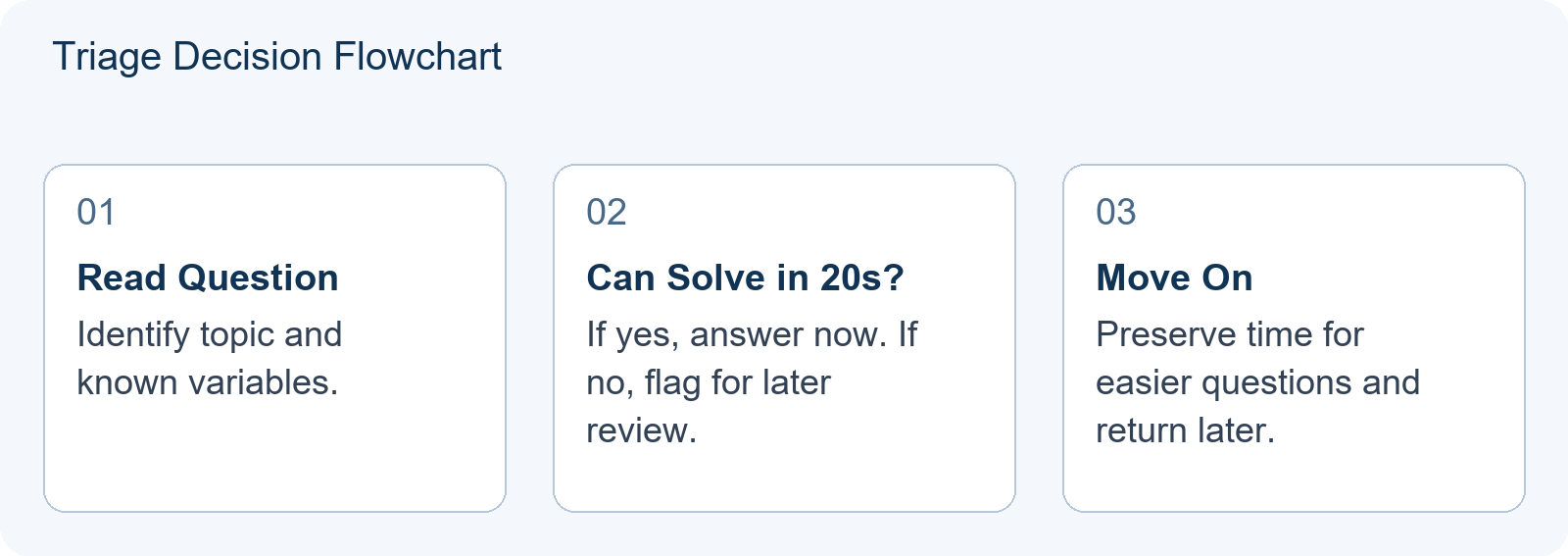
The hardest tactical decision is when to skip. Sunk-cost fallacy is expensive in a 50-minute sprint. A student stares at a Red Zone question for 45 seconds, hoping inspiration arrives, then still cannot start. The rule of thumb for Junior Physics Challenge Prep is simple: if no relevant equation is written and no useful diagram is drawn within roughly 20 seconds, mark the question for review and move on. Return only after all Green and Yellow Zone points are secured.
This system also protects morale. Panic often comes from a single early difficult question that makes the whole paper feel impossible. Triage turns the paper into a sequence of local decisions: answer this, skip that, return later. The student stays in control of the clock rather than reacting to it.
Drill Design: Simulating the 50-Minute Pressure Cooker
Reading about time management is not enough. Students must experience the stress of the clock in practice. Standard homework, done over several hours, does not build rapid retrieval under pressure. Practice sessions must mimic the constraints of the target paper.
One teaching illustration is the Block Sprint. Instead of doing 60 questions at once, break them into blocks of 10 questions with a strict 8-minute limit. Since 10 questions at the 50-second average would take 8 minutes 20 seconds, an 8-minute block is slightly tighter than average and builds resilience. After each block, pause for two minutes to check answers and analyse errors. This prevents fatigue-induced mistakes from compounding and provides immediate feedback.
A second teaching illustration is the Skip-First Pass. Give the student a full set of 60 questions and allow only 15 minutes for a first sweep, marking only Green Zone questions. Then give 20 minutes for the Yellow Zone questions identified during the sweep. Finally, use the remaining 15 minutes for leftover questions and checking. The three phases sum to 50 minutes. This drill trains breadth before depth, which is critical for high-volume papers.
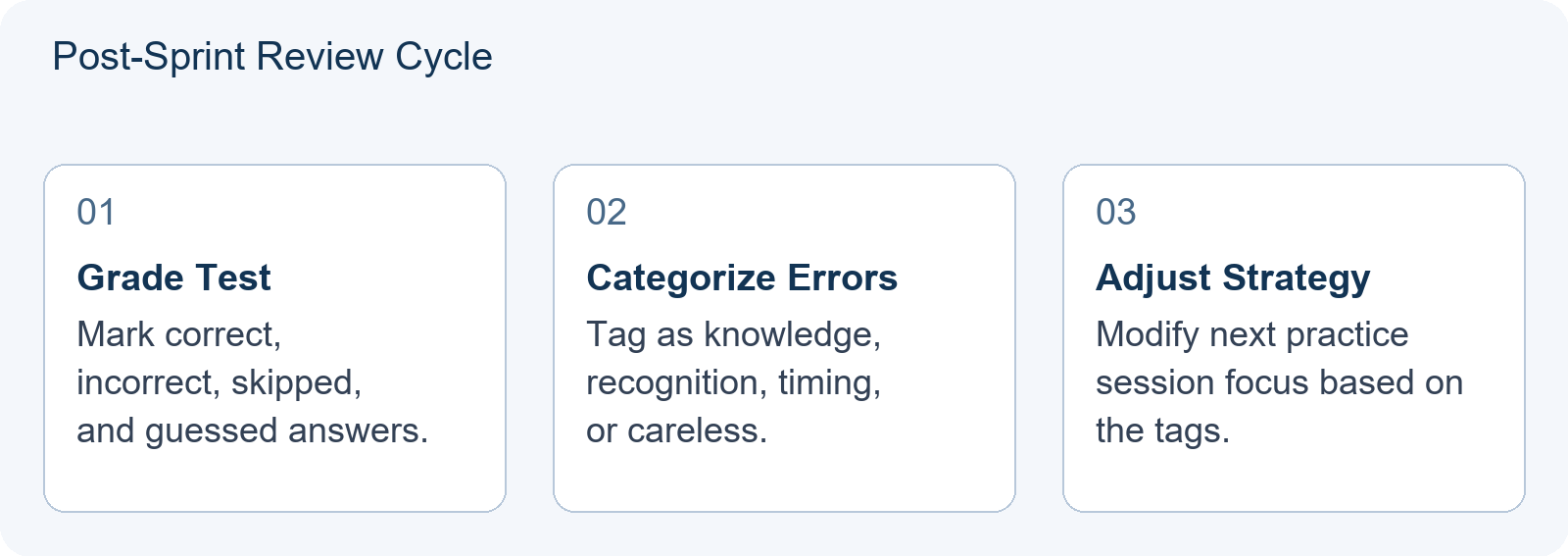
Use timed sets that match the instructions you have. The objective is not just to get the right answer but to get it fast enough to leave room for error correction. After each drill, record not only the score but also the number of questions skipped, guessed, and left blank. Those counts reveal whether the bottleneck is knowledge, recognition, or pacing.
Review Protocol: Analyzing Skipped Questions After the Sprint
The post-test review is where learning actually happens. Many students grade a mock test and move on. For Junior Physics Challenge Prep, the review must specifically address time allocation errors.
Create a log for every skipped or guessed question and categorize the reason:
- Knowledge gap: I did not know the concept. Action: study the topic.
- Recognition failure: I knew the concept but did not see that it applied here. Action: practice varied problem types.
- Time panic: I ran out of time because I spent too long earlier. Action: adjust pacing strategy.
- Careless error: I made a calculation or transcription mistake while rushing. Action: improve handwriting, organisation, or arithmetic checking.
If a student skipped a question because of time panic, look at what happened immediately before. Did they spend two minutes on a multiple-choice question that could have been eliminated by inspection? Did they re-read the same paragraph three times? Identifying specific bottlenecks allows targeted behavioural changes rather than vague advice to be faster.
The review should also separate speed errors from concept errors. A student who answers quickly but wrongly needs accuracy work. A student who answers accurately but slowly needs retrieval practice and triage discipline. The same mock score can hide opposite problems, so the diagnosis must be specific.
Adjusting Content Depth for Speed: Memorization vs. Derivation
Physics teaching often emphasizes deriving formulas from first principles. That is valuable for understanding, but in a timed sprint retrieval speed matters more. Preparation should therefore include deliberate memorization of standard results and common patterns.
Consider projectile motion. A student who derives the range equation R = v^2 sin(2θ) / g from kinematic equations every time will lose seconds. A prepared student recognizes the pattern and applies the formula directly. Knowing standard values, such as appropriate gravitational acceleration for the given context, reduces cognitive load. Always check what the paper's instructions allow.
Memorization has limits. If a question deviates from the standard form, blind application causes errors. The balance is pattern recognition. Students should practice identifying which standard model applies: conservation of energy, momentum collision, circular motion, electric circuit, or wave equation. Once the model is identified, the associated formula is retrieved instantly. This hybrid approach, fast identification followed by direct application, is the hallmark of efficient Junior Physics Challenge Prep.
Students should also build a personal formula sheet from memory. Writing it out repeatedly, then testing recall under a 30-second limit, builds automaticity. The sheet should include conditions and units, not just symbols, because many sprint errors come from applying the right formula in the wrong situation.
Integrating Broader Competition Skills
Time management is transferable across academic competitions. Families often ask how to balance preparation for different events. The analytical rigour required for mathematics contests shares similarities with physics problem-solving, but pacing differs. Mathematics contests often allow more time per question and demand deeper logical chains. Physics sprints demand broader coverage and quicker pattern matching.
Students preparing for multiple events should avoid siloing their study habits. Core skills such as eliminating wrong answers, estimating magnitudes, and reading graphs quickly apply across subjects. Building an integrated study plan can reduce wasted effort. For a broader framework, see our guide on AP and Competition Preparation: Build a Study Plan Around Shared Skills.
Recognizing when to seek targeted feedback is also crucial. If a student consistently struggles with pacing despite knowing the content, more generic practice may not help. They need diagnostic feedback on decision-making. Our previous discussion on Math Competition Plateau: Choosing Between More Practice and Targeted Feedback offers insights that apply here: sometimes analysing how you think is more productive than solving another hundred problems.
Course Fit and Resource Preparation
For families considering external support for Junior Physics Challenge Prep, evaluate whether the programme addresses tactical needs. Not all tutoring focuses on exam technique. Some prioritise deep theoretical understanding, which is valuable but may not directly solve time-pressure problems.
When consulting educators, ask specific questions. Do they provide timed mock papers with strict limits? Do they teach triage and skip decisions? Do they analyse skipped questions after the test? A useful preparation course should combine content review with performance coaching.
Ensure that resources align with the format you are actually preparing for. As noted in our detailed breakdown of the Junior Physics Challenge 2026: A Four-Week Practice Plan for 60 Questions in 50 Minutes, format details matter. Using outdated materials or incorrect time limits can reinforce bad habits. Verify that any practice pack includes solutions explaining the reasoning behind correct answers, not just final numbers, so review protocols can work.
The final principle is sustainable intensity. Sprint practice is stressful, so it should be short, frequent, and reviewed. A student does not need to grind through full papers every day. Two focused sprints per week, each followed by a diagnostic review, can improve pacing more than hours of untimed problem sets. The aim is to make fast, accurate decisions automatic before the real clock starts.
Frequently Asked Questions
Should I guess randomly if I run out of time?
Check the scoring rules first. If the paper gives no penalty for wrong answers and blanks score zero, never leave a question blank; a guess has a non-zero chance of being correct. If wrong answers are penalised, decide based on the stated penalty and expected value. The safest rule is always to follow the competition instructions you have confirmed.
How much time should I spend on diagrams?
Diagrams are crucial for visualising forces and motion, but they should be quick sketches. For many sprint problems, spend about 10 to 15 seconds drawing a rough free-body diagram or motion sketch. If the diagram becomes complex, re-evaluate whether you are over-complicating the problem. Labels and arrows matter more than neat artwork.
Is it better to do questions in order?
Not necessarily. If a difficult question appears early, it can cause panic and drain time. Consider a quick scan to identify easy wins, then work through the paper with a triage mindset. Changing order takes time, so practice this strategy in mock sprints to ensure it saves more seconds than it costs.