
Students considering economics competitions often face a significant barrier before they begin drafting: uncertainty about whether they actually enjoy the specific intellectual labor involved. Unlike mathematics or physics competitions, which rely heavily on problem-solving speed and pattern recognition, writing-heavy economics competitions demand a hybrid skill set. You must locate credible evidence from public datasets, interpret that data correctly, and then weave it into a persuasive, structured argument. Many students discover halfway through a long draft that they dislike the research process or struggle with the nuance of economic reasoning. This article provides a low-stakes framework to test your interest in Economics Competition Preparation before investing weeks of effort.
Why 'Interest' Is a Measurable Skill in Economics Competitions
In academic competitions, interest is not just an emotional preference; it is a proxy for endurance and attention to detail. The John Locke Institute, described in Hanlin's October 2026 John Locke note as an independent educational organization based in Oxford, uses judging criteria that include knowledge, understanding of relevant material, effective use of evidence, argument quality, structure, writing style, and persuasiveness. A student who finds joy in digging through government documents or think-tank reports will naturally produce more nuanced arguments than one who views these sources as tedious obstacles.
If you find yourself frustrated by the ambiguity of economic data or bored by constructing a counter-argument, you may need to reconsider your approach or choose a different competition format. Recognizing this early saves time and allows you to pivot toward activities where your strengths lie. That does not mean every student must love every minute of research. It means the balance of curiosity and persistence should be strong enough to sustain you through multiple revisions.
The 30-Minute Data Sprint: Pick One Chart, Then Read It Carefully
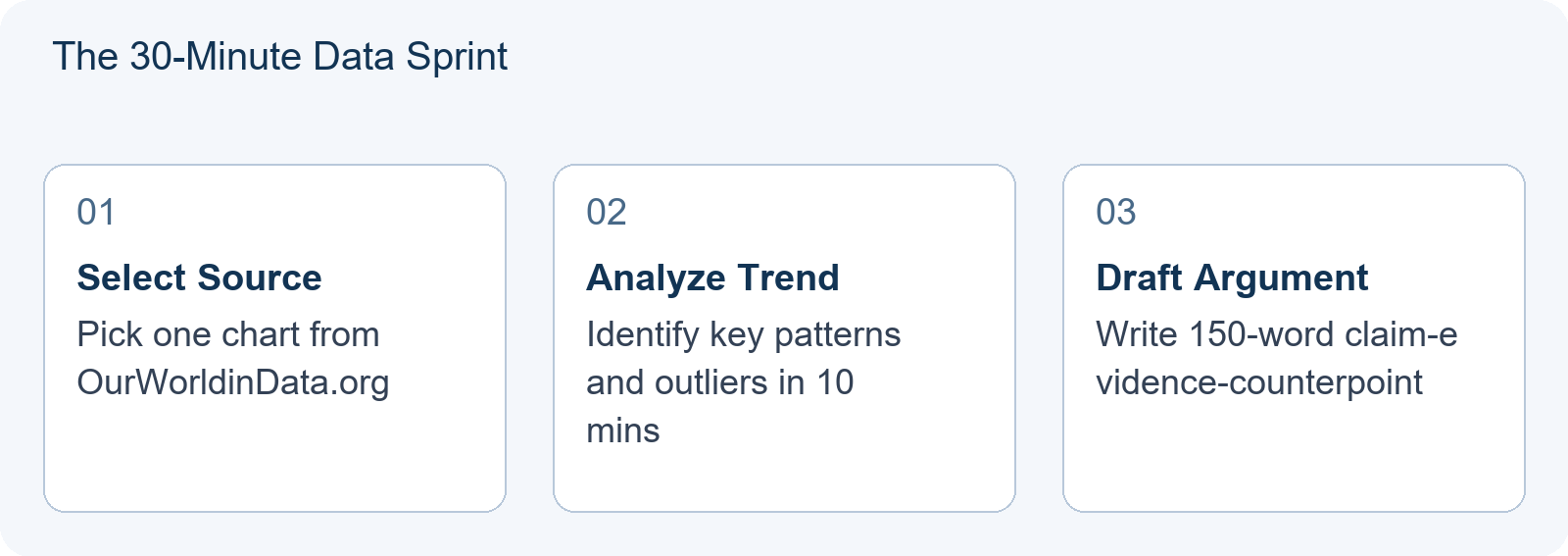
To test your aptitude for evidence-based writing, start with a focused exercise rather than a broad topic search. Select one chart from OurWorldinData.org, a source explicitly recommended in the John Locke guidance summarized in Hanlin's October 2026 John Locke note. Choose a dataset related to a current economic issue, such as inflation rates across different countries or income inequality trends over the last decade.
Spend exactly ten minutes analyzing the chart. Ask yourself: What does the trend line suggest? Are there outliers? What external factors might explain the shifts? This step isolates the skill of data interpretation from the pressure of writing. If you find this analysis engaging and intuitive, you possess the foundational curiosity required for high-level economics essays. If you feel overwhelmed by the noise in the data or unable to identify a clear narrative, this indicates a potential mismatch between your learning style and the demands of competition preparation.
Teaching illustration only, not real data and not a contest problem: imagine a fictional country called Aurora. Its youth unemployment rate is 12.0% in 2018, 18.0% in 2020, 15.0% in 2022, and 13.0% in 2024. The arithmetic is simple: from 2020 to 2024, the rate fell by 5.0 percentage points. The 2020 rate was 6.0 percentage points above 2018, while the 2024 rate was 1.0 percentage point above 2018. Those differences matter because a single endpoint comparison can mislead. A 13.0% rate looks low next to 18.0%, but it still sits above the 12.0% starting point. This kind of small calculation is exactly the sort of check that separates careful evidence use from vague storytelling.
Drafting a 150-Word Micro-Argument: Claim, Evidence, Counter-Point
Once you have analyzed the data, move immediately to construction. Write a 150-word micro-argument using a strict Claim-Evidence-Counter-point structure. For the fictional Aurora illustration, your claim might be: 'Aurora's youth unemployment rate in 2024 remained structurally above its 2018 level despite falling from its 2020 peak.' Your evidence would cite the specific values: 13.0% in 2024 versus 12.0% in 2018, a 1.0 percentage point gap. Your counter-point should acknowledge alternative explanations, such as measurement changes or a temporary 2020 shock, and briefly explain why the longer trend still matters.
This exercise tests your ability to synthesize information quickly. In full-length competition essays, this same logical flow must be expanded substantially. If you struggle to articulate a coherent position in 150 words, expanding it to a full essay will likely result in rambling or repetitive prose. Conversely, if you find the constraint liberating and can craft a sharp, persuasive snippet, you are well-suited for the rigorous editing process required for top-tier submissions. The goal is not to produce a perfect argument in thirty minutes. The goal is to observe whether you enjoy the search, the selection, and the compression of evidence into a defensible claim.
Self-Assessment Checklist: Did You Enjoy the Search or Only the Writing?
After completing the sprint, reflect on the experience using a simple checklist. Did you enjoy the process of finding the right chart? Did you feel satisfied when your counter-point successfully addressed an opposing view? Or did you feel relief only when the timer stopped? This distinction is crucial. Successful Economics Competition Preparation involves long hours of reading academic papers, government documents, and historical analyses. If the act of searching for evidence feels like a chore, you will likely burn out before the submission deadline.
However, if you found yourself wanting to look up another variable to strengthen your argument, that intrinsic motivation is a strong predictor of persistence. The point is not to prove you are already an expert. The point is to discover whether the research loop gives you energy or drains it. A student who finishes the sprint with three new questions is often better positioned than one who finishes with a polished paragraph but no curiosity left.
Scaling Up: From Micro-Argument to Full Competition Essay Structure
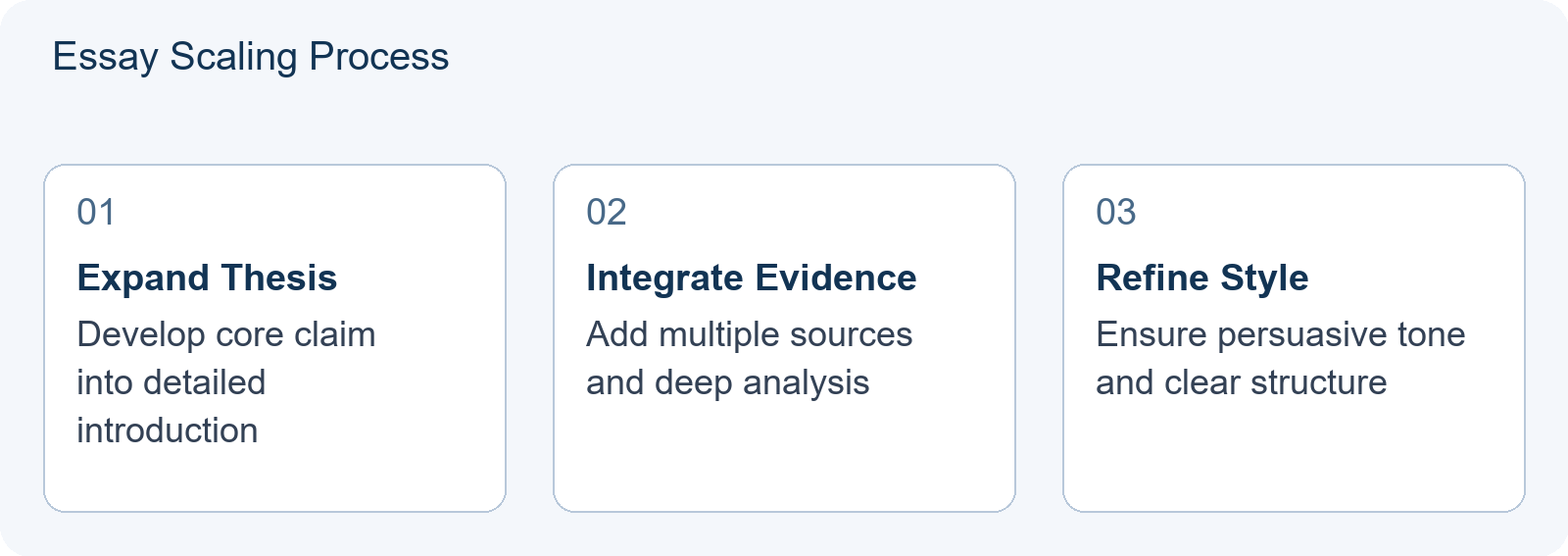
If the 30-minute sprint felt natural, you can scale up to a full competition essay. The structure remains similar but requires deeper engagement. Start with a thesis statement that directly answers the prompt. Follow with three to four body paragraphs, each containing a distinct claim supported by robust evidence from multiple sources. Crucially, integrate counter-arguments throughout the essay, not just at the end. This demonstrates the understanding of relevant material that the John Locke criteria prioritize.
For a writing-heavy competition such as John Locke, Hanlin's October 2026 John Locke note summarizes the limit as 2,000 words, excluding charts, data tables, footnotes, bibliographies, or author declarations. The same note also warns that citation text in any style counts toward the word limit. That means a bibliography entry may be excluded, but an in-text citation or footnote text may still consume words depending on how it is written. Check the current official rules before submitting, and use the note as a planning guide rather than a substitute for the official page.
The transition from micro-argument to full essay is about depth, not just length. Ensure every paragraph advances the central argument. If a section feels like filler, delete it. This discipline prevents the common pitfall of producing a long but shallow paper. When you later receive feedback, the approach in John Locke Essay Results: Turn Competition Feedback Into a Stronger Writing Portfolio can help you convert comments into portfolio evidence. As you repeat this cycle, consider how to document progress using ideas from Academic Competition Portfolio: Showing Progress Across Several Related Activities.
Common Pitfalls in Early Economics Competition Preparation
A frequent error in early preparation is confusing correlation with causation. Students often pick a compelling chart and assume it proves their thesis without checking for confounding variables. Another pitfall is neglecting the persuasiveness criterion. Even if your data is accurate, a dry, list-like presentation may score lower than an argument that engages the reader while maintaining academic rigor. The John Locke criteria include writing style and persuasiveness, so structure and voice are not optional decorations.
Additionally, many students underestimate the importance of the bibliography. Using reputable sources such as Google Scholar, JSTOR, OurWorldinData.org, PubMed, government documents, or think-tank reports adds credibility, depending on the topic. Relying solely on news articles or blogs can weaken your case. Reviewing past winning essays can help calibrate your expectations for tone and complexity, but it should not become a template to copy. Remember, the goal is not just to write well, but to demonstrate a sophisticated understanding of economic mechanisms.
Course-Fit and Resource Request Preparation
For families seeking professional guidance, preparing for a consultation requires specific information. When contacting educators for Economics Competition Preparation, bring your completed micro-argument and the source data you used. This allows mentors to assess your analytical skills and writing style objectively. Be ready to discuss your familiarity with economic concepts and your comfort level with academic English. Understanding your own strengths and weaknesses beforehand makes the mentorship process more efficient.
If you decide to seek mentorship, the checklist in Research Project Mentorship: What a Student Should Bring to a First Meeting helps you prepare concrete material. If you are unsure about how to structure your argument or select appropriate evidence, this diagnostic exercise provides a concrete starting point for discussion. It transforms abstract concerns about readiness into tangible examples that can be critiqued and improved. This proactive approach ensures that any subsequent coaching focuses on refining your existing capabilities rather than teaching basic skills from scratch.
What a Successful 30-Minute Sprint Should Prove
A successful sprint does not prove you will win a competition. It proves something more useful for decision-making: whether you can tolerate, and perhaps enjoy, the uncertainty of evidence-based reasoning. You can finish with a messy paragraph and still discover that you liked the work. You can also finish with a neat paragraph and realize you never want to look at another dataset again. Both outcomes are valuable because they prevent wasted months.
Use the sprint as a repeatable check. Try it with a different chart next week. If the second attempt feels easier, you are building the research stamina that economics competitions reward. If it still feels like punishment, look for another academic format where your strengths are better matched. That is not a failure. It is efficient self-knowledge, and it is the first real step in serious Economics Competition Preparation.
Frequently Asked Questions
Do I need advanced math skills for economics competitions?
Not necessarily for every economics competition. For a writing-heavy competition such as John Locke, Hanlin's October 2026 John Locke note summarizes the criteria as knowledge, understanding, evidence use, argument quality, structure, style, and persuasiveness. Advanced calculus is not one of those listed criteria. Some economics topics may still benefit from quantitative comfort.
Can I use news articles as evidence?
News articles can be a useful starting point, but Hanlin's October 2026 John Locke note recommends sources such as Google Scholar, JSTOR, OurWorldinData.org, PubMed, government documents, and think-tank reports. Supplement news with stronger primary or academic sources whenever possible.
How long should Economics Competition Preparation take?
It varies by student and competition. The 30-minute data sprint is designed as a low-stakes first check before you commit to weeks of reading, drafting, and revising. If the sprint feels productive, build a longer schedule around evidence gathering, outlining, and multiple revisions.