
Preparing for Advanced Placement (AP) exams while simultaneously engaging in international competitions can feel like managing two separate full-time jobs. However, the most effective strategy is not to treat them as isolated tasks but to build a unified study plan around shared cognitive skills. Whether you are tackling AP Calculus alongside AMC 10/12 or preparing for AP English Language while entering the John Locke Essay Competition, the underlying competencies—logical reasoning, precise communication, and problem decomposition—partially overlap. This article explores how to construct a preparation schedule that leverages these overlaps, ensuring that effort spent on one track reinforces the other rather than draining your resources.
The Partial Overlap Between Rigorous Coursework and Competitive Problem Solving
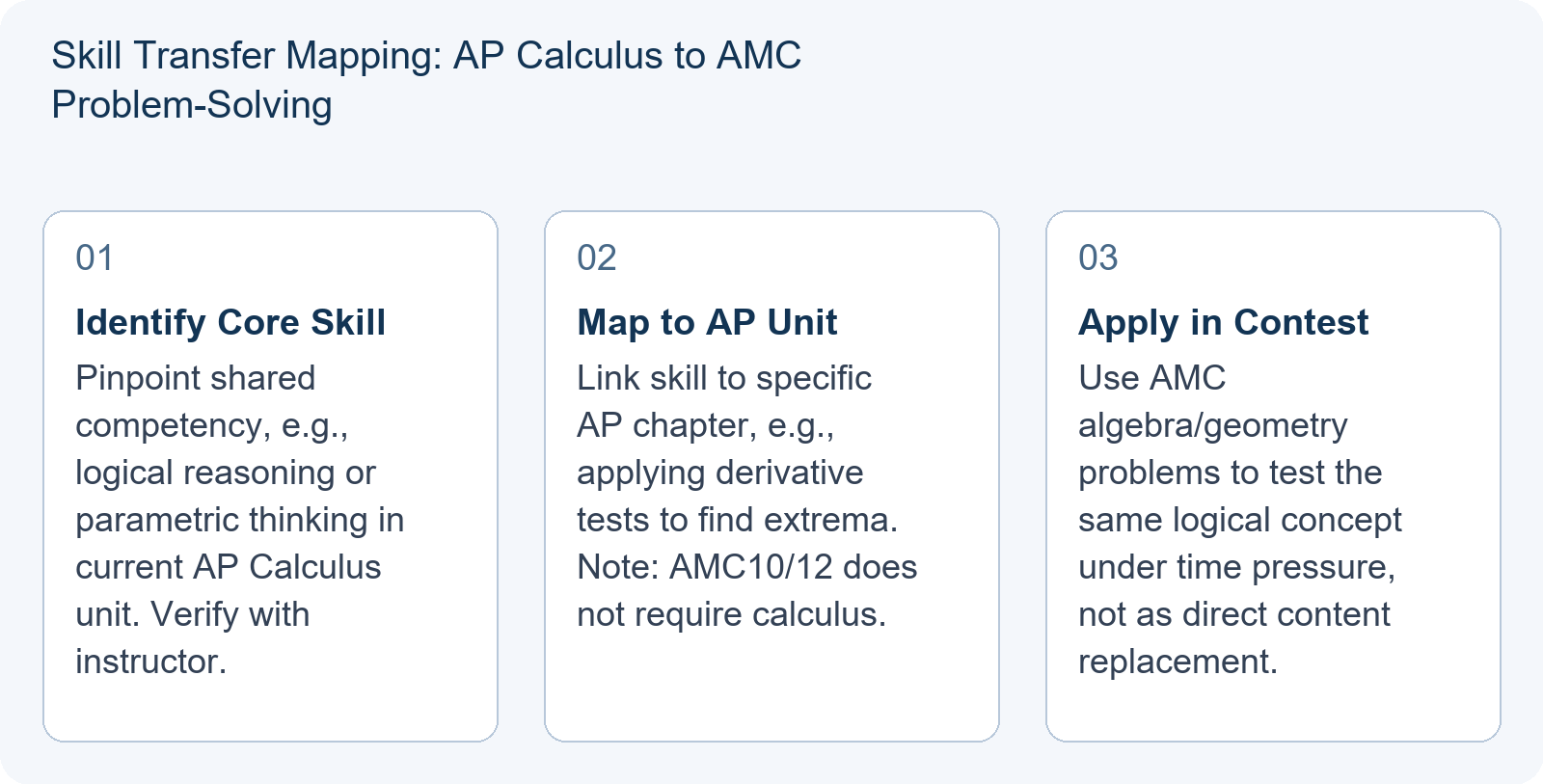
AP courses provide foundational knowledge structure, while competitions test application under pressure and novelty. These domains overlap partially, not completely. For mathematics, the Hanlin AMC 10/12 mock exam analysis highlights a common pitfall: students often possess theoretical knowledge but fail to complete competition problems due to poor time management and panic during unfamiliar question formats. However, AMC 10 and AMC 12 do not require calculus. They test algebra, geometry, combinatorics, and number theory. A student in AP Calculus BC should not assume that advanced calculus content directly replaces AMC preparation techniques. Instead, the shared skill lies in logical structuring: both AP Calculus free-response questions and AMC problems require clear step-by-step reasoning. When studying for AP Calculus BC, for example, practicing with AMC 10-level algebra and geometry problems reinforces the habit of showing complete logical chains—directly benefiting AP free-response scoring. For students deciding between competition routes, see AMC10 vs AMC12: Choosing Your Grade 10 Preparation Route.
Integrating Writing Competitions with AP Humanities
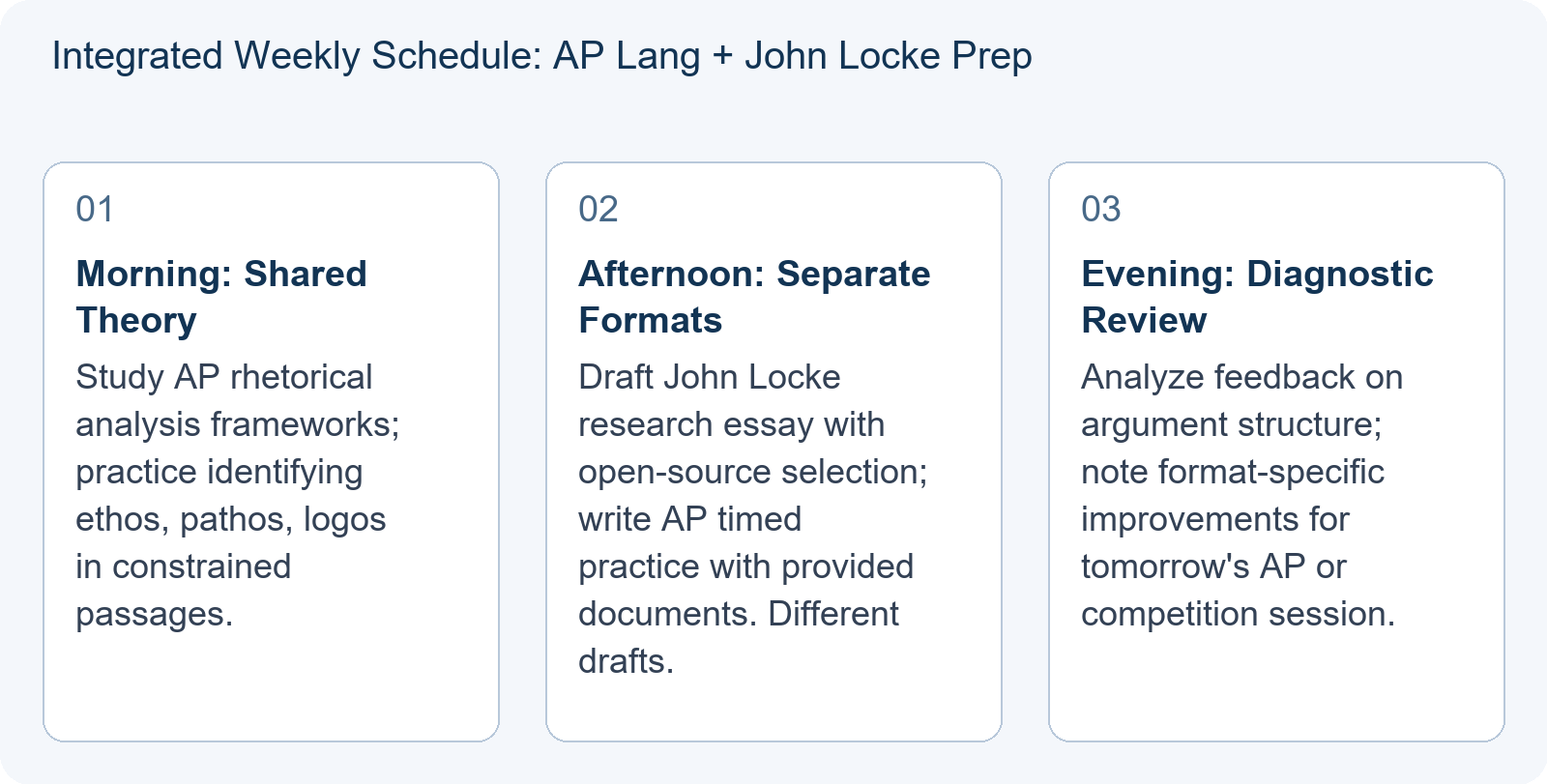
The overlap between AP humanities courses and writing competitions requires careful format-specific preparation. The John Locke Institute Essay Competition, which announced its 2026 winners in October 2026, evaluates arguments based on evidence usage, logical structure, and clarity. These criteria broadly resemble AP English Language and Composition or AP History essay grading. However, the formats differ significantly. AP English Language rhetorical analysis operates under strict time constraints with provided passages. AP History DBQs require synthesis of supplied documents within 55 minutes. John Locke essays permit extended research with open-source selection over weeks or months. A student preparing for both must write format-specific drafts, not one shared submission. The research skills developed for John Locke—evaluating source credibility, building sustained arguments—can transfer to AP essays, but only after adaptation to each format's constraints. The rigorous citation standards recommended by John Locke, using sources like JSTOR or government documents, align with AP college-level academic integrity expectations. By distinguishing these formats, students avoid the error of submitting an open-research essay for a timed AP exam, or conversely, producing thinly sourced work for a competition requiring deep research.
Mathematical Modeling: Bridging AP Statistics and HiMCM
For students interested in STEM, the connection between AP Statistics and mathematical modeling competitions like HiMCM offers genuine skill transfer. HiMCM requires teams to translate real-world problems into variables and models, a core competency of AP Statistics. The 2026 HiMCM season, scheduled for November 4-17, emphasizes "translation ability"—turning messy data into clean mathematical structures. Students taking AP Statistics should view their course projects as mini-modeling challenges. When learning about regression analysis or probability distributions, immediately apply these tools to open datasets relevant to potential HiMCM topics. This active application ensures that when you sit for the AP exam, you aren't just recalling formulas but understanding their utility in solving actual problems. Programming skills developed for HiMCM, such as Python for data cleaning, may enhance performance in AP Computer Science Principles or help automate calculations in quantitative AP courses. However, this remains partial overlap: HiMCM rewards creative model construction over 14 days, while AP Statistics tests specific procedure mastery under exam conditions.
Strategic Time Allocation: A Concrete Weekly Example
A major challenge in dual preparation is time scarcity. The following weekly schedule allocates fixed hours to shared core, separate format practice, and rest. Adjust based on your actual AP course unit.
Shared Core (6 hours): Identify the current AP unit topic and select competition material that exercises the same underlying skill. For example, if AP Calculus BC covers parametric equations, spend 2 hours on related motion problems from physics or competition contexts. If AP English Language covers argumentation, spend 2 hours analyzing how competition-winning essays structure claims. Verify your actual course unit with your instructor before selecting materials.
Separate Format Practice (4 hours): Dedicate time to format-specific drills that do not overlap. Spend 2 hours on AP multiple-choice practice under timed conditions. Spend 2 hours on competition-specific techniques, such as AMC speed strategies or John Locke research methods. Do not replace AP MCQ practice with olympiad case studies; both formats require direct familiarity.
Rest and Consolidation (1 hour daily minimum): Protect sleep and review time. Use diagnostic tools, such as the free AMC mock tests offered by Hanlin, to identify weak spots without formal grading pressure. These diagnostics help allocate remaining study time efficiently.
For guidance on when targeted feedback becomes more valuable than additional practice, see Math Competition Plateau: Choosing Between More Practice and Targeted Feedback.
Leveraging Institutional Resources for Integrated Prep
Many educational providers offer both AP and competition preparation. Hanlin International Education provides AP tutoring and competition coaching. Their AMC mock exams diagnose weaknesses in competition-specific skills, while their AP courses cover corresponding subject knowledge. When choosing preparation support, ask instructors how specific competition modules connect to your AP syllabus. Effective instruction should articulate clear links—such as how optimization techniques in calculus apply to both AP exam questions and logistics modeling problems. However, no provider can guarantee higher AP scores or admission outcomes based on competition participation alone.
Managing Preparation During Peak Seasons
October and November present a unique crunch period. With AP fall classes ramping up, AMC registration deadlines approaching, and HiMCM starting in early November, demands peak. It is crucial to stagger intense activities. Do not attempt to learn new advanced concepts during the week before a major competition if you are already stressed. Instead, use this period for consolidation and light review. The Hanlin AMC mock exam, which combines past papers with original questions to match official difficulty, can serve as a diagnostic without the pressure of formal grading. Remember, fatigue leads to errors; protecting your mental bandwidth supports sustained performance. For students building broader competition involvement alongside coursework, Academic Competition Portfolio: Showing Progress Across Several Related Activities offers additional strategic frameworks.
Conclusion: Building a Cohesive Academic Narrative
Integrating AP and competition preparation creates a cohesive academic narrative for university admissions when based on genuine skill development. Admissions officers value consistency and depth. Showing that you have mastered AP Calculus BC while also achieving recognition in AMC/AIME demonstrates sustained engagement with mathematics. Similarly, pairing AP English success with writing competition commendations proves intellectual curiosity. By building your study plan around partially shared skills—logic, modeling, argumentation—you reduce redundancy and increase efficiency. Start by mapping your current AP units against upcoming competition dates. Identify the overlapping skills and design your weekly routine to target those intersections. This strategic alignment transforms two demanding tracks into one powerful engine for academic growth, without overclaiming that success in one guarantees success in the other.
Diagnostic Drill: Testing Skill Transfer in a Single Session
Theoretical overlap is easy to claim; practical transfer requires verification. Students often assume that mastering AP Calculus concepts automatically improves AMC performance, or that strong essay writing skills seamlessly translate between timed exams and open-research competitions. To test whether your preparation actually bridges these gaps, use the following diagnostic drill. This exercise isolates specific cognitive tasks to reveal where shared skills genuinely reinforce each other and where format-specific constraints create hidden barriers.
Step 1: The Shared Logic Test (Mathematics)
Select one standard AP Calculus BC free-response question involving optimization or related rates. Solve it completely, showing every step of logical deduction, variable definition, and justification. Then, immediately attempt an AMC 10/12 problem requiring similar algebraic manipulation or geometric reasoning, but without calculus tools. Compare your approaches. In the AP context, you likely prioritized rigorous notation and explicit theorem citation. In the AMC context, did you abandon formal structure for speed? If your AMC solution lacked clear intermediate steps because you rushed to the answer, your "shared skill" of logical structuring has failed under time pressure. The diagnostic reveals that knowing calculus does not prevent sloppy algebraic reasoning when the stakes change from partial credit to binary scoring. Effective integration means maintaining disciplined decomposition even when the format rewards brevity.
Step 2: The Argumentation Constraint Test (Humanities)
Take a thesis statement developed for a John Locke-style research essay. Now, attempt to defend this same position within the strict 55-minute limit of an AP History DBQ, using only provided documents. Observe the friction. Your research-based argument may rely on external sources or nuanced historical context unavailable in the DBQ packet. If you find yourself unable to adapt the core logic to the restricted evidence set, your preparation has conflated deep knowledge with analytical flexibility. The shared skill here is not content recall, but structural adaptability. A successful student recognizes that the logical skeleton of an argument can survive different evidentiary constraints, whereas a fragile argument collapses when removed from its original research context.
Interpreting Your Results
If both tests reveal significant disconnects, your study plan treats AP and competition prep as parallel tracks rather than integrated systems. You are likely memorizing formats instead of mastering underlying competencies. Conversely, if you maintained logical rigor in the AMC problem despite time pressure, and successfully adapted your essay thesis to the DBQ constraints, you have achieved genuine skill transfer. This indicates that your preparation focuses on cognitive habits—precision, decomposition, and adaptability—that serve multiple contexts.
Next Practice Task
For the next week, modify your routine based on these diagnostics. If math logic faltered under pressure, practice solving AMC problems while verbally explaining each step aloud, simulating the rigor required for AP free-response grading. If humanities adaptation was weak, take a single research topic and draft three versions: a full essay, a timed rhetorical analysis, and a document-synthesis paragraph. Do not seek new content; reuse existing material to stress-test your ability to shift formats. This targeted repetition builds the mental agility needed to move between structured coursework and novel competitive challenges without losing coherence. Remember, the goal is not to make the tasks identical, but to ensure your foundational skills remain robust regardless of the container they occupy.
Frequently Asked Questions
Can I prepare for AP exams and competitions at the same time?
Yes, but focus on partially shared skills rather than treating them as identical. Use competition problems to deepen logical reasoning for AP concepts, while maintaining separate format practice for each. For example, AMC problems reinforce algebraic structures that also appear in AP Calculus, but AMC10/12 does not require calculus and tests distinct techniques.
How do writing competitions help with AP English?
Writing competitions like John Locke and AP English share broad competencies in argumentation and evidence use, but require format-specific drafts. John Locke allows extended research with open sources; AP rhetorical analysis and DBQs operate under strict time constraints with provided materials. Practice research skills for one, then adapt them to the timed constraints of the other.
What is the best way to manage time during peak seasons?
Use a fixed weekly schedule with allocated hours: shared core work connected to your current AP unit, separate format practice for each domain, and protected rest. During crunch periods, prioritize consolidation and diagnostic review over new material. Verify your actual course unit before selecting competition activities to ensure genuine overlap.