
Many math competition students hit a point where increasing the number of problems solved no longer improves their scores. This phenomenon, known as a Math Competition Plateau, is frequently misdiagnosed as a lack of effort. However, for many learners, the bottleneck is not quantity but the quality of error analysis. If you are stuck at a specific score range (e.g., consistently scoring 100-110 on AMC 10/12), simply grinding through more past papers may reinforce existing gaps rather than close them.
Distinguishing Volume from Precision
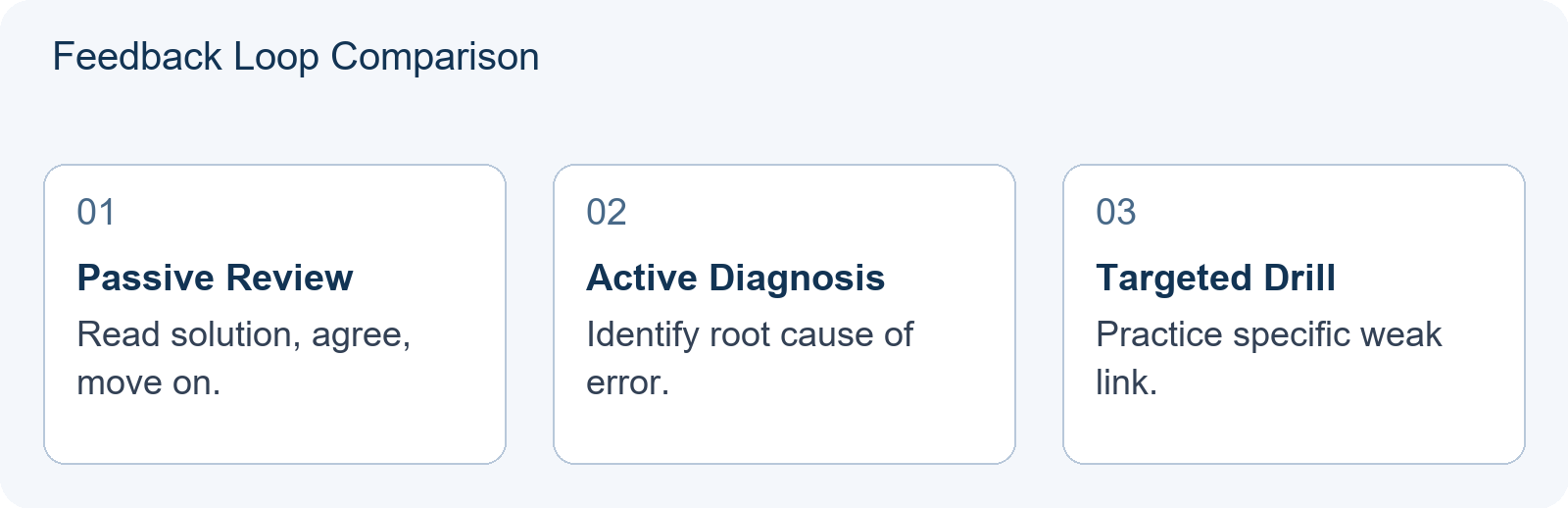
The core distinction lies in how errors are processed. High-volume practice without structured review leads to "passive repetition," where students solve familiar problem types correctly but fail to address underlying conceptual misunderstandings. In contrast, targeted feedback involves dissecting incorrect answers to identify specific failure modes—such as algebraic manipulation errors, misreading constraints, or missing key insights.
Hypothetical Case A: The Volume Trap
Consider Student A, who aims to improve their AMC 12 score. They adopt a strategy of solving five full-length mock exams per week. Over six weeks, they complete 30 exams. Despite this high volume, their score remains stagnant at 95. Upon review, it becomes clear that Student A spends only 5 minutes checking answers after each exam. When they make an error, they read the official solution, nod in agreement, and move on. They do not attempt to re-solve the problem independently or categorize the type of mistake made. Consequently, when encountering similar problems in subsequent exams, they repeat the same logical leaps or calculation slips. The plateau persists because the feedback loop is too shallow to alter neural pathways associated with problem-solving strategies.
Hypothetical Case B: The Diagnostic Approach
Student B adopts a different approach. They limit themselves to one full-length mock exam per week but dedicate three hours to post-exam analysis. For every incorrect answer, they maintain a logbook with three columns: Error Type (e.g., Calculation, Conceptual, Time Management), Root Cause (e.g., forgot quadratic formula sign convention), and Corrective Action (e.g., re-derived the formula from scratch). After four weeks, Student B's score rises to 115. By identifying that 60% of their errors were due to rushed algebraic simplification, they implemented a specific drill: solving ten complex algebraic expressions slowly, focusing solely on step-by-step accuracy. This targeted intervention addressed the root cause, breaking the plateau.
Diagnostic Table: Identifying Your Plateau Type
To determine whether you need more practice or better feedback, use the following self-assessment framework. Be honest about your current habits.
| Indicator | Suggests Need for More Practice | Suggests Need for Targeted Feedback |
|---|---|---|
| Error Consistency | You make random, unrepeatable mistakes across different topics. | You repeatedly miss questions involving the same concept (e.g., combinatorics cases). |
| Solution Review | You rarely look at solutions for questions you got right. | You read solutions but cannot reproduce the logic without looking. |
| Time Allocation | You finish exams early but leave easy points on the table due to carelessness. | You run out of time on hard questions because you spent too long on medium ones. |
| Confidence Level | You feel unsure about basic definitions or formulas. | You understand the theory but struggle to apply it under pressure. |
A Practical Sequence for Breaking the Plateau
If your diagnosis leans toward needing targeted feedback, follow this three-step sequence before adding new problem sets:
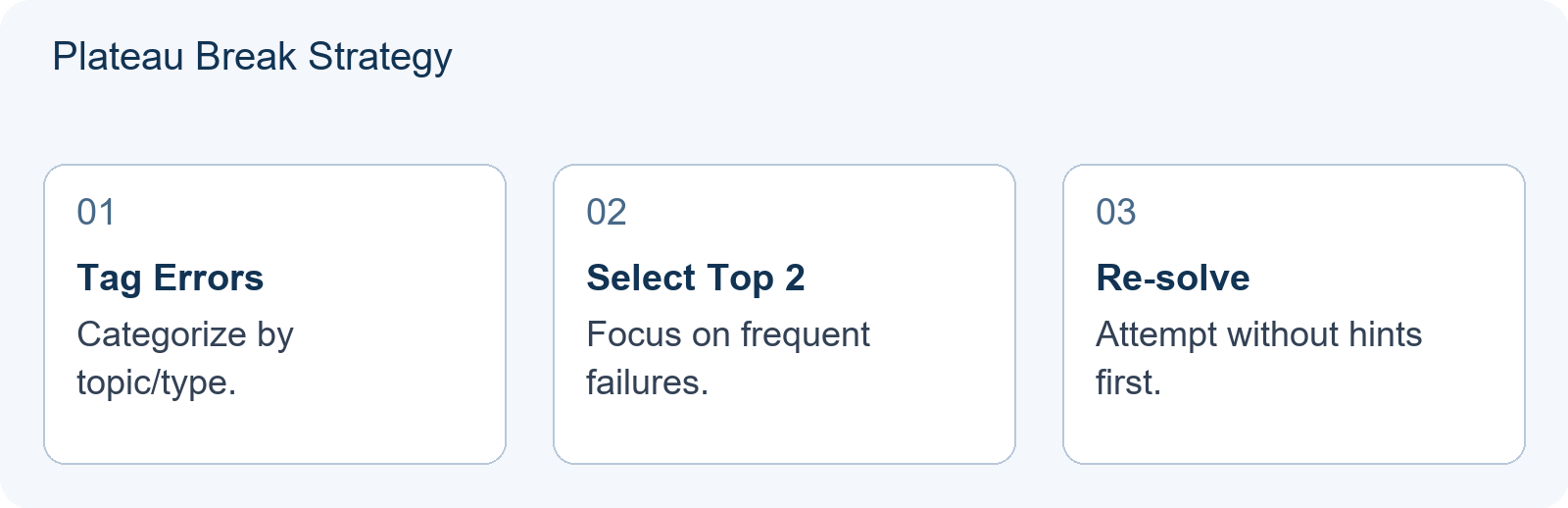
- Categorize Past Errors: Take your last three mock exams. Label every wrong answer with a specific tag (e.g., "Geometry - Circle Theorem Misapplication"). Do not just write "I didn't know it." Write exactly which part of the reasoning failed.
- Isolate Weak Modules: Identify the top two tags that appear most frequently. These are your priority zones. Ignore all other topics for now.
- Active Re-Solving: Find five new problems that match these specific tags. Solve them without looking at any hints. If you get stuck, spend at least 15 minutes struggling before consulting a solution. Then, immediately re-solve the original missed question from memory.
This method shifts focus from breadth to depth. It ensures that practice time is spent reinforcing weak links rather than strengthening already strong areas. For guidance on choosing between competition tracks at the grade 10 level, see our article on AMC10 vs AMC12: Choosing Your Grade 10 Preparation Route. For a concrete example of structured practice planning in a timed competition setting, refer to our Junior Physics Challenge 2026: A Four-Week Practice Plan for 60 Questions in 50 Minutes. Finally, for an overview of how competition results are organized across different subject areas, including humanities and social sciences, see our Humanities and social science competition results page.
Next Steps: Demonstrating Skill Transfer
The ultimate test of breaking a plateau is not just a higher score, but the ability to explain why a previous approach failed. A student who has moved beyond the plateau should be able to articulate the specific conceptual hurdle they overcame. If you find yourself unable to diagnose your own errors objectively, consider seeking external feedback from a mentor or peer group. Sometimes, an outside perspective can spot patterns that internal reflection misses. Remember, the goal is not to solve more problems, but to solve them differently.
Frequently Asked Questions
How many mock exams should I take per week?
There is no universal number. If you are plateauing, reduce volume to allow time for deep analysis. One exam with thorough review is often more effective than five exams with superficial checking.
What if I don't know why I made an error?
If you cannot identify the root cause, try to re-solve the problem from scratch without looking at the solution. If you still get it wrong, the gap is likely foundational. Review the relevant theorem or definition directly.
Does this apply to team competitions like HiMCM?
Yes, but the unit of analysis changes. Instead of individual errors, analyze team process failures, such as unclear role division or communication breakdowns during modeling phases.