
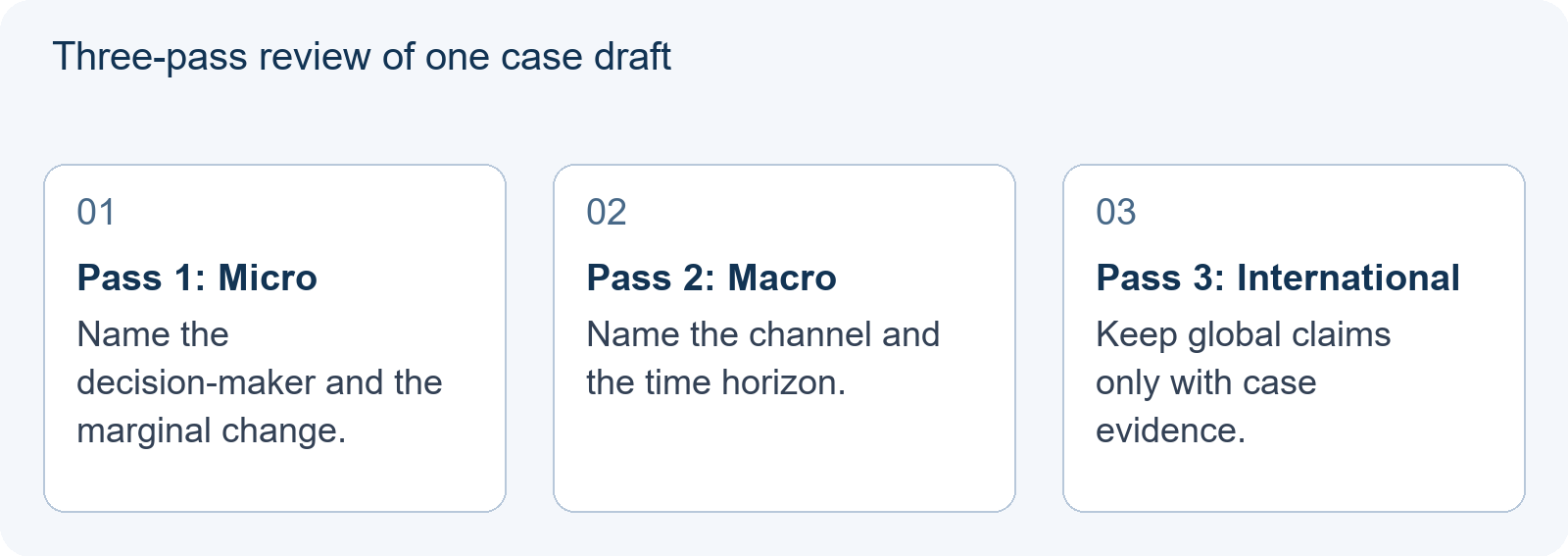
If a CNEC/NEC case answer stalls after the definitions, a useful first diagnosis is to check whether the draft has been reviewed through three lenses. The three-lens review is a single drill: take one written answer, read it three times — micro, macro, international — and only then rewrite. Each pass asks a different question of the same sentences, so the final version keeps claims that have a mechanism, a time horizon and a piece of case evidence behind them. This is a preparation method for students and tutors; it is not a description of how any paper is marked, and no scoring rule is implied.
Why three passes beat one longer answer
A case answer can fail in a predictable way: the student writes a definition, adds an example, and stops. Adding more paragraphs may not fix this, because the missing element can be a causal chain rather than volume. Three short passes are designed to surface different faults. A micro pass catches a claim with no decision-maker. A macro pass catches a mechanism with no time horizon. An international pass catches a global sentence that the case never paid for.
The drill also separates two things students may confuse: not enjoying economics and not yet having a review routine. If the open question is whether economics competition work suits you at all, a short data task such as the Economics competition preparation interest test: Try a 30-Minute Data Sprint is a better starting point than a case rewrite. The three-lens grid assumes you have already decided to write cases and want the writing to hold together.
Pass one: the micro lens
Read the draft with one question: who is deciding, and what changes for them at the margin? Mark every sentence that names an actor — a firm, a consumer, a worker, a government department — and check that the sentence states what that actor gains or loses and why. A sentence such as 'the tax will hurt the industry' fails this pass, because it names no decision and no mechanism. A sentence that survives says which cost rises, which quantity adjusts, and over what range.
Three micro checks are useful. First, market structure: is the actor a price taker or does it set price? Second, elasticity: if the case gives quantities or substitutes, say which side of the market is more responsive, because that decides who bears the burden. Third, welfare: separate the transfer from the loss. A tariff moves surplus from buyers to producers and to the government; the deadweight loss is the part that is not a transfer. Students who merge these into one 'bad for the economy' sentence lose the mechanism they had already found.
Pass two: the macro lens
The second pass asks: does this claim belong to a quarter or to a decade? A case answer can mix horizons without noticing. A statement that investment costs rise next year is a short-run claim about spending; a statement that the capital stock is smaller is a long-run claim about productive capacity. Both can be true, but the answer must not use the second to answer a question about the first.
Name the transmission channel explicitly. A cost increase that raises investment costs reduces investment, which reduces aggregate demand in the short run; over years, a smaller capital stock lowers potential output. If the case involves a price measure, check whether the good carries a large weight in the index used — a capital good bought by firms may barely move a consumer price index even when its price rises sharply. Fiscal effects deserve the same treatment: revenue collected is not the same as welfare gained, and a tariff whose revenue funds a subsidy has a different net effect from one that does not. If the case gives no horizon, state the horizon you are assuming and say why.
Pass three: the international lens
The third pass can be forced. Read the draft and ask a single question: does the case contain trade, exchange-rate or cross-border evidence that this sentence depends on? If it does, check four things. Comparative advantage: does the country import the good because its opportunity cost is lower abroad? If so, a tariff moves production toward a relatively less efficient use of resources. Country size: only a large importer that can depress the world price can gain a terms-of-trade advantage; a small price-taking importer cannot. Retaliation: if the case names export sectors or trading partners, an export-side loss belongs in the answer. Exchange rate: under a floating exchange rate and all else equal, a tariff reduces import spending, which reduces demand for foreign currency and tends to appreciate the domestic currency, making exports dearer and partly offsetting the intended trade effect.
If none of that evidence is in the case, the correct move is to cut the international paragraph, not to decorate it. An unsupported global sentence reads as knowledge display rather than analysis, and it can replace a mechanism the reader needed.
Worked teaching illustration: a tariff on imported solar panels
This is a hypothetical teaching illustration written to show the method. It is not an actual contest case, and no official question, figure or mark scheme is reproduced or implied.
Country A imports most of its solar panels. The government proposes a 20 per cent tariff on imported panels. The pre-tariff import price is $250 per panel, so the tariff adds $50 and the domestic price rises to $300 if the full amount is passed through. For the illustration, assume Country A imports because foreign producers have a lower opportunity cost, not because of a quota or a foreign subsidy. Country A is a small importer that cannot influence the world price, so near-full pass-through to the domestic price is the reasonable assumption.
| Lens | Question asked of the draft | Claim that survives |
|---|---|---|
| Micro | Whose marginal cost changes, and how responsive is each side? | The tariff raises panel prices by $50, raising installation firms' costs and reducing installations demanded; domestic panel producers expand, and their gain depends on existing capacity and elasticities. |
| Macro | Which horizon, and through which channel? | In the short run, higher investment costs reduce renewable investment; over years, a smaller capital stock lowers potential output slightly. Tariff revenue is a transfer, not a welfare gain. |
| International | What cross-border evidence does the sentence need? | Given the stated assumption, imports reflect lower opportunity cost abroad, so the tariff shifts production toward a comparative disadvantage; a small country gains no terms-of-trade advantage, and any retaliation would add export losses. |
Two refinements show why the passes must be separate. On the micro pass, note that tariff revenue equals $50 multiplied by the post-tariff quantity, so revenue can fall if quantity collapses — elastic demand makes the fiscal effect ambiguous, not automatically positive. On the macro pass, if the panels are mostly capital goods, a consumer price index may barely move even with a large panel price change. Neither point belongs in a definition paragraph; both belong in a mechanism.
Contrasting illustration: when the international lens should be dropped
A second hypothetical teaching illustration, not an actual contest case.
A city proposes raising its bus fare from $2.00 to $2.50 — a 25 per cent increase — to cut a subsidy and reduce congestion. The micro pass asks who bears the fare: commuters with a car available may respond by driving, while commuters without a practical alternative pay. Because car travel creates congestion that the driver does not pay for, shifting riders into cars can worsen the very congestion the policy targets; that externality is a strong micro point in the case. The macro pass asks about the city budget and the transport weight in the local price index, and about the horizon: the fare change bites immediately, the congestion effect builds over months as habits adjust.
The international pass finds nothing: no imports, no exchange rate, no trading partner is mentioned. A paragraph on the city's 'global competitiveness' would be an unsupported international link, and cutting it is a gain, not a loss. The same grid therefore produces three sections in the solar case and two in the bus case. That asymmetry is the point of the method.
The review grid: four marks and one rewrite rule
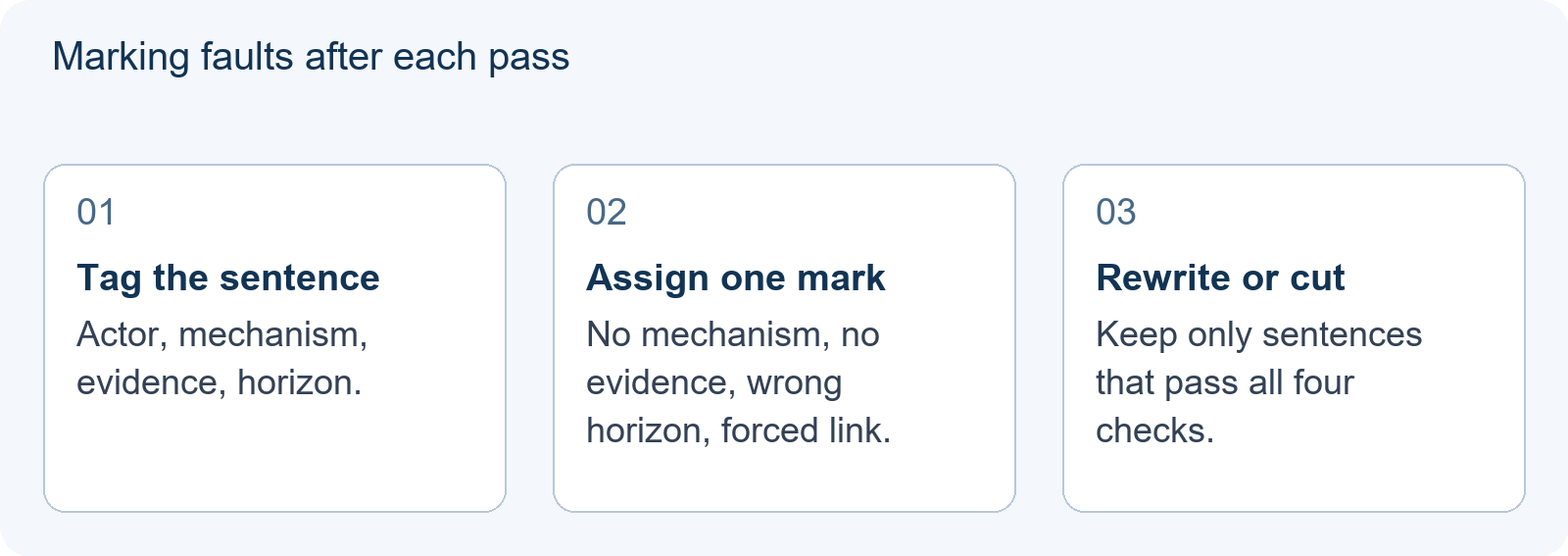
After each pass, mark the draft rather than rewriting it in place. Four marks cover the faults this drill targets:
| Mark | Symptom in the draft | Repair question |
|---|---|---|
| No mechanism | A claim with no actor or causal step | Who changes what, and why does that follow? |
| No evidence | A claim the case never supports | Which figure or stated condition backs this sentence? |
| Wrong horizon | A long-run effect answering a short-run question | What period does the case actually ask about? |
| Forced link | A global claim with no cross-border evidence | Can this be cut without losing the argument? |
The rewrite rule follows from the grid: keep a sentence only if it names an actor, states a mechanism, ties to at least one case condition or figure, and matches the requested horizon. Applied literally, the rule can shorten drafts. A shorter version can feel harder to write, because every remaining sentence now has to carry weight.
How Hanlin's materials fit this drill
Hanlin's economics team describes its CNEC/NEC materials in a way that is relevant to the drill. According to the Hanlin Courses WeChat report '10 Outstanding Coach Certificates and Global Championship Results: Hanlin's Economics and Business Strength' (28 October 2026), CNEC/NEC involves microeconomics, macroeconomics, and international economics and current affairs. The same report says Hanlin's NEC Economics Notes were organised around the competition syllabus, with modular organisation, diagrams and case-analysis support. It lists CNEC custom tutoring for students in grades 8 to 12 interested in economics or business, applicable to IEO and CNEC preparation, with a syllabus that explains key economics terms, targets the preliminary round, and supports students seeking to progress to the China finals. These are descriptions of Hanlin's own provision, not official rules of any competition.
Used alongside that structure, the grid is a checking layer rather than a replacement for content. The notes are described as syllabus-aligned; the three passes test whether a particular draft actually used the mechanisms. The grid does not add facts to the case or replace subject knowledge.
Preparing for a review conversation
A review session has a clear starting point when it begins from a marked draft rather than a blank page. Bring three things: the case text, one written answer, and the grid with your own marks. Then ask narrow questions. 'Which of these four marks appears most often in my draft?' 'Is my micro mechanism complete, or did I stop at the definition?' 'Does my international paragraph have evidence in the case, or should it go?' A tutor can address specific marks more directly than a general request; 'how do I improve' gives less to work with.
Ask about sourcing too. If a session uses notes, ask which topic areas they cover and how case analysis is supported, so you can check the draft against the right sections. Students choosing between economics events can compare route structures before committing, for example through the IEO vs IEOC: A Route Map for Selection Pages and Preparation; students testing whether their weakness is quantitative rather than analytical can use a LSESU Economics Challenge 2027: A Quantitative Diagnostic Before Topic Revision as a contrast. Neither replaces a case rewrite, but each answers a different question.
One practical note on resources: Hanlin's October 2026 report states that students who join its economics competition team registration can receive the latest edition of the notes free of charge. That is a description of a stated arrangement at that time, not a standing public download, and it should be confirmed with the contact channel rather than assumed.
What the drill does not do
The grid will not supply facts the case does not contain, and it will not tell you which lens a particular question rewards. It also cannot turn a thin case into a rich one: if the evidence is limited, the honest answer is shorter. What it does is make the difference between a definition dump and an argument visible on the page, in a form you can mark, discuss and rewrite before the next practice case.
General event background is available at Event background.
Frequently Asked Questions
How long should each of the three passes take?
For a one-page case answer, try about ten minutes per pass, then one rewrite. The passes are short because the aim is to mark faults, not polish prose three times. If a pass runs long, that can be a sign the draft has too many claims rather than too few checks.
Does every CNEC/NEC case answer need an international paragraph?
No. The international lens earns a paragraph only when the case contains trade, exchange-rate or cross-border evidence that the claim depends on. A domestic case about a local fare or a single market may support micro and macro analysis only. Cutting an unsupported global paragraph can improve an answer.
Can the same grid be used for other economics competitions?
The structure follows the three areas attributed to CNEC/NEC in Hanlin's report: microeconomics, macroeconomics, and international economics and current affairs, and the report describes the notes as syllabus-aligned. That makes the grid a natural fit for economics case work in general. It is not a claim about how any other competition is scored, and business-case tasks centred on marketing or finance may need different checks.