
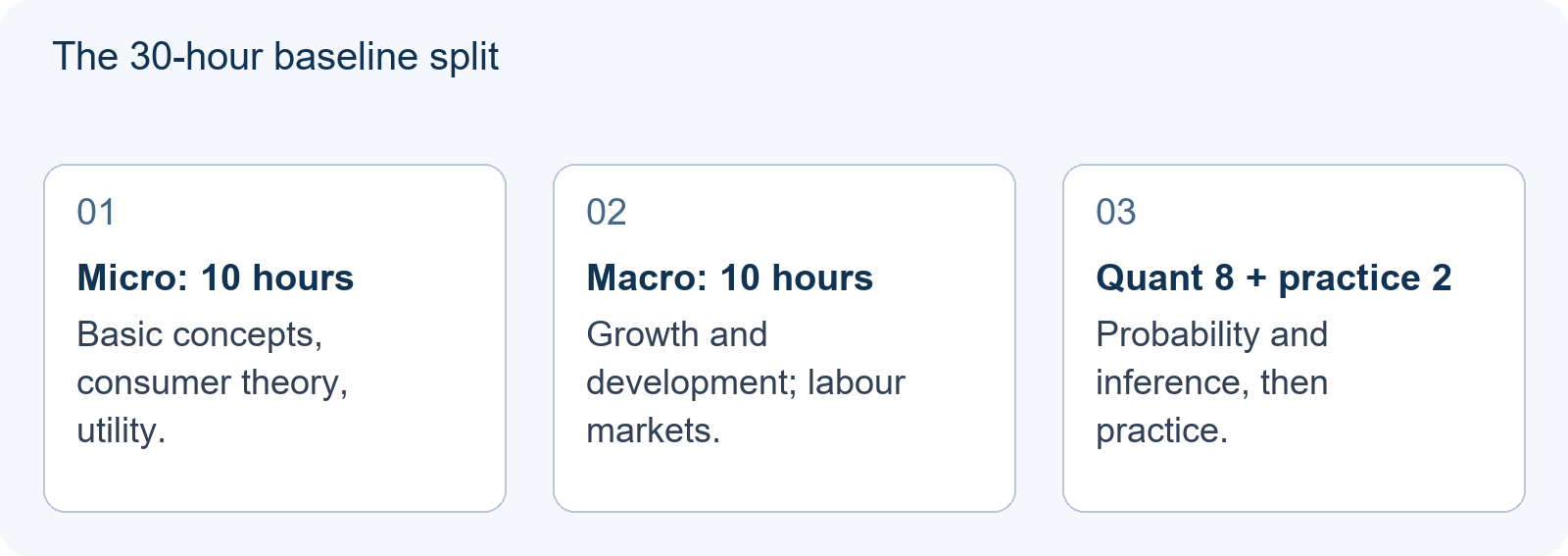
If your diagnostic shows uneven microeconomics, macroeconomics and quantitative performance, start with a 30-hour planning baseline: 10 hours of microeconomics, 10 of macroeconomics, 8 of quantitative foundations and 2 of question practice. Then move hours toward whichever error category is actually costing marks. That split comes from Hanlin's LSE preparation course outline in the Hanlin Courses WeChat article titled 10 Outstanding Coach Certificates and Global Championship Results: Hanlin's Economics and Business Strength, published on 28 October 2026. The same report describes the 2027 LSESU Economics Challenge as covering microeconomics, macroeconomics, and mathematics and quantitative analysis, and says the challenge is organized by the LSESU Economics Society in cooperation with ASEEDER. The split is a course structure, not a requirement of the challenge, and no hour count predicts a score. What follows is a sequence for a student who already has a diagnosis and needs to decide where the next 30 hours go.
The 30-hour baseline and what each block is for
The four blocks in the report add up to 30 hours. The report prints only part of each phase's topic list, marked with ellipses, so treat the named topics as checkpoints rather than as a complete syllabus. It also describes the outline as aimed at students who have not previously taken related economics competition training such as NEC or IEO — a detail worth noting when you judge how much of the baseline you personally need.
| Block | Hours | Topics named in the report | What the block should leave you with |
|---|---|---|---|
| Microeconomics | 10 | Basic Economic Concepts; Consumer Theory and Utility | A stated condition you can explain in words, symbols and a diagram |
| Macroeconomics | 10 | Measurement of Economic Growth and Development; Labour Markets and Unemployment | Each term linked to a mechanism and to evidence you could look for |
| Quantitative foundations | 8 | Probability Theory; Statistical Inference | A repeatable setup routine that survives time pressure |
| Practice and explanation | 2 | Practice Questions | A marked set that tells you which block to change next |
Two hours of practice is a checkpoint, not the whole of your timed work. If timing is one of your problems, timed work has to appear inside the other three blocks as well; otherwise the practice block may be the first place a timing problem becomes visible.
Three strands, not one subject
The coverage described in the report — microeconomics, macroeconomics, and mathematics and quantitative analysis — is often taught as one body of economics. Practically, errors cluster into three different repairs. Conceptual errors need re-teaching: you cannot state the condition, or you cannot say which direction an effect runs. Quantitative errors need procedure: you know the idea but lose the algebra, the units, or the first step. Application errors need decision-making: you can do the item slowly but not inside the time available. A student who files all three under “I don't know economics” can over-invest in reading and under-invest in drills.
As a teaching illustration, suppose a utility-maximising choice is set up correctly but the final ratio is inverted. The microeconomics is intact; the arithmetic is not. Spending another hour reading consumer theory will not fix it, while ten minutes of ratio and fraction drills might. The reverse is also true: if you cannot say in words what the equal-marginal condition means, drilling arithmetic simply makes you faster at the wrong model.
The diagnostic-to-allocation rule
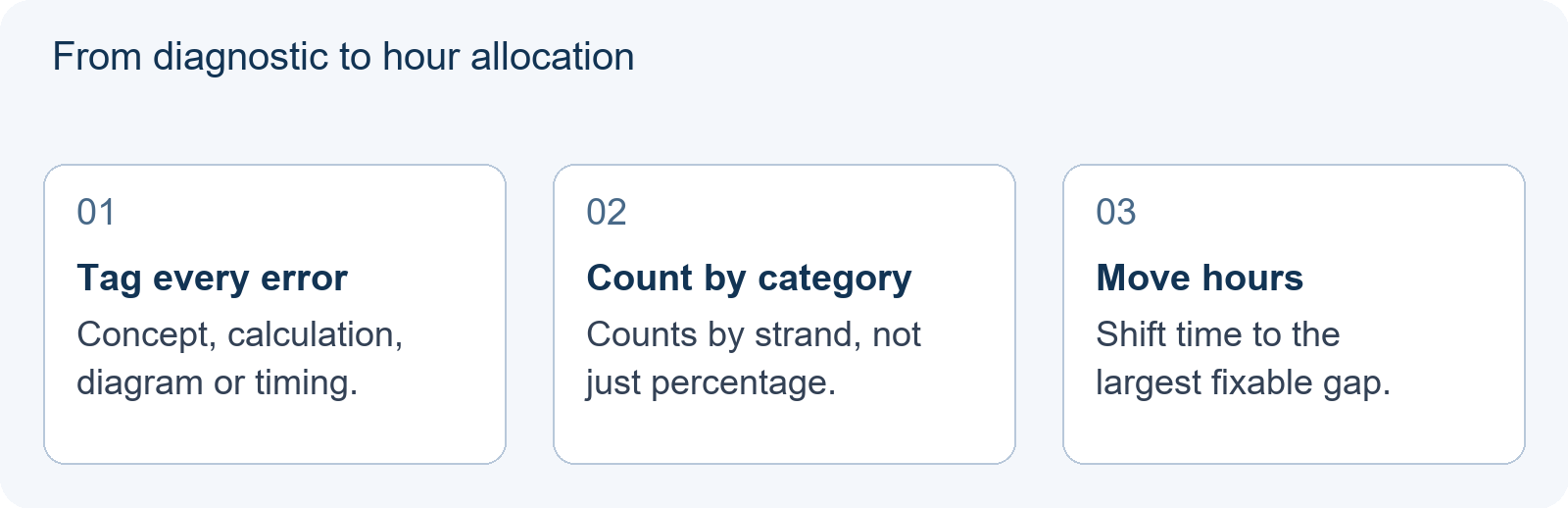
Before spending any of the 30 hours, tag every error in a marked set. A suggested scheme, from a teaching perspective rather than from any official marking guide, uses four tags: concept, calculation or setup, diagram or data interpretation, and timing. Count errors by tag and by strand, then move hours toward the largest tag that is realistically fixable in the time you have left.
| Tag | What it looks like in a marked script | What it should change |
|---|---|---|
| Concept | Cannot state the condition, or picks a plausible-sounding option for the wrong reason | Re-teach the topic before adding more questions |
| Calculation or setup | Right idea, wrong algebra or units; or no idea how to begin | Short repeated drills, not more reading |
| Diagram or interpretation | Misread axes, wrong shift, or a data description that does not match the table | Translate the same idea between words, graph and number |
| Timing | Final items blank or rushed despite accuracy elsewhere | Timed blocks and an explicit triage rule |
If you do not yet have a marked set to tag, start with LSESU Economics Challenge 2027: A Quantitative Diagnostic Before Topic Revision, because the allocation rule needs counts, not impressions. One further guardrail: keep a floor of a few hours in every strand. Sections neglected for a whole cycle may reappear on the day, so a floor keeps every strand tested at least once.
Microeconomics: ten hours with consumer theory as the first checkpoint
The report names Basic Economic Concepts and Consumer Theory and Utility within the microeconomics phase. A workable order is to secure the basic vocabulary first — scarcity, opportunity cost, marginal reasoning — then move to consumer theory and utility, where the same idea has to survive three representations: a written condition, a symbolic statement, and a diagram. Do each of those once for the same problem, then attempt two numerical cases without notes. If one representation breaks, that is the one to practise, not the other two.
Audit the errors before adding content. If you can state the equal-marginal condition but lose marks on the arithmetic, your microeconomics hours should be spent on calculation under light time pressure, and the concept phase can be shortened. If you cannot state the condition at all, more questions will produce more of the same error. A useful test of whether a topic is actually secured is an unseen item: recognition of a worked example is not the same as mastery, and the report's emphasis on understanding and applying economic theory points toward explanation and application rather than recognition alone.
Macroeconomics: ten hours from measurement to transmission
The macroeconomics phase names Measurement of Economic Growth and Development, plus Labour Markets and Unemployment. These topics reward a three-column note format: term, mechanism, evidence. For each term, write what moves, why it moves, and what you would expect to see in the data if your explanation were right. That converts a definition into a testable claim and prepares you for questions that describe a change rather than ask for a label.
Distinguish two error types that look similar on a marked script. A recall error means you could not produce the term or its direction; it is relatively quick to address with retrieval practice. A transmission error means you produced the term but could not carry it through a chain of effects, or you mixed up a level with a change. Transmission errors need explanation practice rather than glossary revision. If most of your macro errors are recall, the macro block can be compressed and the hours moved elsewhere — but only after a second marked set confirms the pattern.
Quantitative foundations: eight hours of probability and inference
The quantitative phase names Probability Theory and Statistical Inference. One failure mode here is not missing knowledge but an absent routine. Build a four-question checklist and apply it to every item until it is automatic: what quantity is being asked for; what the sample space or conditioning is; whether the answer is sensible in units and magnitude; and whether a limiting case would expose an error. The checklist is a teaching suggestion, not an official method, but it converts a vague sense of difficulty into a sequence of decisions.
Then re-test with mixed items under time pressure, because setup failures may appear only when the clock is running. One adjacent read may help: the site's Economics competition preparation interest test: Try a 30-Minute Data Sprint can check whether the work itself suits you. If your accuracy is fine but your pace is not, the repair is timed setup drills; if both are poor, the repair is re-teaching before speed work.
Two hours of practice, then rebalance the next cycle
Run a mixed set, mark it, and count errors by strand and tag. Then change the split — once. Teaching illustration, hypothetical and not a real student, not an official score report and not a prediction: a student marks a self-assembled 40-item set and scores 12 of 16 in microeconomics, 11 of 12 in macroeconomics and 5 of 12 in quantitative work, for 28 of 40. Tagging the 12 errors gives 3 micro concept errors, 1 micro diagram error, 1 macro concept error, 5 quantitative setup or calculation errors, and 2 quantitative probability-concept errors.
Macro shows little room for improvement on this set, while quantitative has seven errors, five of them procedural. A reasonable first rebalance moves four hours from macro to quantitative: 10 micro, 6 macro, 12 quantitative and 2 practice — still 30 hours. A contrasting illustration: a student scoring 8 of 16 in microeconomics, with six concept errors concentrated in consumer theory, and 10 of 12 in quantitative work might move four hours from quantitative to micro, to 14 micro, 10 macro, 4 quantitative and 2 practice. That move is defensible only if the quantitative performance is strong and stable; if the same student is accurate but slow in quantitative work, cutting that block would remove timed practice, so the hours should come from macro instead. Neither illustration predicts a score; both are teaching illustrations.
Preparing for a course-fit or resource conversation
Whether or not you take a taught course, a short preparation conversation can be productive when you arrive with evidence. Bring four things: section-level counts from your marked set, the error tags you assigned, the hours per week you can realistically protect, and your prior background in economics competitions, since the outline in the report is described as aimed at students without prior NEC- or IEO-type training. Add your intended sitting if you have one, because the sequence compresses differently at eight weeks than at twenty.
Ask which strand the adviser believes is your binding constraint, and what evidence would change that view. Ask also which parts of the topic list are checkpoints rather than full coverage, given that the published outline is printed only in part. For broader study-planning context, the note on AP and Competition Preparation: Build a Study Plan Around Shared Skills covers how economics competition work can overlap with school courses. Be cautious with any promise of a fixed score outcome from a fixed hour count; the 30-hour split is an organizational baseline, and the reallocation rule above is only as good as the marking that feeds it.
General event background is available at Event background.
Frequently Asked Questions
Is the 30-hour split an official requirement for the 2027 LSESU Economics Challenge?
No. It is Hanlin's published preparation outline, reported on 28 October 2026, describing a course structure of 10 hours microeconomics, 10 macroeconomics, 8 quantitative foundations and 2 question practice. The challenge's coverage is described as microeconomics, macroeconomics, and mathematics and quantitative analysis. The hour split is a planning choice, not an exam specification, and it does not predict a score.
My diagnostic shows weak microeconomics and strong quantitative work. Should I still use the sequence?
Yes, but reverse the reallocation. Start from 10 micro, 10 macro, 8 quantitative and 2 practice, then move hours toward the strand with the largest correctable error category — for example to 14 micro, 10 macro, 4 quantitative and 2 practice, while keeping a small floor in every strand so one weak section cannot become a blind spot.
Can I follow this if I have already done NEC or IEO?
The outline in the report is described as aimed at students who have not previously taken related economics competition training such as NEC or IEO. If you have that background, the concept phases can be compressed and the saved hours moved into timed practice. Keep the diagnostic step regardless, because familiarity with a topic is not the same as accuracy on unseen items.