
When families begin planning for high school competitions, the focus often lands on winning specific medals. However, as students accumulate multiple activities, the challenge shifts from individual performance to portfolio coherence. A strong academic competition portfolio does not merely list achievements; it demonstrates a logical trajectory of skill development. This article addresses the specific difficulty of showing progress across several related activities, distinguishing this strategic view from general preparation tips.
The Core Difficulty: Disconnected vs. Connected Evidence
The primary problem in building a portfolio is avoiding the "checklist effect." Admissions officers or program reviewers look for depth and evolution. If a student lists a math competition qualification, a math modeling participation, and a calculus course without connecting them, the portfolio appears fragmented. The goal is to show how each activity builds upon the previous one, creating a narrative of increasing complexity and application.
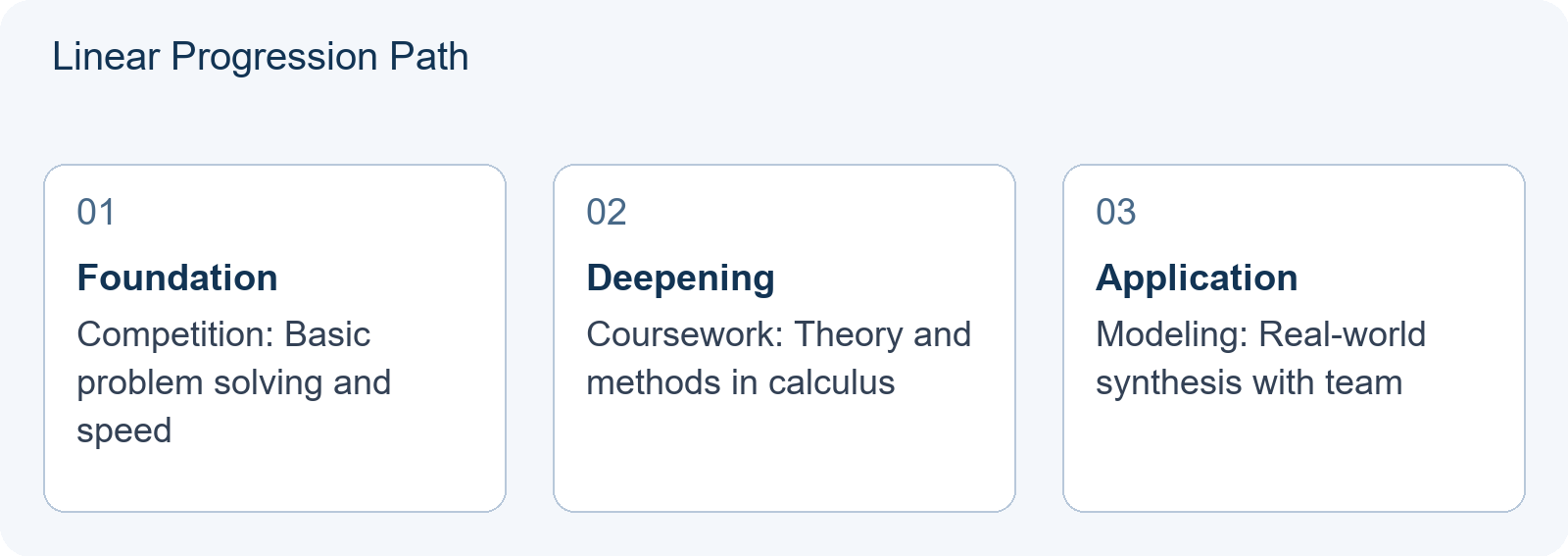
Teaching Illustration 1: The Linear Progression Model
The following is an original teaching illustration, not an official past-paper question or verified student case.
Consider a hypothetical student, Alex, who starts with foundational math skills. In Grade 9, Alex participates in a competition emphasizing speed and accuracy in standard problems, establishing baseline quantitative reasoning. In Grade 10, Alex takes a calculus course, moving from discrete problem-solving to continuous mathematical modeling concepts. Finally, in Grade 11, Alex joins a math modeling team. Here, the skills from the earlier competition (problem decomposition) and the calculus course (modeling rates of change) are applied to a real-world open-ended problem.
In this portfolio, the progression is clear: Tool Acquisition → Conceptual Deepening → Applied Synthesis. Each step relies on the previous one. The reviewer can see that Alex did not just randomly pick competitions but followed a path where earlier successes enabled later, more complex challenges.
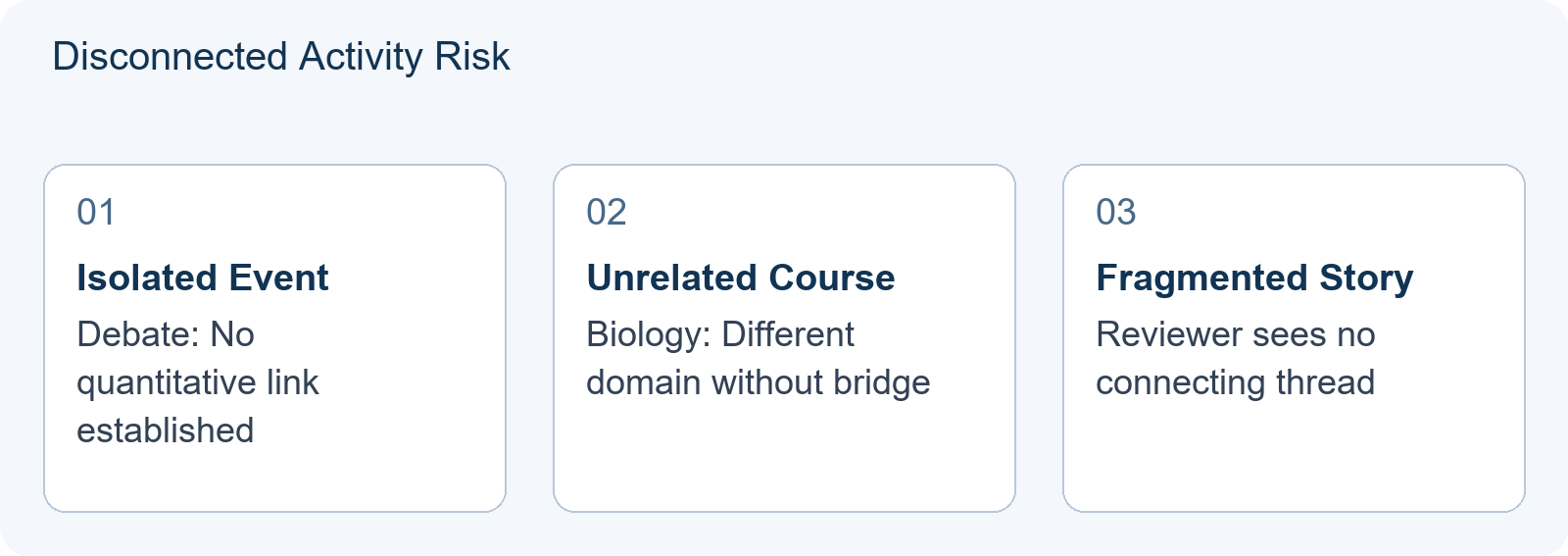
Teaching Illustration 2: The Disconnected Shortcut
The following is an original teaching illustration, not an official past-paper question or verified student case.
Contrast this with a hypothetical student, Jamie, who jumps between unrelated fields. Jamie wins a national debate award in Grade 9, then takes a biology course in Grade 10, and finally enters a coding hackathon in Grade 11. While each achievement is impressive individually, the portfolio lacks a central thread. There is no obvious transfer of skills. Debate logic does not directly explain the biology lab work, nor does the hackathon build on the biological research unless explicitly framed as bioinformatics.
Without a deliberate connection, Jamie's portfolio risks appearing scattered. The reviewer must guess the underlying interest, which weakens the impact. The mistake here is assuming that diversity alone equals strength, whereas strategic coherence often outweighs random breadth.
Diagnostic Table: Evaluating Your Portfolio Structure
| Portfolio Element | Weak Indicator | Strong Indicator |
|---|---|---|
| Activity Selection | Random mix of subjects | Thematic cluster (e.g., Quantitative Modeling) |
| Skill Demonstration | Lists outcomes only | Explains process and growth |
| Timeline | Simultaneous unrelated efforts | Sequential building blocks |
| Narrative | No clear 'why' | Explicit link between past and present |
Targeted Practice Sequence for Portfolio Building
To transform a collection of activities into a cohesive portfolio, students should engage in reflective practice after each major milestone. This is not about writing essays immediately but about identifying the bridge to the next step.
- Post-Activity Audit: After completing a competition or course, write down three specific skills gained (e.g., data interpretation, time management under pressure, hypothesis testing).
- Next-Step Mapping: Before starting the next activity, identify which of those three skills will be most critical. For instance, if data interpretation was key in a statistics course, highlight how it will inform model selection in a subsequent modeling challenge.
- Integration Statement: Draft a brief summary connecting the two. "My experience analyzing datasets taught me to validate assumptions before modeling, a principle I applied when choosing variables for my next project."
This sequence ensures that each new activity is not an isolated event but a continuation of developing expertise. For guidance on structuring academic English skills in preparation for international transitions, see Preparing academic English for an international-school transition. For competition results that demonstrate how humanities and social science activities can fit into a broader portfolio, review Humanities and social science competition results. The MEC Business Plan Ideas: A Seven-Day Test Before Your Team Starts Writing article offers a concrete example of how a short testing framework can validate whether team activities align before full commitment.
Demonstrable Skill for the Learner
The specific skill a learner should be able to demonstrate next is metacognitive articulation. This means being able to explain not just what they did, but why they chose it and how it prepared them for subsequent challenges. When a student can clearly articulate the link between their foundational competition training and their advanced modeling approach, they have successfully built a portfolio that shows progress across several related activities.
Frequently Asked Questions
Do I need to win every competition to have a good portfolio?
No. A strong portfolio focuses on consistent engagement and demonstrable skill growth. Participation in challenging activities shows initiative and resilience, even without top awards, provided you can articulate what you learned.
How many activities should be in my academic portfolio?
Quality over quantity. Three to four deeply connected activities that form a coherent narrative are often more impactful than ten unrelated ones. Focus on a thematic cluster, such as quantitative modeling or scientific inquiry.
Can I include non-competition activities in my portfolio?
Yes. Courses like AP classes or independent research projects are valuable components. They provide the theoretical background that makes competition success possible, strengthening the overall narrative of academic progression.